

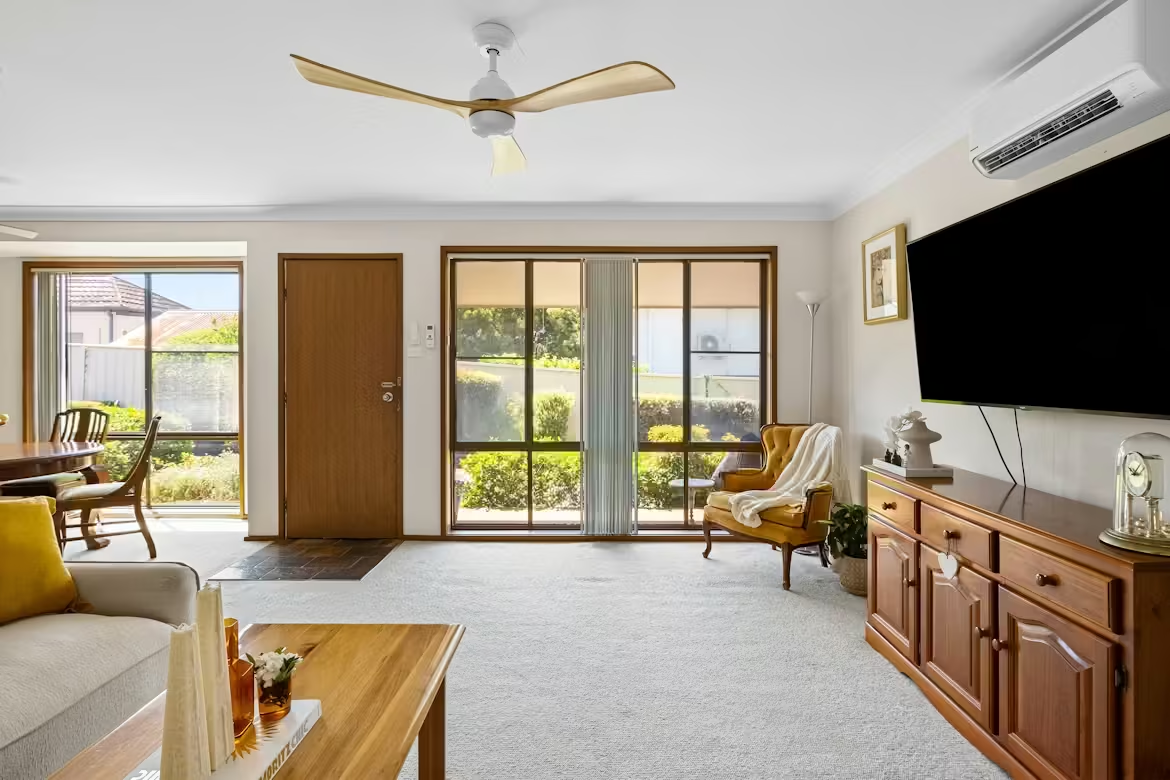
Most Brisbane bedrooms take a 1200mm or 1320mm ceiling fan. Living areas usually want 1400mm to 1500mm. That’s the short version of every ceiling fan size guide you’ll find, and it holds up about two-thirds of the time. Ceiling height and how the fan behaves on speed one decide the rest.
What size ceiling fan for a room?
The standard ceiling fan size chart maps blade span to floor area. Use it to narrow the field to two options, then read the rest of this page before you buy.
Fan size by room
Room | Approximate size | Blade span |
Study, nursery, small bedroom | up to 3 x 3m | 1120mm (44″) |
Standard bedroom | around 2.8 x 3.5m | 1200mm (48″) |
Master bedroom | around 3 x 4m | 1320mm (52″) |
Living or family room | around 4 x 4.5m | 1400mm (56″) |
Open plan living and kitchen | 4 x 5m and up | 1500mm (60″), or two fans |
Covered alfresco | varies | 1400mm minimum, IP-rated |
Those spans are the ones stocked here. Any ceiling fan size calculator Australia turns up will convert from an American square-footage table, which is why the answer comes back as 44 or 52 while the box in front of you is labelled 1120 and 1320.
Why do ceiling fan size charts disagree with each other?
Because most of them descend from the same US table, rounded at different points. Run a 4.2 x 3.3m room through three sources, and you’ll get three answers. One will say 1120 to 1220. Another opens it up to 1420. A third names 1320 flat and offers no range at all.
None of them is wrong. They’re all working from floor area, and floor area is close to the least interesting thing about a room.
Treat the chart as a shortlist. It tells you which two spans are plausible. Ceiling height, where the bed sits, and whether you run the fan on low all night settle which of the two you actually buy.
What size ceiling fan for a bedroom?
Compare two fans from the same range on speed one, not speed nine, and the result surprises people. An 1120mm low profile might sit near 130rpm and shift somewhere around 4,000 cubic metres an hour. The 1320mm version of that same fan, carrying a light kit, can drop closer to 95rpm and move slightly less air.
Less air. From the bigger fan.
The larger span wins comfortably once you open it up. In a Brisbane bedroom you’ll use the top three speeds maybe a handful of nights a summer, and spend the other three hundred on speed one, which is where a fan costs almost nothing to run next to the air conditioner.
Oversizing is the more common regret, and a quiet one. Nobody rings us to complain their fan is too big. They stop touching anything above the lowest setting, notice the blades dominate a 3.6 x 3.6m room every time they walk in, and live with it.
Undersizing costs you something as well, and it lands on about four February nights.
So: where a bedroom sits between two spans, take the smaller one.
How do you measure ceiling fan size?
Blade span, tip to tip, straight through the centre. On a three- or five-blade fan, measure the centre of the motor housing to one blade tip and double it.
That’s the method. Blade count changes the sound and the look, not the sizing.
Does ceiling height change what size ceiling fan you need?
In a fair share of Brisbane houses, more than room size does.
Australian wiring rules put the lowest point of the blades at a minimum of 2.1 metres above the floor, and there’s no discretion in it. A standard 2.4m ceiling leaves you 300mm of working room between plaster and that limit. Plenty of good-looking fans eat all of it. Low profile DC models generally sit somewhere in the 210 to 240mm range from ceiling to the base of the light, which clears comfortably. A designer fan with a 470mm drop does not, and liking the look doesn’t buy you the clearance back.
Right there is where a sizing chart stops being any use to you.
Brisbane makes this harder than most cities, because two houses on the same street can pull in opposite directions. Post-war brick and the newer estate builds sit at 2.4 to 2.6m, so hugger mounts and short drops, and the fan you can legally fit is often a size down from what the chart wants. Original Queenslanders through Paddington, Ashgrove and Wilston run 3m and frequently more. There the problem inverts. Mount a fan tight against a 3.2m ceiling and the air column spreads and weakens well before it reaches anyone sitting under it, so you fit a downrod and bring it into the room.
Four streets apart. Opposite advice.
One more constraint the charts skip: blades want distance from the walls as well as the floor. A 1500mm fan can look fine on floor area and still sit too close to a wall in a long narrow lounge.
Should every ceiling fan in the house be the same size?
Where the rooms are close in size, yes. Where they aren’t, stop trying.
Matching the whole house to one model sounds tidy and falls apart quickly, because low-profile ranges rarely carry every span, and the model that comes in 1320 often doesn’t come in 1420. People get stuck on this for weeks.
The way out is to split the decision. Size the main living area properly on its own terms, then match the bedrooms to each other and accept that they share a span even if one is slightly larger. Consistency where it’s visible, correctness where it matters.
Worth knowing before you order: the per-fan cost of installation drops when several go in on the same visit, since the setup, the access gear and the travel are all paid for once. If you’re doing four rooms, doing them together is a different job to doing them one at a time.
Will the fan blades flicker your downlights?
They can, and it catches people out because the measurement they took was the wrong one.
Homeowners check that the blades won’t physically hit the downlights. Fair enough. But the flicker comes from blades passing under the light and cutting through the beam, which happens well outside the fixture itself. You get a strobe that shows up from certain positions in the room and is invisible from others, which is exactly the kind of fault that’s hard to describe and easy to dismiss until you’ve sat under it for an evening.
Changing the fan almost never fixes it. Relocating or re-aiming the affected downlights does, and it’s a much smaller job than living with the strobe. If you’re already planning new LED downlights in that room, the fan position needs to be decided first.
Fan lights are the other half of this. An integrated light in a fan is a compromise fitting, and in a master bedroom it usually won’t carry the room on its own, which bites hardest when the fan is going in where the existing ceiling light hangs. Assume you’ll want separate lighting and plan the circuit accordingly.
Getting the span right is straightforward once you know your ceiling height and your drop. Getting the fan mounted to something that will carry it for fifteen years is the part that needs a licensed electrician, and it’s the part that decides whether you end up with a quiet fan or an annoying one. If you’re weighing up sizes for a room or a whole house, talk to our team and we’ll tell you what will fit before you buy. Call 07 3324 1447. We’re based in Woolloongabba and cover Brisbane.
Frequently Asked Questions
A 3.6 x 3.6m room takes a 1200mm or 1320mm fan. Go 1200mm if it's a bedroom you'll run on low, 1320mm if it's a living space.
No. Bigger fans have a higher ceiling of performance and often a lower floor, so on speed one a smaller fan from the same range can move more air. The difference matters most in bedrooms.
Yes, if it's a hugger. On a 2.4m ceiling, the 2.1m clearance rule leaves you 300mm to work with, and a standard rod is through that before the blades go on. Span barely enters into it.
People come unstuck at the shop. The drop measurement decides whether a fan can go in your house at all, and it's the number manufacturers bury deepest, three clicks into a spec table, while the listing photo has the fan hanging in some room with a 3m raked ceiling and a mezzanine behind it. So people buy on the photo. Then we turn up, put a tape on it, and the fan goes back in the box.
Not by span. RPM on its own tells you very little about noise either, which is why a fan spinning at 130rpm can be near silent and another at the same speed can hum through a wall. Motor type does most of the work here, with DC fans running noticeably quieter than AC across the board. After that it's blade pitch and balance. And then there's the mounting, which is where the noise problems we get called out to almost always originate. A fan fixed to a properly braced joist is quiet. A fan hung off a light point that was never rated to carry a moving load will transmit every rotation into the ceiling, and no amount of blade balancing fixes it.
Two, in most Brisbane open plan layouts over about 30 square metres. One 1500mm fan centred in a long room leaves the ends still.
