

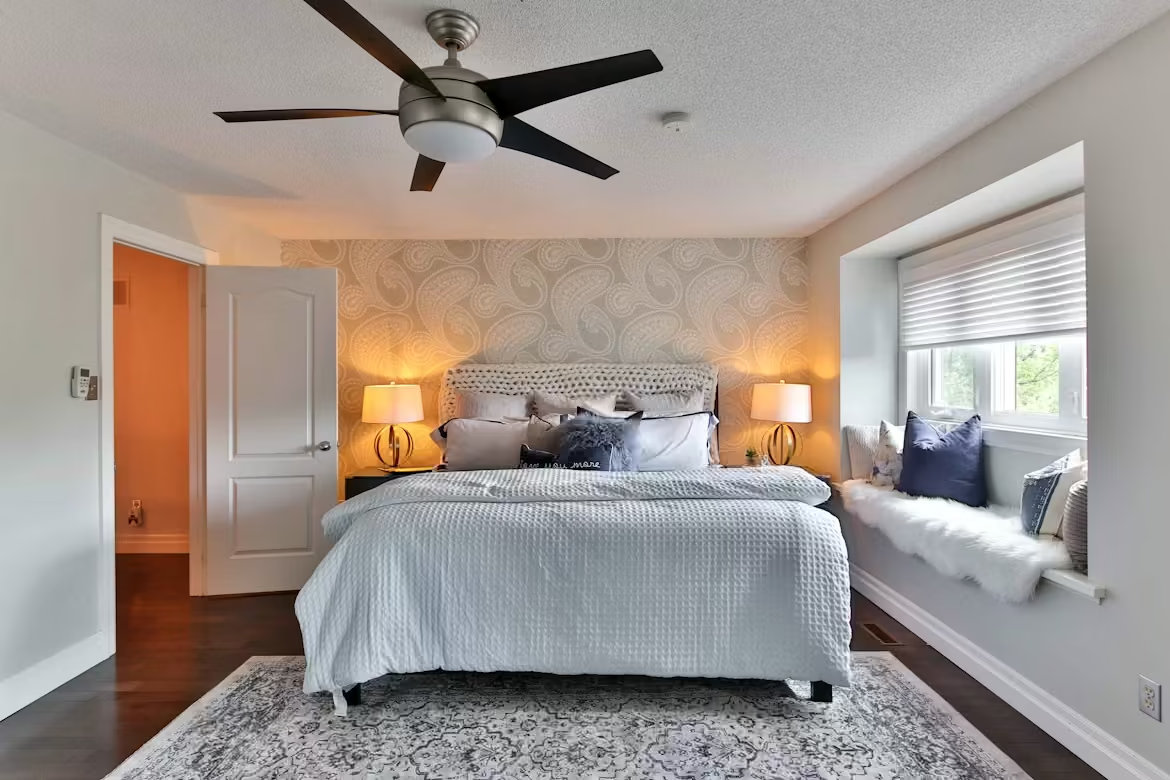
For most Brisbane homes, a DC ceiling fan is the better choice. It runs quieter, gives you genuinely usable low speeds, and it won’t pick up the audible buzz that Energex’s off-peak signal produces in some AC motors. AC fans still make sense where simplicity and repairability matter more than silence: sheds, rentals, garages, patios.
The energy saving is real, but it’s the smallest reason to choose one.
Why does my ceiling fan hum at night?
There’s a good chance it’s ripple control, and it’s the one explanation most fan buying guides never mention.
Energex uses audio-frequency load control across much of the South East network to switch off-peak hot water systems. A signal at roughly 1050 Hz gets injected into the supply on top of the standard 50 Hz mains. Hot water controllers listen for it and switch accordingly. Everything else on the circuit just has to sit there and cop it.
An AC induction motor responds to that injected frequency audibly. You get a hum or a buzz that starts at the same time most nights, runs for a while, then stops. Some dimmable LED downlights react to the same signal, which is why a house can start humming and flickering together and look like a wiring fault when it isn’t one.
DC fans don’t behave that way. The motor is fed by its own driver rather than running straight off the mains, so the signal doesn’t reach it in a form it can react to.
We hear about this most often in bedrooms, because that’s the room where a low background hum stops being background. If a fan sounds fine in the day and annoying at 10 pm, the fan probably isn’t faulty, and it’s a different problem to the clicking that comes from a loose blade or mount.
What’s the difference between an AC and a DC ceiling fan motor?
Both fans plug into the same 230V supply. The difference is what happens after that.
An AC fan runs its motor directly off the mains and changes speed using a capacitor, which is why you get three coarse steps and not much control between them. A DC fan takes the same mains supply and converts it at the canopy, then feeds the motor through an electronic driver. That conversion is what buys you the fine speed control and the missing hum.
Worth clearing up a common objection: domestic DC ceiling fans don’t use brushes. They’re brushless EC motors with an onboard inverter, so the brush wear argument you’ll see in engineering forums doesn’t apply here. Nothing is rubbing itself away inside the motor.
It also answers the obvious follow-up question. No, your house isn’t wired for DC, and no, you don’t need it to be.
Is a DC ceiling fan quieter than an AC one?
Yes, noticeably, and this is the reason people who’ve switched are happy with them.
Read through what Australian owners say about their DC fans and the pattern is hard to miss. Almost nobody leads with power bills. They lead with the fact that they can hear the air moving and nothing else. On low, a good DC fan in a bedroom is quiet enough to sleep under without the motor sitting in the background.
The speed range is part of that. AC fans step in coarse jumps, and the lowest of three settings is often still too much for a bedroom on a mild night. DC fans typically give you six or more steps, with the useful ones clustered at the bottom end where you need them.
Manufacturers have gone a bit far with this, admittedly. Sixteen speeds and “natural breeze” simulation modes are marketing rather than engineering. Six well-spaced speeds do the job.
How much power does a DC ceiling fan save?
Less than the brochures suggest, and that’s fine.
Ballpark figures: a DC fan draws somewhere around 25 to 35 watts flat out, against roughly 60 to 100 watts for a comparable AC fan. The percentage sounds dramatic. Applied to a fan running a few hours a night through a Brisbane summer, the actual saving is small.
Anyone quoting you a headline efficiency figure as the main reason to upgrade is selling, not advising. Ceiling fans were never a big load to begin with. Treat the efficiency as a bonus that comes attached to the quiet, because that’s what it is.
Which lasts longer, an AC or a DC ceiling fan?
This is the question people ask most and get answered least, so here’s a straight answer: AC fans have fewer things to go wrong.
An AC induction motor is a crude, well-proven design with very little in it to fail. DC fans add an electronic driver module, and that module is the most common failure point. When it goes, you’re usually replacing the fan rather than repairing it, because drivers are model-specific and rarely stocked once a range is discontinued.
That changes what you should be looking at in the showroom. Warranty length matters more on a DC fan than an AC one, and so does whether the brand will still exist in five years. Fanco, Ventair and Martec have been around long enough to be a reasonable bet. An unbranded import at a tempting price is a gamble on parts availability, not just build quality.
So the honest summary: DC wins on noise and control, AC wins on having less to break. For a bedroom or living area, quiet is worth the trade. For a shed, patio or rental, it usually isn’t.
Do DC ceiling fans only work with a remote?
Mostly, and this is the part worth deciding before an electrician is standing in your ceiling.
Most DC fans ship with a remote and no wall control option, which frustrates people who want a room to work like a normal room. A few manufacturers, Fanco among them, offer DC models with hard-wired wall controls. If that’s what you want, say so before you buy, because retrofitting one afterwards usually isn’t possible.
Three practical points:
- If you’re going with a remote, mount the supplied cradle beside the existing light switch. The bracket comes in the box. The room then behaves the way visitors expect it to.
- A standard AC fan speed controller on the wall will not run a DC fan. If your smart home setup relies on that switch, plan around it. DC fans that integrate do it through their own wifi module or app, not through the wall.
- Remotes can sync multiple fans, which is handy in an open-plan area and awkward to replicate with wall controls.
Where it becomes a real electrical decision rather than a preference is a retrofit. Plenty of Brisbane units and townhouses have concrete slab ceilings on the lower level, so even putting a fan in where a light point already sits leaves you no practical way to run a new switch drop. In those homes, the remote isn’t a compromise; it’s the only sensible option.
In a new build or a renovation, it’s a rough-in call. If you want hard-wired wall control, the cabling has to go in before the walls close up. That’s the kind of thing we raise on site during a switchboard and circuit upgrade or a rewire, when the ceiling is still open, and the decision is cheap to make.
Do plastic blades move less air than metal ones?
No, and the advice you’ll see saying otherwise has the reasoning backwards.
Airflow comes down to blade pitch, blade diameter and motor torque. Material barely enters into it. What moulded blades do is allow a more aggressive pitch at a sensible manufacturing cost, and they don’t corrode. In Brisbane humidity, and particularly anywhere near the bay, that second point matters more than the first. Metal blades on a covered outdoor patio in Wynnum will show it within a few seasons.
So which should you choose?
Buy DC for anywhere you sleep, work or sit for long stretches. Buy AC for sheds, garages, patios and rentals where a hum doesn’t matter and easy replacement does.
If you’re already hearing a nightly hum from an existing AC fan, that’s the strongest case for switching there is, because no amount of servicing will fix it. Replacing several fans one at a time as they annoy you costs more in labour than booking them as a single install. Worth thinking about before you start.
Ceiling fans look like a simple job, and most of the time they are. The decisions that cause trouble later are the ones made before the fan comes out of the box: control type, ceiling construction, whether the circuit can take another point. If you’re planning fans as part of a renovation or you’ve got one humming through the night, get in touch with the Dawson Electric team, and we’ll work through it with you on site.
Frequently Asked Questions
In bedrooms and living areas, yes. The price gap on the fan itself has narrowed considerably, installation costs the same either way, and most DC models now include features that were extras on AC fans. In a shed or on a patio, the case is much weaker.
Usually. The existing wiring point is the same, so a straight swap is common. The complication is control. If your fan currently runs from a wall speed controller, that controller won't work with a DC motor, and you'll need either a remote or new cabling for a compatible wall control.
Ripple control. Energex injects an audio-frequency signal to switch off-peak hot water systems, and some AC motors and LED dimmers react to it audibly. Same time each night is the giveaway. Random flickering at odd hours points to something else, usually harmonics from other equipment or a genuine fault worth having checked.
They need either their supplied remote or a wall control made for that specific model. Standard AC fan speed controllers aren't compatible. This is worth confirming before purchase rather than after.
The motor itself will outlast an AC motor comfortably. The electronic driver is the limiting part, and it typically decides the life of the fan. Choose an established brand with a long warranty and you're covering the part most likely to give up.
