

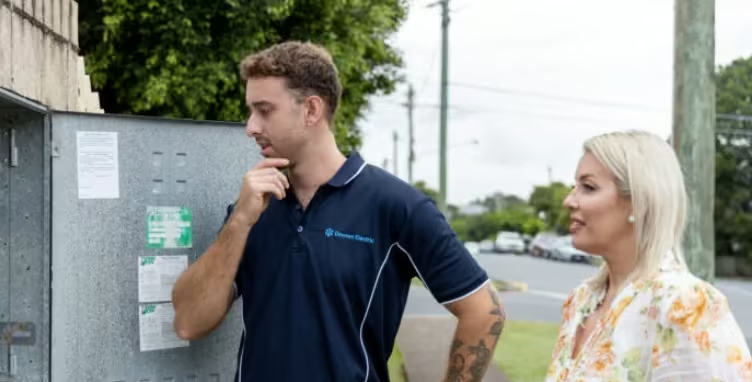
How many circuits does a house need? The wiring rules set no number. Most Brisbane homes run six to twelve final subcircuits: lighting split front and back, two general power circuits, a dedicated kitchen circuit, hot water, oven, and air conditioning on its own. Legal and adequate are two separate tests, and only one of them appears on a compliance certificate.
How many circuits does a house need under Australian wiring rules?
None specified. There’s nothing in AS/NZS 3000 stating that a four-bedroom house needs eight circuits, or six, or any figure at all. A two-storey home wired with one power circuit upstairs and one down, cable sized correctly, breakers matched, RCD protection in place, will pass inspection.
We’ve seen it. More than once, in houses barely fifteen years old.
What the standard does require is that an installation suits the purpose it was built for. That’s where this gets interesting, because a breaker that goes during ordinary household use has arguably failed that test. A breaker tripping on overload isn’t reporting a fault. The circuit is telling you it was never designed for the load it carries.
So the useful question isn’t the count. It’s whether yours still matches how the house gets used.
How many power circuits are in most homes?
Ask five electricians and the shape of the answer holds steady even when the numbers move around.
Kitchen on its own. Fridge on its own where possible, because a breaker that goes on a Friday night and doesn’t get noticed until Sunday costs you everything in it. Two general power circuits minimum, split one per floor. Kitchen and laundry never sharing.
No rule covers that last one. Nobody’s being prosecuted for it. But every electrician who has stood in a laundry explaining a tripping breaker to a homeowner mid-wash knows exactly why it’s poor design.
The version you’ll actually meet: microwave, dryer, kettle and fridge all landing on one 16A circuit. On 16 amps rather than 20, breakfast alone gets you close. Toaster and kettle together. Add a vacuum somewhere in the house, or a bar heater in winter, and the board decides for you.
Honest note, since it’s relevant. Plenty of sparkies live in houses wired precisely this way. Trips a couple of times a year. Never quite reaches the top of the weekend list. Common enough that it barely registers as a problem worth booking someone for.
Why older Brisbane homes got away with fewer circuits
The old approach wasn’t wrong when it was done. What changed is what people plug in.
Lighting shows this best. A house wired before the LED era ran halogen downlights at roughly 50 watts a fitting, so fifteen of them across a lounge and kitchen put real load on a lighting circuit. Swap those for LEDs at six or seven watts and the same circuit barely notices. Point count told you very little then and tells you less now, which is why the average number of circuit breakers in a home is a poor guide to whether that particular home is adequately wired. The number on the board says nothing about what runs through it.
How do you know your circuits are undersized?
The board tells you.
A breaker that goes repeatedly on the same circuit during normal use, at roughly the same time of day, is the clearest signal in home electrical circuit design that the original split no longer suits the household. Other things worth watching for:
- The same breaker going every time two particular appliances run together
- Power points warm to the touch on a heavily loaded circuit
- Lights dipping when the aircon compressor kicks in
- Extension leads doing permanent work anywhere in the house
Knowing which device on your board actually moved matters here. A safety switch tripping is a different problem to a circuit breaker tripping, and the fix looks nothing alike.
How many amps does a Brisbane house need?
Nobody can tell you from a description. Not honestly, anyway.
The answer comes out of a maximum demand calculation, the method set out in Appendix C of AS/NZS 3000, or from logging the house through a real peak: splits running on a February afternoon with the oven going and the dryer full.
Here’s the part that catches people out. 50 amp service fuses are common across Queensland, and they aren’t blowing regularly. Five bedrooms, three bathrooms, ducted air conditioning throughout, induction cooktop, pool pump, sitting on a 50 amp main switch without complaint. Real draw lands well under what homeowners assume, because diversity does the work. Nothing runs at once, and the calculation method accounts for that.
Broad picture across Australian homes: newer city builds around 80 amps, regional closer to 60, rural lower again, older housing stock lower still. The network sets that ceiling.
And American figures don’t translate. A 100 amp US service is roughly equivalent to 50 amps here, because their voltage is half ours. If you’ve been reading US content telling you a family home needs 200 amps, the baseline is wrong before you start.
Which loads actually change the answer?
Two.
Induction cooktops and EV chargers are the loads pushing houses past what their supply was designed to carry. Nearly everything else has quietly got more efficient over twenty years.
The EV side carries a Queensland wrinkle that national guides skip entirely. Under the Queensland Electricity Connection Manual, Energex applies a 20 amp equipment limit to single-phase connections, so a standard 32 amp wall charger can’t simply be wired in and energised. It needs an approved active device management arrangement, a load-controlled tariff, or three-phase. Home EV charger and dedicated circuit installation in Brisbane is a network approval question as much as a wiring one, and finding that out after the car arrives is a poor way to learn it.
We’ve also seen blown service primaries on single-phase homes charging hard. Rare. Still happens.
Three-phase 63 amp supply will probably become standard for large all-electric homes with two cars in the garage. For most households it isn’t the answer and isn’t a dealbreaker either, and solar capacity comes down to roof space long before it comes down to phases.
One opinion that’ll save some people money: most homes don’t need fast charging at all. The car sits in the garage ten or twelve hours a night. A standard outlet putting in somewhere around 1.3 kilowatts covers ordinary daily driving, and plenty of owners run that way for years, using public chargers only on trips.
Building or renovating? Decide now
Add circuits and points while the walls are open.
The gap between running an extra circuit during construction and retrofitting one into a finished double-storey is enormous, and the retrofit end has very little to do with wiring. Access, plaster, paint, time.
Cheap insurance if you’re building: run conduit down an internal wall for anything you might ever want later. A second oven, or a studio out the back. You may never pull a cable through it. The one time you do, it pays for itself many times over.
If your breaker goes in a pattern you can predict, that’s a design problem rather than a habit you should be working around. Dylan and the team can run a maximum demand assessment on your place, tell you what your existing circuits are carrying, and give you a fixed price on the fix before anything starts. Call 07 3324 1447 or get in touch.
Frequently Asked Questions
Yes. Every final subcircuit requires overcurrent protection, and modern boards use circuit breakers rather than the ceramic rewireable fuses still sitting in plenty of older Brisbane switchboards. RCD protection is required separately on power and lighting circuits. Fuse wire in your board is less a compliance question than an age one.
10A for lighting, 16A or 20A for general power, 20A on a dedicated kitchen circuit, 32A for an oven or air conditioner, 40A and up for larger fixed loads. The size follows the cable it protects.
One dedicated to it, at minimum. Two in a modern kitchen with induction, a wall oven and a bench that's never clear.
Only where there's spare capacity on the board and in the consumer mains; older Brisbane boards tend to run out of physical ways well before they run out of electrical headroom, which is usually the point an upgrade enters the conversation.
Fewer than you'd expect, and the wiring is the harder part. Original Queenslanders were built for a fraction of today's load, and timber construction with no cavity makes new runs fiddly rather than genuinely difficult. Most end up rewired in stages with the board relocated.
