

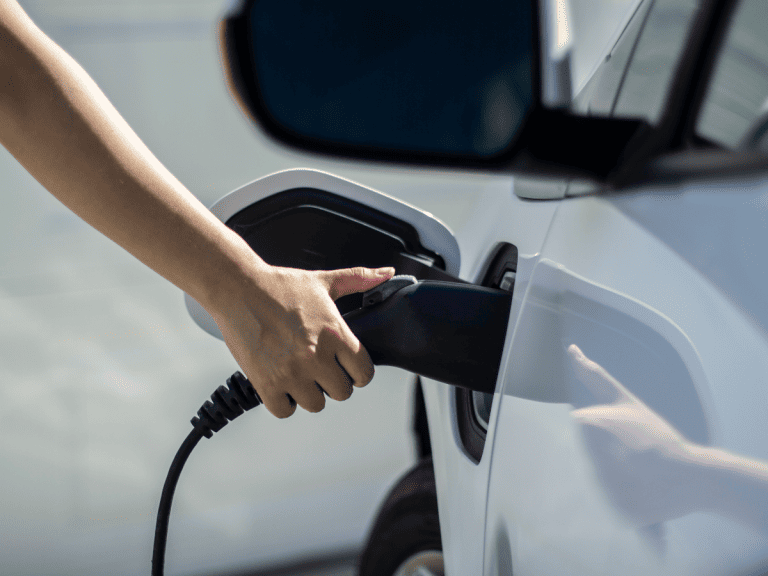
You can install an EV charger at home in Brisbane in as little as half a day. But what decides the outcome isn’t the charger itself; it’s your switchboard’s spare capacity and whether Energex needs to sign off on the connection. Get those two answered first, and the rest of the job is straightforward.
Single-Phase or Three-Phase: Which EV Charger Suits Your Home?
Most homes across Brisbane are wired for single-phase power. A single-phase EV charger, sometimes labelled a Level 2 EV charger in car manuals and American charging guides, tops out around 7kW. A 7kW EV charger of this size restores roughly 40km of driving range per hour, enough for an overnight top-up on a typical daily commute.
A 3-phase EV charger is a different proposition. It draws across three active wires instead of one, which is what lets it push 11kW or 22kW into the car, genuinely useful if you’re charging two EVs, running a small fleet, or you just don’t want to wait. The catch is that three-phase supply has to already exist at your switchboard. Confirming whether your home has three-phase power is the first thing to check before assuming a 3-phase charger is even on the table. Plenty of older Queenslanders and post-war brick homes around Brisbane were never wired for it, and adding it isn’t part of a standard charger install. It’s a separate conversation with Energex.
For one EV and typical daily driving, a 7kW EV charger on single-phase power is usually the sensible call. It’s simpler to install, rarely needs network approval, and still tops up a full day’s driving overnight.
Will Energex Approve Your EV Charger?
This is the part almost nobody explains properly, and it’s where a lot of installs stall. Energex, as Brisbane’s electricity distributor, treats an EV charger as a significant new load on the local network, not because your house can’t handle it, but because your street’s transformer has to.
In many cases, a single-phase EV charger under a certain draw can go in under a standard notification, lodged by your electrician as part of the job. A 3-phase EV charger, or any installation above the network’s notification threshold, needs Energex pre-approval before work begins. Energex checks whether the local transformer has spare capacity to carry the extra load. Timeframes vary, and in some pockets of Brisbane with older infrastructure, approval can take longer than the electrical work itself. If Energex flags a compliance issue rather than a capacity one, our guide on handling an Energex defect notice covers what happens next.
None of this is a reason to delay. It’s a reason to start earlier. A licensed electrician lodges the Energex paperwork as part of the job, under the Electrical Safety Act 2002 and AS/NZS 3000 wiring rules. Submitting it early matters, because the network’s assessment clock doesn’t start until someone does.
Can Your Switchboard Handle an EV Charger?
Here’s the reframe worth sitting with: most people shop for the charger first and the switchboard second. It should be the other way around.
To install an EV charger at home, you need a dedicated circuit protected by its own RCD, with a switchboard that has a spare way to take it. That’s rarely a problem in a home built in the last fifteen years. It’s a real problem in the older housing stock that makes up a huge share of Brisbane’s suburbs.
We recently quoted a job in a 1930s Queenslander in Camp Hill where the board still had ceramic rewireable fuses and precisely zero spare ways. In a case like that, installing an EV charger at home means the switchboard comes first, and the charger comes second, not the other way around. Sequencing the job this way isn’t about padding the invoice. A board with no spare capacity can’t take a new circuit safely, so skipping the upgrade risks a job that fails inspection or can’t be finished at all.
If your board is original to a Queenslander or an early post-war brick home, budget the switchboard as part of the conversation, not a surprise halfway through. Our guide on switchboard upgrade costs covers what actually drives that price.
Where Should the Charger Go: Near the Car or Near the Board?
Most people assume the charger goes wherever the car parks, and that’s usually the right call. The detail that changes the quote is what sits between that spot and the switchboard.
Queenslanders make this trickier than most homes. The switchboard usually sits underneath the house, the car parks out at street level, and that gap is easy to underestimate until someone measures the cable run itself. Longer runs simply cost more in labour.
Does the parking spot get decent Wi-Fi? That question matters for a smart EV charger specifically, because app control and load scheduling both rely on a working signal. Plenty of homeowners only discover theirs is patchy after the unit’s already on the wall. Outdoor installations carry their own requirement: a correctly IP-rated, weatherproof enclosure for anything under a carport, on a driveway, or beneath an open patio, not a standard indoor unit pressed into service outside.
None of this rules out mounting near the car. It just means the electrician doing the quote should walk the actual path from board to bumper, not assume it.
Tethered or Untethered, and Which Connector Type?
A tethered charger comes with the cable permanently attached. An untethered EV charger has a socket on the wall, and you plug in your own cable, which means one charger works across more setups if the household ever changes cars.
Connector type is simpler than people expect: virtually every EV sold new in Australia today uses a Type 2 EV charger connector, so compatibility isn’t really the decision point it once was. Go untethered, though, and you’ll need a matching Type 2 EV charger cable on hand. Most Australian EVs already carry one in the boot, though it pays to confirm this rather than assume it. The real trade-off is convenience versus flexibility: tethered is quicker to use every day, untethered gives you options if you replace the car or want to charge visitors’ EVs occasionally.
Should You Buy the Charger Yourself, or Go Through Your Installer?
Buying a charger online and having an electrician “just install it” sounds like the cheaper path. It often isn’t, and here’s the honest version of why.
A residential EV charger needs to be compliant, correctly rated for your circuit, carrying a proper Type 2 EV charger connector as standard, and backed by a manufacturer warranty that survives an insurance claim if something ever goes wrong. Cheap imported units bought sight-unseen don’t always tick all three boxes, and an electrician who didn’t supply the unit has no leverage if it fails early. We’d rather quote the charger and the install together. It means one point of accountability instead of two. It’s the same logic behind steering clear of unlicensed electrical work altogether. One accountable party beats two half-responsible ones.
If solar integration matters to you, this is also where it gets decided. A solar EV charger (one that can throttle charging to match your panel output rather than pulling flat-out from the grid) is a genuinely different piece of hardware to a standard smart EV charger, and not every unit on the market does it well. Worth raising at quote stage: swapping in a solar EV charger later usually means redoing wiring that a standard install didn’t need.
Getting Your EV Charger Installed in Brisbane
An EV charger installation cost isn’t one number: it moves with switchboard condition, cable run, Energex approval, and charger type, which is exactly why we quote it as a fixed price after actually seeing the job, not off a phone call. Ask around for an EV charger installation cost before anyone’s actually seen your switchboard, and the number you get is a guess dressed up as a quote.
On the running side, charging at home costs less per kilometre than running the car on petrol, and an off-peak electricity plan widens that gap further. Your own number comes from your retailer’s off-peak rate, which most providers list clearly on a bill or app rather than burying in fine print.
For EV charger Brisbane comparisons, remember this: the switchboard moves the number, not the charger brand.
Dawson Electric has been installing EV chargers across Brisbane suburbs, from Camp Hill and Morningside to Hawthorne and Clayfield, under a licensed, fixed-price quote, a genuine on-time guarantee, and the same clean-site standard our team applies to every job, backed by 300+ five-star Google reviews. Whether it’s a straightforward residential EV charger or one wired to work with solar, we handle the switchboard, the Energex approval and the install as one job. If you’re after an EV home charger in Brisbane and want all three sorted at once instead of chased separately, that’s the EV charger installation we run.
If you’re ready to get a fixed quote for your installation, contact Dawson Electric today.
Frequently Asked Questions
Switchboard capacity usually decides the shape of the job, whether it's a straightforward circuit addition or a switchboard upgrade first. Cable run and Energex approval both influence the number from there, generally by less. None of this shows up in a phone estimate, so we quote only after seeing the switchboard in person.
Well under what the same driving distance costs in petrol, and cheaper again if the charging happens overnight on an off-peak plan. Your electricity tariff and your EV's efficiency both shape the exact saving. Households vary enough on both fronts that one figure for all of Brisbane would be more guess than guide.
No, not for most single-EV households. A single-phase EV charger, sometimes labelled a Level 2 EV charger in US guides, tops out around 7kW. A 7kW EV charger like this covers a full day's driving on an overnight charge for the vast majority of drivers. The two real reasons to look at a 3-phase EV charger instead are multiple EVs in the household or wanting the fastest possible charge speed, and even then it only works if three-phase supply already reaches your switchboard.
No. Fixed wiring work, including the dedicated circuit and RCD protection an EV charger requires, is licensed electrical work in Queensland. It also needs to be certified and, in many cases, notified or approved through Energex.
Often, yes, particularly for three-phase or higher-draw installations. Your electrician lodges the notification or approval as part of the job, but timing matters. Leave it until the charger's already on site. From there, the install date waits on Energex's timeline rather than the electrician's, usually the slower of the two.
