

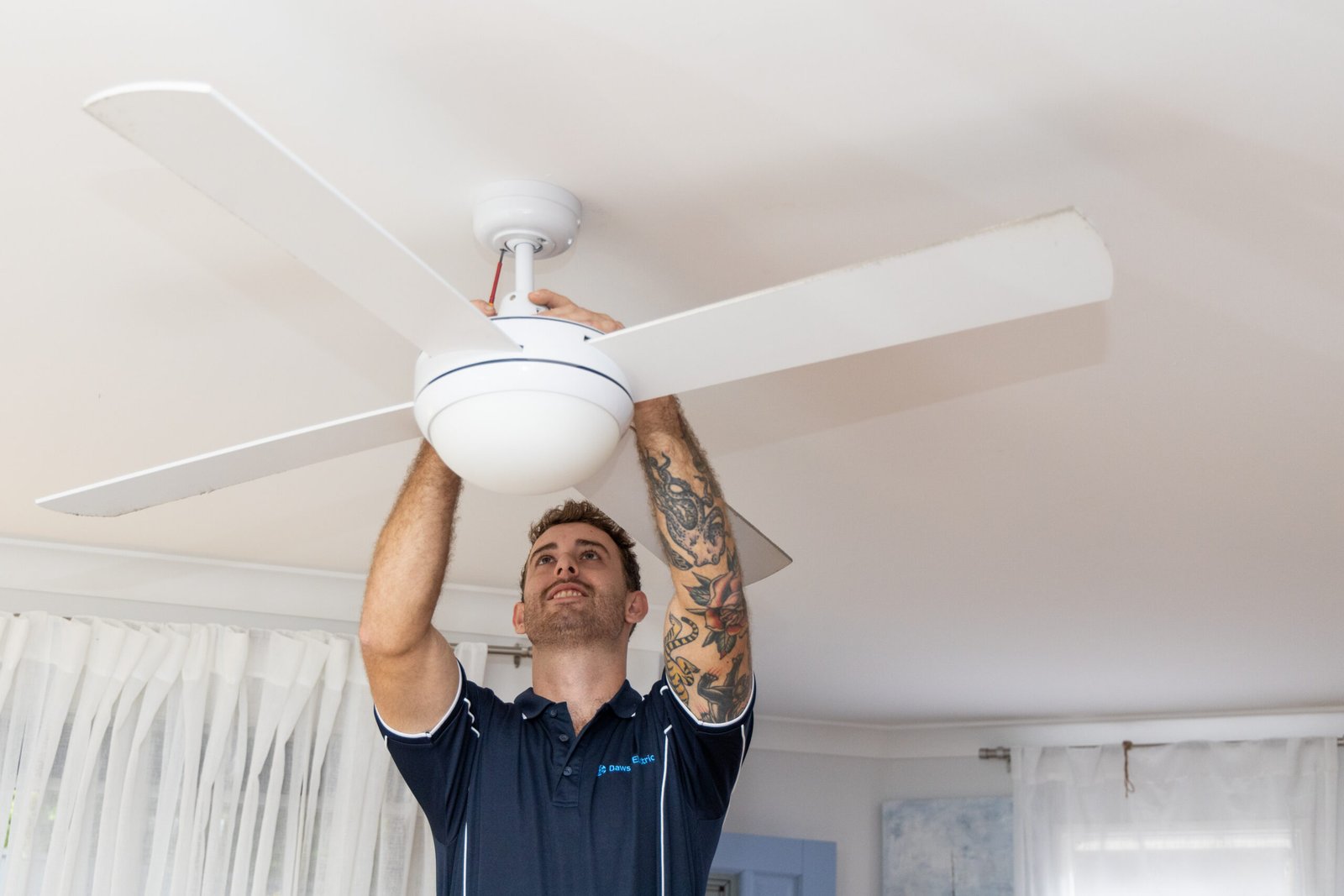
Ceiling fan installation cost Brisbane-wide comes down to one question before anything else: Is there already wiring where the fan is going? Swapping a fan onto an existing outlet is the quickest, lowest-cost job an electrician does. Running a new circuit through the roof is a different job entirely. Everything else, from fan type to ceiling height to access, sits inside that gap.
What does ceiling fan installation cost in Brisbane?
Every quote falls into one of three tiers. Not eight. Three.
| Installation type | What’s involved | Relative cost |
| Replacing an existing fan | Existing outlet, existing switch: disconnect, mount, reconnect | Lowest |
| New fan at an existing light point | Wiring is there, but the mounting and often the switching need work | Mid-range |
| New fan where there’s no wiring | New cable run from the switchboard, new switch, new mounting point | Highest, quote required |
Here’s the part most cost guides miss: tiers one and three aren’t points on a spectrum. They’re effectively different trades. A straight swap is a mounting-and-connection job. A new circuit is an electrical installation project that happens to end in a fan. That’s why one ceiling fan installation might cost several times another, and why any page quoting a single flat figure for how much does it cost to install a ceiling fan isn’t telling you much.
Exact ceiling fan installation charges depend on your ceiling, your wiring, and your roof, which is why Dawson Electric quotes fixed, upfront, and free.
Why the wiring already being there changes everything
An existing outlet means the circuit, the switching, and (usually) the mounting already exist. An existing light point means the power is there. We’ve covered whether a ceiling fan can be installed where a light is in detail, but the short version is that light points are wired and mounted for a fitting that weighs a few hundred grams, not a spinning motor. No wiring at all means a new run from the switchboard, and if the board itself is older or already at capacity, a switchboard upgrade can enter the conversation, too.
That last one is where your roof decides the price. “Fishing a cable” means feeding new wiring through the roof cavity to where the fan will hang, and Brisbane’s housing stock makes that anything but standard:
- Queenslanders typically have generous, walkable roof cavities. Cable runs are comparatively quick.
- Post-war brick-and-tile homes sit in the middle. Workable, but tighter, with older wiring that sometimes needs attention while we’re up there.
- Modern low-pitch truss roofs are the slow ones. There’s often less than half a metre of clearance at the edges, and an electrician is crawling between truss webs to reach the fan position. Same cable, same fan, considerably more labour.
You’ll notice most articles ranking for this topic never mention roof type. Several are written for American homes: drywall, attics, aluminium wiring, and permit fees. None of that applies here, and it’s a fair sign the writer has never been inside a Brisbane roof in February.
What else affects the cost?
Beyond wiring, a handful of factors move the price, usually together rather than one at a time.
Ceiling height and downrods. High or raked ceilings need a downrod to bring the blades to an effective height, and sometimes scaffolding or a taller platform to work safely.
Fan weight and mounting. This one catches people out. Many older light points in Brisbane homes aren’t rated to hold a fan. A fan doesn’t just hang; it oscillates, and the mounting has to be rated for that load. If the existing bracket isn’t fan-rated, it gets replaced before anything else goes up. That’s not upselling; it’s the difference between a fan and a ceiling hazard.
Switching and controls. Adding a wall switch, wiring a remote receiver, or setting up smart control each adds time. A ceiling fan with light installation also needs separate switching for the light and the fan, which older wiring doesn’t always accommodate cleanly.
Outdoor and bayside installs. Alfresco areas need appropriately rated fans, and homes near the bay need corrosion-resistant ones. More on that below, because buying the wrong fan for the location means paying twice.
Replacing a ceiling fan vs installing a new one
Ceiling fan replacement is its own decision, and it’s usually simpler than people expect. If the outlet and mounting are sound, the replacement sits in the lowest cost tier.
The real question is whether to repair or replace. A fan that hums, wobbles, runs slowly, or has developed a clicking noise usually has a tired capacitor or worn bearings. Capacitors are a cheap fix on a fan worth keeping. But on an older AC fan, once labour is factored in, repair often costs a meaningful share of a new DC fan that runs quieter and draws far less power. When a fan is past a certain age, ceiling fan replacement tends to beat repair. You’re not paying to keep old technology alive.
Do you need a licensed electrician to install a ceiling fan in Queensland?
Yes. Connecting a fan to fixed wiring is licensed electrical work under Queensland law, with no exceptions for “simple” swaps. A ceiling fan electrician issues a Certificate of Electrical Safety on completion, which is your proof that the work was done and tested by a licensed tradesperson. Unlicensed electrical work can void your home insurance, and that’s before considering what a bad connection above your bed actually means.
Worth correcting something you’ll read elsewhere: several pages ranking for this topic mention “permit fees” and “inspection costs.” That’s American. Queensland doesn’t require a homeowner’s permit to install a ceiling fan. It requires a licensed electrician to do the work and certify it. If a cost guide is quoting permit fees, it wasn’t written for here.
If you’re searching for how to install a ceiling fan Australia-wide, guides for a DIY approach: the mounting and assembly you can look at, but the wiring connection isn’t yours to make.
What about Bunnings or retailer installation?
Retailer installation services are worth understanding, because sometimes they’re genuinely the right call. A typical retailer install covers connecting your new fan to an existing, compliant outlet. That’s it. No new wiring, no switch changes, no bracket upgrades, and if the installer finds a non-fan-rated mount or degraded wiring, the job usually stops there.
For a straight swap in a modern home with sound wiring, that can honestly be the cheaper option. Where it falls short is any home where something needs assessing, which, in practice, describes a lot of Brisbane’s older housing stock. An electrician for ceiling fans quotes the whole job, including whatever the ceiling reveals, rather than the narrow slice a retailer’s package covers.
Do I supply the fan, or does the electrician?
Either works. If you’ve found a fan you like, any electrician to install ceiling fan units you’ve purchased will fit it. Just confirm it suits the location before buying, particularly for outdoor or coastal spots.
Ceiling fan supply and install as a package has one quiet advantage: the electrician specs the fan for the room and the mounting, so there are no surprises on the day. We regularly fit Hunter Pacific, Martec, Brilliant, and Mercator fans across Brisbane, and we’ll tell you plainly when a cheaper model isn’t worth wiring in.
How much does it cost to run a ceiling fan?
This is the section that reframes the whole decision. How much does it cost to run a ceiling fan? Very little. The difference between a fan and air conditioning is roughly the difference between cents and dollars for the same hours of run time. When comparing air conditioning vs ceiling fans on financial grounds, the gap comes down to physics: a fan doesn’t cool air, it moves it, and moving air takes a fraction of the energy that refrigerating it does.
The AC-versus-DC choice matters here. DC motors draw roughly a third of what an equivalent AC motor does, run near-silent, and offer more speeds. They cost more upfront. Over a Brisbane summer of nightly bedroom use, that gap closes steadily, and then keeps paying.
Our position, plainly: a DC fan in any room that runs long hours pays for itself, and an AC fan in a bedroom is a false economy. You’ll hear it every night and pay for it every quarter.
Run the fan with the air conditioning, and you can set the thermostat a couple of degrees higher for the same comfort, which is where ceiling fan installation stops being an expense and starts being the cheapest cooling decision in the house.
Choosing the right fan for a Brisbane home
Enough to avoid buying the wrong fan, not a buying guide. If you want the full rundown before you shop, our ceiling fan buying guide covers it properly.
| Room size | Blade span |
| Small (bedroom, study) | 1200mm or under |
| Standard bedroom/living | 1300–1400mm |
| Large living / open plan | 1500mm+ |
Beyond size: a reverse function earns its keep in winter, pushing warm air back down. Alfresco fans need the right IP rating for the location, because an indoor fan under a patio corrodes and fails early. And for bayside suburbs like Wynnum and Manly, salt air eats standard finishes; marine-grade or coastal-rated fans exist for exactly this reason.
How to keep the cost down
- Batch the installs. Fitting three fans in one visit costs well under three separate visits, because setup, travel, and testing get shared across the job. If you’re thinking about ceiling fan installation for more than one room, do them together.
- Use the existing outlet if you can live with the fan’s position. Relocating a point is real work; keeping it isn’t.
- Bundle it with other electrical work you’ve been putting off. Same logic, same saving.
- Get the ceiling checked before buying a heavy fan. A quick look at the mounting saves buying a fan that the ceiling can’t take.
And the one that doesn’t save money: buying the cheapest fan on the shelf. The installation cost is identical for a fan that lasts three summers and one that lasts fifteen. The labour is where the money goes, so spend it wiring in something worth keeping.
Why Brisbane homeowners choose Dawson Electric
Family-owned and Brisbane-based since 2007, with 300+ five-star reviews and an on-time guarantee that costs us if we’re late, not you. Fixed pricing, free quotes, Australian-made CLIPSAL components, and a clean-work standard we call “grandma’s house”: every van carries a Dyson, and we use them.
Searching for a ceiling fan electrician or ceiling fan installation near me? Dawson Electric services every Brisbane suburb from Woolloongabba to the bayside. Contact us for a free fixed quote, or call : (07) 3324 1447. If we’re late, the first $250 of the job is on us.
Frequently asked questions
It depends almost entirely on wiring. Replacing a fan on an existing outlet is the cheapest job; ceiling fan installation in Brisbane homes that need wiring costs several times more, because it's a new circuit, not a swap. A fixed quote after seeing the ceiling is the only accurate answer.
No. Connecting any fan to fixed wiring is licensed electrical work in QLD, and unlicensed work can void your home insurance. You can choose the fan; an electrician has to connect and certify it.
A straight replacement typically takes under an hour. A new fan at an existing light point runs longer once switching and mounting are sorted. A new circuit through the roof is usually a half-day job, depending on roof access.
Often, yes. The wiring is there. The two things to check are whether the mounting point is fan-rated (many older ones aren't) and how the switching will work, especially for a ceiling fan with light installation, where the light and fan need separate control.
In any room that runs long hours, bedrooms especially, yes. They draw a fraction of the power, run quieter, and the upfront premium closes over a couple of Brisbane summers.
Noticeably. Travel, setup, and testing get shared across the job, so the per-fan ceiling fan installation cost Brisbane electricians quote for a multi-fan visit is well below the single-fan rate.
