

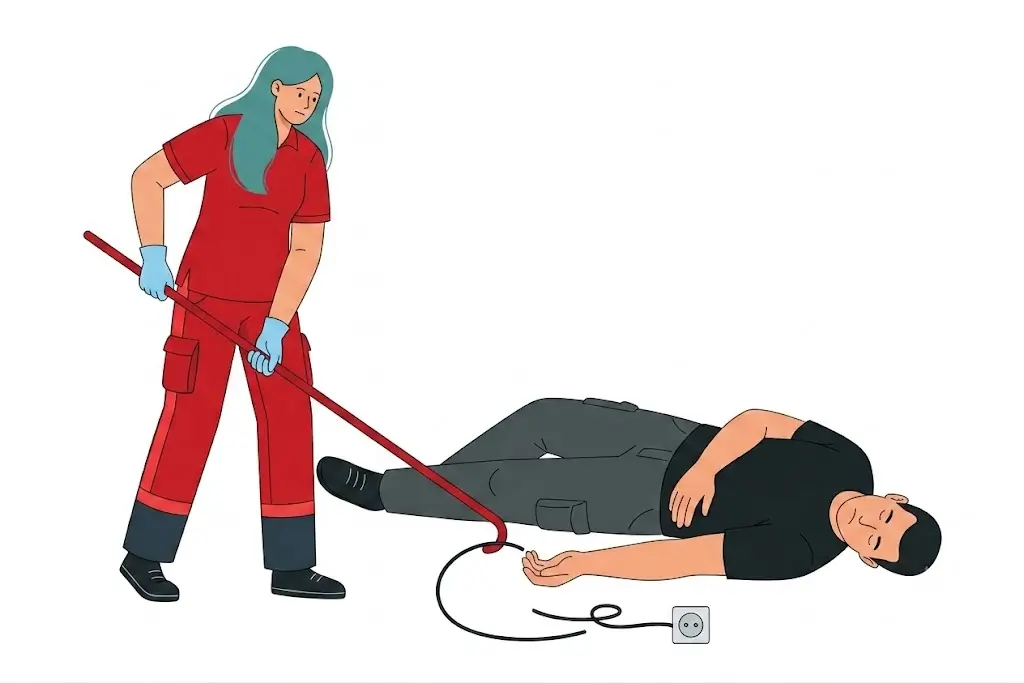
Call 000 and ask for an ambulance straight away if the person has lost consciousness, can’t breathe properly, or their heartbeat has gone irregular. Those are the signs that this is serious. Before you reach them, though, one thing comes first: the power. Current can travel through someone who’s still in contact with it, and into you. So you check the power is off, then you touch them. Not the other way round.
That covers the emergency. But there are two things most people in Brisbane don’t know, and both matter. A shock that felt mild still warrants a heart check, because a dangerous rhythm can develop hours after the event. And the fault that caused the shock is still there. The electricity didn’t fix itself when the person let go. Proper first aid for electric shock handles the person first and the wiring second, and on a Brisbane property, the wiring is our job.
When to call 000 (and when to go to ED anyway)
Call 000 for an ambulance if the person who got the shock has any of the following:
- Lost consciousness, even for a second
- Is breathing very fast, very slowly, or not at all
- Has a heartbeat that’s racing, dragging, or irregular
- Fell from a height when the shock threw them back
Those four are not a judgement call. Any one of them means an ambulance, immediately.
Here’s the part healthdirect mentions but buries, and it’s the one we’d underline. Even when none of those signs appears, when the person feels fine, shakes it off, and wants to get back to work, they should still see a doctor and have their heart checked. Electricity can disturb the heart’s rhythm without leaving a mark you can see, and that disturbance doesn’t always arrive at the moment of contact. An ECG is a five-minute test. It’s worth the trip to the ED. This is the cautious end of electric shock treatment in Australia, and it’s the right call far more often than people assume.
First aid for electric shock: step by step
Australian first aid runs on the DRSABCD action plan, and it works because it forces you to deal with danger before you deal with the patient. The order matters. Get it wrong and there are two casualties instead of one.
- Danger first. Look, don’t touch. The person may still be in contact with the current, and skin-to-skin contact will shock you too.
- Kill the power. Switch off at the mains, pull the relevant fuse, or unplug the appliance. This is the cleanest fix when you can reach it safely.
- If you can’t cut the power, separate them with something dry and non-conductive. A dry wooden broom handle is the classic, for good reason. Wood doesn’t carry current. A wet broom handle does, so dry matters.
- Check response and breathing once it’s safe. Talk to them, touch their shoulder. If they’re not breathing normally and you’re trained, start CPR.
- Treat any burn. Hold it under cool running water for a full 20 minutes, not a splash, the full time. Cover it with a light non-stick dressing or clean, non-fluffy material. No ice. No butter, no creams, no toothpaste. Those trap heat or introduce infection, and infection is one of the real risks with electrical burns.
One specific note on water and on hands, because “what to do after electric shock on hand” is one of the most common ways people land on a page like this. Hands are a frequent entry point. You grab a faulty appliance, and the current enters through the palm. The visible burn might look minor, but electrical burns often do more damage below the skin than on it. Cool it, cover it, and get it looked at properly.
Downed power lines are their own category. Stay at least 8 metres clear of any fallen cable. You’ll see 6 metres quoted on some older first-aid pages. The more conservative current guidance is 8, and when the downside is electrocution, we round up, not down. Don’t try to move the cable. If a car is in contact with a live line, the people inside are usually safer staying where they are. Tell them not to move and not to get out. Call 000, then report the line to Energex on 13 19 62 so the network side can be isolated. The car’s tyres and body can hold the occupants at the same voltage as the cable, which is what keeps them from being shocked. Stepping out breaks that and puts them between the live metal and the ground.
What does an electric shock actually feel like?
Most people who’ve had one don’t struggle to describe it. It’s usually a sharp jolt or a zap that runs up the arm. Sometimes the muscles clamp down hard enough that the person can’t let go of whatever they grabbed, which is one of the more dangerous parts, because they stay in contact longer. A bad one can throw you backwards.
After it’s over, the arm might feel like it’s ringing, or go numb, or carry pins and needles for a while. That electric shock sensation in the body comes from current moving through tissue and nerves that aren’t built to carry it. A tingle is the milder version of the same thing, a low-level current leak felt as pins and needles at the point of contact. People ignore tingling because they don’t really hurt. Being shocked by electricity at any level still points to a fault somewhere, and the strength of the shock doesn’t tell you how serious the fault is.
Electrocution vs electric shock: what’s the difference?
The two terms get used as if they mean the same thing. They don’t, and the distinction is simple. An electric shock is what happens when current passes through the body. It covers everything from a harmless static nip to a serious injury. Electrocution means death caused by that shock.
So a person can survive an electric shock. Nobody survives electrocution, by definition. We use the words carefully because the difference between the two often comes down to the path the current took, how long it lasted, and whether anyone cut the power in time. Electrocution first aid and electric shock first aid are the same set of actions taken with the same urgency. The difference is only in the outcome.
After-effects: what to watch for in the hours and days after a shock
This is the part the medical and safety sites tend to skip, and it’s the part that worries us most.
A shock isn’t always over when it’s over. The heart is the main concern. Current can leave the heart’s rhythm unsettled, and a dangerous arrhythmia can surface hours later, which is exactly why the ECG matters even when someone feels fine.
Beyond the heart, slower problems can show up over the next few days. Muscle soreness is the most common one. A shock makes the muscles contract hard, sometimes hard enough to strain them, and people don’t always connect the ache a day later back to the shock.
Burns are the other thing to keep an eye on. An electrical burn can look settled and then turn: redness spreading, weeping, more painful than it was. That’s infection, and it’s the complication that actually puts people back in hospital after an electrical injury. Get it seen.
Other delayed electric shock symptoms are easier to miss. Numbness or tingling in the arm. Headaches. Some people don’t sleep well for a week, or feel rattled and anxious in a way they can’t quite place. None of it always appears at the time. That’s the whole problem with the after-effects of electric shock. The shock can feel finished when it isn’t.
Go back to the emergency department if something appears or gets worse over the following days.
Why do I keep getting small shocks from my taps, appliances, or power points?
Getting zapped around the house isn’t something you’ve done wrong. Nine times out of ten, it’s the wiring, and it’s worth finding out which fault before it gets worse.
The harmless one is static: a carpet, dry winter air, a synthetic jumper. It’s a quick snap when you touch a doorhandle, and it carries no current from the mains. Annoying, not dangerous.
The other one is the answer to “why do I keep getting electric shocks” that actually matters. If you feel a shock or tingle off a metal tap, a fridge door, a stove, the shower, or a power point, that metalwork is most likely live with stray voltage. The usual culprits are a broken neutral or a failed earth connection, or sometimes a poorly installed appliance, which is one reason work like air conditioning installation should always go to a licensed electrician. The safety path that should carry stray current away has been compromised, so your body becomes the path instead.
This isn’t something to live with or work around. A tap or an appliance that shocks you is a live one, and that’s urgent. Keep your hands off the meter box and the switchboard. Don’t touch metal fixtures around the property either: taps, the stove, anything that might be carrying the voltage. Warn the household. Call Energex on 13 19 62 to make the network side safe, then book a licensed electrician to find the fault on your side of the meter. In our experience, a recurring tingle is the early warning before a much worse shock, the kind of thing we’d rather find on a callout than after an ambulance.
How many volts is dangerous? And what does 240V do to you
People ask how many volts is lethal, and the honest answer is that voltage is only half the picture. It’s the current, measured in amps, that stops a heart, and it doesn’t take much. Around 30 milliamps through the body is enough to trigger ventricular fibrillation, the chaotic rhythm that leads to cardiac arrest.
Now the uncomfortable part. Australian mains runs at 240 volts. Pushed through a wet or sweaty body, where skin resistance drops, 240V can drive current well past that 30mA threshold without effort. That’s why a “household” shock is never something to dismiss, and why the hazards of electricity in a home are taken seriously by anyone who works with it daily. It’s also why the wiring rules, AS/NZS 3000, require residual current devices, better known as safety switches, on circuits in modern installations. An RCD is built to cut the power in a fraction of a second when it detects current leaking to earth. It’s the single best protection between a fault and a fatality.
How a licensed electrician investigates after a shock incident
This is the work no medical site or safety pamphlet can do for you, and it’s where a Brisbane electrician earns the callout.
When we attend a property after a shock, we’re hunting for the fault that the first aid didn’t address. The process is methodical. We start with a visual inspection of the switchboard, looking for scorching, loose terminals, ageing ceramic fuses, the absence of RCDs. Then we test. An RCD trip test confirms the safety switches actually cut out when they should. An insulation resistance test, run with a megohmmeter, tells us whether the cable insulation has broken down and current is leaking where it shouldn’t. Earth continuity and loop impedance tests confirm the earthing system is doing its job, which is the very thing that fails in a stray-voltage tingle.
A handful of faults turn up over and over. A damaged appliance cord is the simplest. Water in a wet-area fitting is common in older bathrooms and laundries. Then there’s the wiring itself: a failed RCD, a broken neutral, rubber-insulated cable that’s decades past its use-by. Some of it you can see the moment the switchboard cover comes off. Most of it you can’t, which is what the testing is for. A diagnostic visit runs an hour or two. The fault decides everything after that.
Had a shock at home? Someone in the house getting tingles off the taps? Book a safety check before it happens again. There’s usually a second incident coming if the fault sits there unfound, and the second one tends to be worse than the first.
How to prevent electric shocks at home
Most household shocks are preventable, and the prevention is unglamorous. That’s usually how it goes with safety.
- Fit safety switches (RCDs) on your circuits, not only the power circuits. Test them every three months with the test button. If it doesn’t trip, it isn’t working.
- Replace damaged cords and appliances rather than taping them up.
- Keep appliances away from water: the bathroom, the kitchen sink, the pool area.
- Upgrade old switchboards with ceramic fuses and no RCDs. Older homes carry electrical risks that the original wiring was never meant to handle. They were fine for the house they were built for, and they aren’t fine now.
- Use a licensed electrician for fixed wiring work: switchboards, new circuits, rewiring. Not a handyman, not a mate. Unlicensed electrical work is genuinely dangerous, and in Queensland, it’s illegal for a reason.
- For workplace equipment, keep it tested and tagged under AS/NZS 3760, in line with Safe Work Australia guidance.
Dawson Electric is a licensed Brisbane electrical team. If you’ve had a shock at home, keep getting tingles off the taps, or just want the wiring checked before something goes wrong, contact us. We’ll find the fault, make the property safe, and walk you through what we’ve found before any work starts.
FAQs
Direct cardiac arrest happens during or shortly after the shock, not days afterwards. But a disturbed heart rhythm can develop within hours, which is why an ECG after any shock matters, even a mild one.
If you can still let go, break contact and switch the power off at the mains. If you're stuck to it, you can't free yourself, so someone else has to cut the power and move you clear with something dry and non-conductive. After that, call 000 if there's been any loss of consciousness, breathing trouble, or an irregular heartbeat.
Yes, treat it as a fault. A genuine shock from a power point usually means a wiring or earthing problem, not a quirk. Stop using it and have a licensed electrician investigate.
Yes. Even when you feel fine, get your heart checked. Electrical injury isn't always visible, and the heart is the organ most worth ruling out.
A live tap usually means stray voltage, often from a broken neutral or a failed earth connection. Don't touch it. Call Energex on 13 19 62 to make the area safe, then get a licensed electrician out to find the fault.
It depends on what's behind the shock. A diagnostic visit usually takes one to two hours. A faulty cord is a quick fix; a broken neutral or a switchboard upgrade is a bigger job. Either way.
A tingle is a low-level current leak, pins and needles, where you touch the object. A shock is the stronger, sharper version. Both mean a fault. The tingle is just the quieter warning.
