

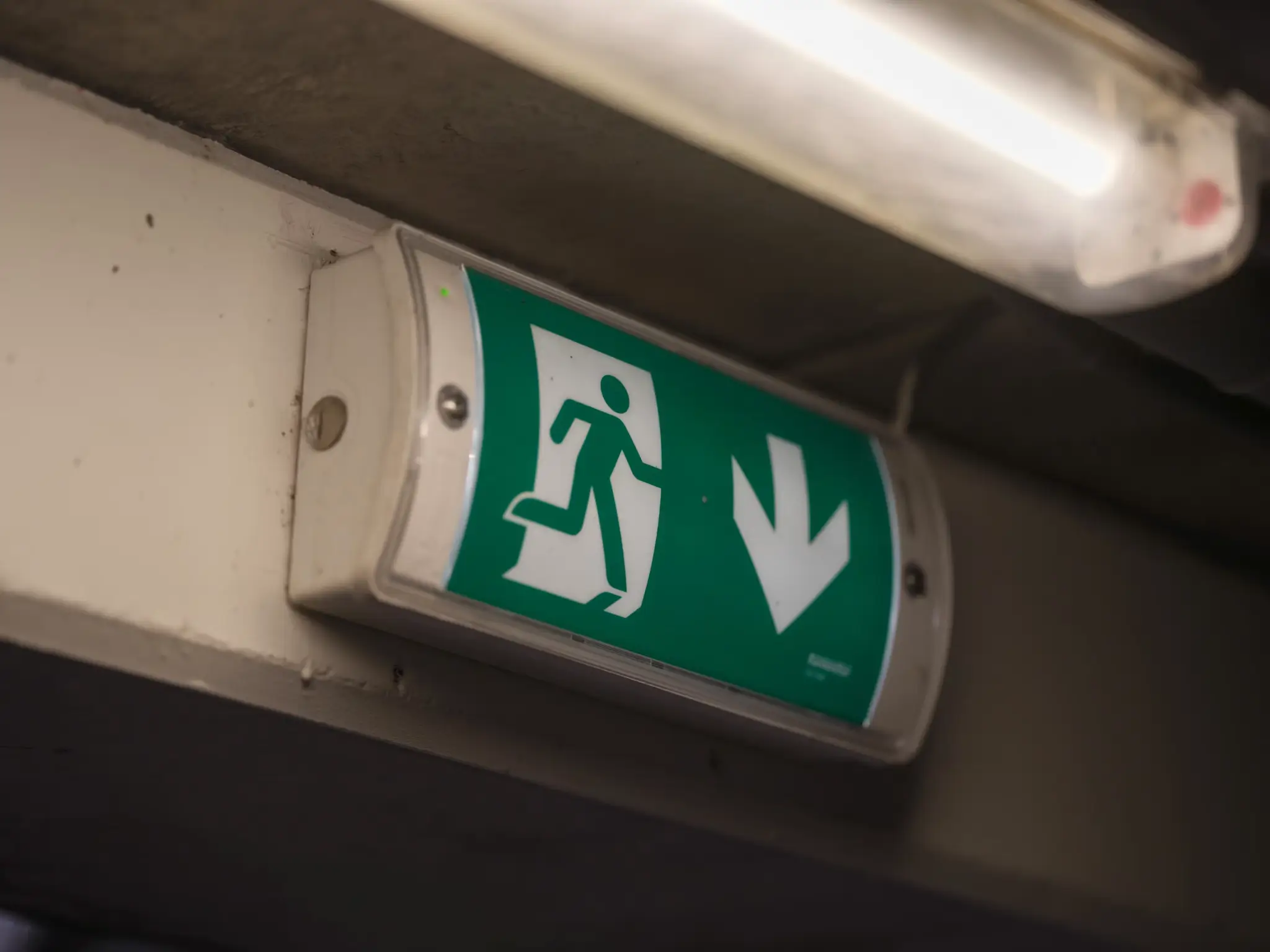
If you own or manage a commercial building in Brisbane, or you sit on a body corporate for a block of units, the emergency and exit lighting is yours to keep tested. AS/NZS 2293 is the standard that governs it. The rule itself is short: test every six months, and every fitting has to stay lit for at least 90 minutes on battery after the mains are cut.
Then you log it. A missing record counts against you the same as a missed test, which is what catches people out at audit time. Let the schedule lapse altogether, and you are looking at lost certification and a hard conversation with your insurer.
Most of what follows is the detail that one rule leaves out, because a battery test is only part of it, and how your system was wired decides how the test actually gets done.
How often does emergency lighting need to be tested?
Six months is the interval, and it does not flex. The maintenance half of the standard, AS/NZS 2293.2, calls for a full discharge test twice a year on every self-contained exit sign and emergency luminaire. A discharge test is what it sounds like. The fitting runs on its own battery, mains off, for the full 90 minutes, and someone confirms it stays bright the whole way.
Why 90 minutes? The figure assumes the worst case. Power fails partway through an evacuation, the building is dark, and the battery in the fitting is well into its life rather than the fresh one a lab tested for approval. An older battery gives less light. Ninety minutes proves there is still enough of it to get people out.
What the emergency lighting standards actually cover
People say “the standard” as if there is one. There are three. AS/NZS 2293 splits into parts, and the reason that matters to you is that a contractor or certifier will quote part numbers and expect you to keep up.
Part 1 handles the design and commissioning of new systems. It is the one referenced in the National Construction Code 2022, so it governs fitouts and anything going up. Part 3 sits at the manufacturing end and decides whether a product can be sold as compliant at all. Neither is the part you think about twice a year.
Part 2 is. It covers inspection, testing and maintenance, and it sits behind every six-monthly service invoice and every line in your log book. If you remember one number, remember 2293.2.
The exit lighting Australian standard and the emergency lighting standard are not two separate documents, as the search results made it look that way. AS/NZS 2293 covers exit signs and emergency luminaires together. Search emergency lighting standards Australia, and you land on the same clause set, whichever phrase you started with.
Who can test emergency lighting in Queensland?
You need a licensed electrician, and in Queensland, that means a current electrical work licence under the Electrical Safety Act 2002. The reason is not bureaucratic. Testing means isolating live circuits and sensing the supply feeding the test facility, then working out what failed when something does. The Electrical Safety Office treats that as electrical work, full stop, so a building manager or maintenance officer cannot sign it off themselves, no matter how handy they are.
The licence is the legal floor, not the whole story. A good tester isolates the emergency lighting without dropping the rest of the building, can read a charge indicator for what it actually means, and tell a flat battery from a dead charger at a glance. Get that last call wrong, and you are paying to bin fittings that needed a ten-dollar part. That gap is most of why unlicensed electrical work costs far more in the long run than the invoice you were trying to avoid.
Emergency lighting sits alongside safety switches as part of a building’s core electrical safety obligations, and the two are worth reviewing together if your building has not had a full check in some time.
The three ways an emergency lighting system gets tested
Emergency lighting systems fall into three testing approaches, and which one you have comes down to how the building was wired. They run from cheap fittings that cost you in labour every service, through to gear that costs more upfront and then asks almost nothing of you.
Manual testing and the test switch
With manual testing, someone has to physically do the whole thing. The electrician kills the emergency lighting circuit and leaves it dead for 90 minutes, then walks the building checking every fitting is still alight. Cutting power to a whole site for an hour and a half is obviously a problem, so most boards built for this carry an emergency light test switch. Some people call it a test timer. It isolates just the emergency lighting circuit and leaves the rest of the building running.
If you are upgrading a switchboard, name the emergency lighting test switch when you brief your electrician. If you are not sure whether your board is due for attention, these warning signs are worth a look. The test switch is a cheap bit of gear that decides whether your six-monthly test is a controlled job or a building-wide blackout.
The weakness of manual testing is that it leans entirely on a person being in the right spot at the right time. You cannot stand in front of every fitting at the 90-minute mark across a large site. Some get checked at 80 minutes, some at 100, and the record ends up approximate. That is where manual results drift from the truth.
Self-testing luminaires
Self-testing fittings do the discharge test on themselves. On the six-month schedule, each unit runs its own test, checking the lamp and the battery and its control gear, and flags the result with a coloured LED. Nobody has to trigger it, and nobody waits out the 90 minutes. A technician still walks the site, but only to read the LEDs and write them down, which on a mid-sized building turns a long afternoon into a short one.
Monitored systems
Monitored systems are the top of the range. The fittings are networked to a central controller that runs the tests on schedule and watches battery and lamp health in real time. When you need a compliance report, it is already written, and you pull it up remotely. No hand-keyed logs, no transcription errors. On a large site or a group of buildings, the labour saving is the whole argument.
One thing to settle before you sign: open protocol or proprietary. A proprietary system ties you to one manufacturer’s hardware for the life of the install. If their prices climb or they retire the product line, you have very little room to move.
| Method | Ongoing labour | What you get | Upfront cost |
| Manual | High. Trigger the test, wait 90 minutes, and inspect every fitting | Physical inspection only | Lowest |
| Self-testing | Medium. Test runs itself, but each indicator is read and logged | LED fault indication per fitting | Low to medium |
| Monitored | Low. Testing and reporting are both automatic | Historical diagnostics, remote reports | Medium to high |
Why a new battery often will not fix a dead fitting
Here is the part nobody explains to building owners. When an emergency light fails its duration test, the obvious move is a new battery. Often, that is the wrong move. The fault can sit in the power converter, the component that takes mains power and keeps the battery charged. Fit a fresh battery, and the light might work for a day on the charge it arrived with, then die again, because the converter never refills it.
Once you have ruled the battery out and the converter is the culprit, the sensible move is usually to swap the whole self-contained unit rather than nurse the converter along. The unit is not expensive. The repeat visits chasing a part that keeps dying are. That is the maths most building managers never get walked through, and it is the difference between a fitting fixed once and a fitting on the books every service.
So a proper emergency lighting check is a diagnosis, not a parts swap. Anyone can drop in a battery and tick the sheet. Knowing whether the battery was ever the problem is the part you pay a licensed electrician for.
Damage is simpler. Any visible crack or break in the housing or diffuser fails the fitting on the spot, working light or not. The diffuser shapes where the light falls, and a cracked one throws it somewhere useless. Lit or unlit, it comes off the wall.
Is emergency light testing the same as test and tag?
No, and the two get confused all the time. Test and tag is for portable gear you can unplug, the leads, kettles and power tools, under AS/NZS 3760. Emergency light testing is for the fixed exit signs and luminaires wired into the building, under AS/NZS 2293. They are separate jobs against separate standards, with separate records. A test and tag round does nothing for your emergency lighting, and an emergency lighting service does nothing for your appliances. One contractor can do both, but make sure both actually appear on the invoice.
What your emergency lighting records have to show
A test you cannot prove may as well not have happened, as far as an auditor goes. AS/NZS 2293.2 says the results go in a log book, paper or digital, and in Queensland, you hold those records for at least seven years. Anyone with a reason to check, a certifier, an insurer, or a fire safety auditor can ask to see them, and a gap in the log reads as a gap in the testing.
Each service entry needs to show:
- the date, and who did the work, with their licence
- every fitting tested and its result, including how long it actually held its charge
- any defect found and what was done about it, whether that was a new battery or a full unit
- a comparison against the baseline data from when the system was commissioned, where you have it
If your records are a shoebox of service dockets, fix that before the next audit rather than during it. A proper log that ties each result to a specific fitting is the difference between a stack of paper and actual light test compliance.
Emergency exit light installation in Brisbane
New fitout in Fortitude Valley or a retrofit in an older Brisbane building, where ageing electrical infrastructure can quietly compound compliance problems, emergency exit light installation starts at the design stage and follows AS/NZS 2293.1. Exit signs go above exit doors, over stairs, and anywhere the egress path changes direction, so people never lose sight of the way out. The emergency luminaires get spaced along those paths off the standard’s spacing tables, and ceiling height and floor layout decide how many you need.
Get the design right at install, and commissioning is straightforward, and the six-monthly emergency lighting maintenance that follows stays simple for the life of the building. Skimp on it and you pay later, in failed inspections and rework.
Dawson Electric handles emergency and exit light testing across commercial and strata buildings in Brisbane, along with fault diagnosis and new installation, with records you can hand straight to a certifier. Get in touch to book a test or get a per-fitting quote.
Frequently asked questions
A licensed electrician. Isolating live circuits and reading why a fitting failed is electrical work under the Electrical Safety at Work Act 2002, which rules out facilities staff or a handy caretaker doing it themselves. The licence is the line, legally.
It depends on fitting count and method, so be wary of anyone quoting a flat rate sight unseen. Expect a call-out fee plus a price per fitting. Ten fittings in a small office is a quick job. A six-storey strata block with self-testing luminaires on every level is not. Ask for the per-fitting rate, and you can actually compare quotes.
Mostly, you cannot, just by looking. The charge indicator on each fitting only tells you that mains power is reaching it and topping up the battery. Whether that battery holds for the full 90 minutes is a separate question, and the only way to answer it is a discharge test with the result written down.
No, and plenty of buildings get billed as if they were. Test and tag is for portable gear you can unplug, under AS/NZS 3760. Exit light testing and emergency light testing both cover the fixed exit signs and luminaires wired into the building, under AS/NZS 2293. Booking one does nothing for the other, so check that both are on the invoice.
