

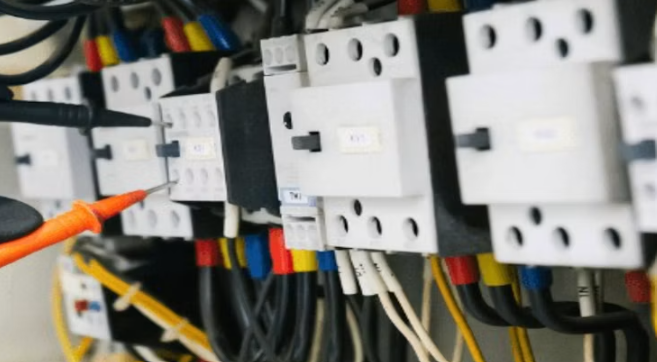
An air conditioner tripping circuit breaker protection is drawing more current than the circuit is rated to carry, and the breaker is doing its job. The timing tells you the cause. Trips the instant you reset it, trips the moment the compressor kicks in, or trips after twenty minutes of running: three different faults, and two different trades.
Most people ring us after the fourth or fifth reset. By then the useful information has been thrown away, because the pattern of when the aircon trips circuit breaker protection is most of the diagnosis. Watch it once properly, and you’ll know who to call.
Aircon trips circuit breaker: what the timing tells you
Nobody writes this down, which is why the average “5 reasons your AC trips” article is close to useless. Reset the breaker once, with the aircon switched on at the wall, and watch the clock.
Trips immediately, before anything runs
Dead short or a fault to earth somewhere in the circuit or the unit. Nothing is drawing load yet, so nothing about the compressor explains it. Stop resetting. This one is an electrician today.
Trips at the exact moment the compressor starts
Inrush. A compressor motor pulls several times its running current in the first second or two of starting, commonly four to six times, and anything that stretches that window out will push a healthy breaker past its curve. Failed run capacitor, pitted contactor, or a compressor with internals starting to bind.
Trips after it has been running a while
Thermal. Heat is building somewhere it shouldn’t. Could be a loose terminal at the breaker itself. Could be a filthy condenser lifting head pressure until the compressor draws more amps than it was designed to. Could be a compressor at the end of its life.
That third one is where the money hides, and it’s the one homeowners misread most often, because a unit that runs for twenty minutes feels like a unit that works.
Air conditioner breaker tripped and won’t reset. What then?
Leave it off.
A breaker that refuses to hold has found something. There’s a story that goes around the trade about a bloke who kept resetting a tripping aircon circuit through a hot week, and the last time he did it there was a flash outside and part of his cladding came off the wall. Shorted isolator at the outdoor unit. The breaker had been telling him for days.
Resetting a breaker is free and takes two seconds, which is precisely the problem. It feels like a solution. What you’re doing is asking a protective device to keep re-energising a fault, and the fault is not going to get better while you do it.
If it won’t reset with everything switched off at the wall, the fault is live in the wiring or in the unit, and it needs someone with a licence and a meter.
Why does my air conditioner keep tripping the breaker when nothing has changed?
Things did change. Capacitors dry out, contacts pit, coils foul, terminals relax. None of it announces itself.
The single most common culprit, by a wide margin, is the run capacitor in the outdoor unit. A capacitor gives the compressor motor the phase shift it needs to start cleanly. When it weakens, the motor can’t get moving properly, so it sits there pulling locked-rotor current for far longer than the breaker’s curve allows. Techs sell these by the box during a Brisbane heatwave. The part is small and cheap.
Which is where the internet gets people into trouble. Half the forums call it a five-minute job. The other half point out, correctly, that a capacitor stores a charge that will put you on the ground even with the power isolated. Both are true, and in Queensland both are beside the point: work inside the outdoor unit is electrical work under the Electrical Safety Act 2002, and doing it yourself is unlicensed electrical work regardless of how confident you are or how many videos you’ve watched. Your insurer will take the same view after a fire.
AC keeps tripping breaker only on the hottest days
Look at the condenser before you look at anything electrical.
The outdoor coil rejects heat. When it’s packed with lawn clippings, lint and Brisbane’s summer dust, it can’t, so head pressure climbs, and the compressor pulls more current to do the same work. On a 24 degree day it copes. On a 38 degree day it doesn’t, and the breaker trips at four in the afternoon and holds fine by seven.
The same story runs from the other end. Blocked filters, a frozen evaporator, refrigerant lines icing up, the motor grinding away against a restriction it can’t clear. Check your indoor filters. That part you’re allowed to do, and it’s the cheapest thing on this page.
The warm switchboard nobody mentions
Put your hand near the board. If the area around the aircon breaker feels warm compared to the rest, that’s worth saying out loud when you ring.
A breaker running hot trips below its rated current. A loose terminal generates heat, the heat lowers the trip threshold, and the whole thing presents exactly like an overload even though the circuit is fine. We’ve re-torqued connections on older Brisbane boards and had the problem disappear, no parts, no aircon tech.
There’s a rough test electricians use for this. Swap the aircon breaker with an identically rated one from another circuit. If the fault follows the breaker to the new circuit, the breaker is finished. If it stays with the aircon, the breaker was never the issue. Not a DIY job, but it tells you what a sparky is going to do in the first ten minutes.
Should I call an electrician or an air conditioning technician?
There’s a test that settles this, and it beats arguing about it.
Switch the breaker off. Go to the outdoor unit, open the isolator and pull the disconnect so the condenser is cut off from the circuit entirely. Now reset the breaker.
Holds? The fault is inside the air conditioner. Refrigeration tech.
Trips again with the unit disconnected? The fault is in the circuit, the cable or the board. Electrician.
Worth acknowledging the other side, because a good air conditioning tech will make this argument: most refrigeration mechanics carry enough electrical knowledge to triage a tripping circuit, while plenty of electricians can’t tell you anything useful about the refrigerant side. Fair. The isolation test just means you don’t pay someone to find out they’re the wrong trade. On a split system you often end up needing both anyway, which is the same split that governs who is legally allowed to install the unit in the first place.
Do not let anyone put a bigger breaker in
This is the one thing every electrician agrees on, and the one thing homeowners are most often talked into.
Breakers protect the cable, not the appliance. A 16 amp breaker on that circuit means the cable behind your wall is rated for roughly that much current and no more. Swapping it for a 20 amp breaker doesn’t fix a compressor that’s overdrawing. It removes the thing that was stopping the cable from carrying current it was never sized for, and the fault carries on quietly until the insulation gives up inside a wall cavity or the breaker itself cooks into the busbar and takes the board with it.
Going from a C16 to a C20 because the aircon keeps tripping is a lazy fix. Kicking the can down the road, as one sparky put it, except the can is a fire.
The correct first move, if the breaker is genuinely suspect, is a like-for-like replacement. Same rating, same curve. That way you’re testing the breaker and not quietly redesigning the circuit. If the circuit truly is undersized for the load, the fix is the cable and the switchboard, not a bigger number stamped on the front of a breaker.
One exception people confuse with upsizing: a Type C curve breaker is designed to tolerate motor inrush where a Type B isn’t. Changing curve type at the same amp rating is a legitimate call for an electrician to make. Changing the amp rating is not.
If your air conditioner is tripping the circuit breaker and you’ve worked out it’s the circuit rather than the unit, our licensed electricians will find the fault properly instead of handing you a bigger breaker. Fixed pricing, free quotes, and we clean up after ourselves. Talk to the team at Dawson Electric or call 07 3324 1447. We service every Brisbane suburb, Monday to Friday.
Frequently Asked Questions
No. An occasional trip is an early trip, and the fault behind it gets worse in one direction only.
The breaker isn't. Whatever is causing it might be. The device is doing exactly what AS/NZS 3000 requires it to do, and the risk sits in the fault it's protecting you from, especially if that fault is a loose connection generating heat inside a switchboard or an isolator that's been letting water in.
Different device, different fault. An RCD or RCBO trips on leakage to earth, usually moisture in the outdoor unit, a degraded compressor winding, or damaged cable insulation. A breaker trips on current. If it's your safety switch going, that narrows the search considerably and it's still licensed work.
Depends entirely on which of the three timing patterns you have. A fouled condenser and a failed capacitor sit at opposite ends of the scale from a compressor replacement or a new circuit run from the board. Get the diagnosis before you get quotes, or you'll be comparing prices for different jobs.
