

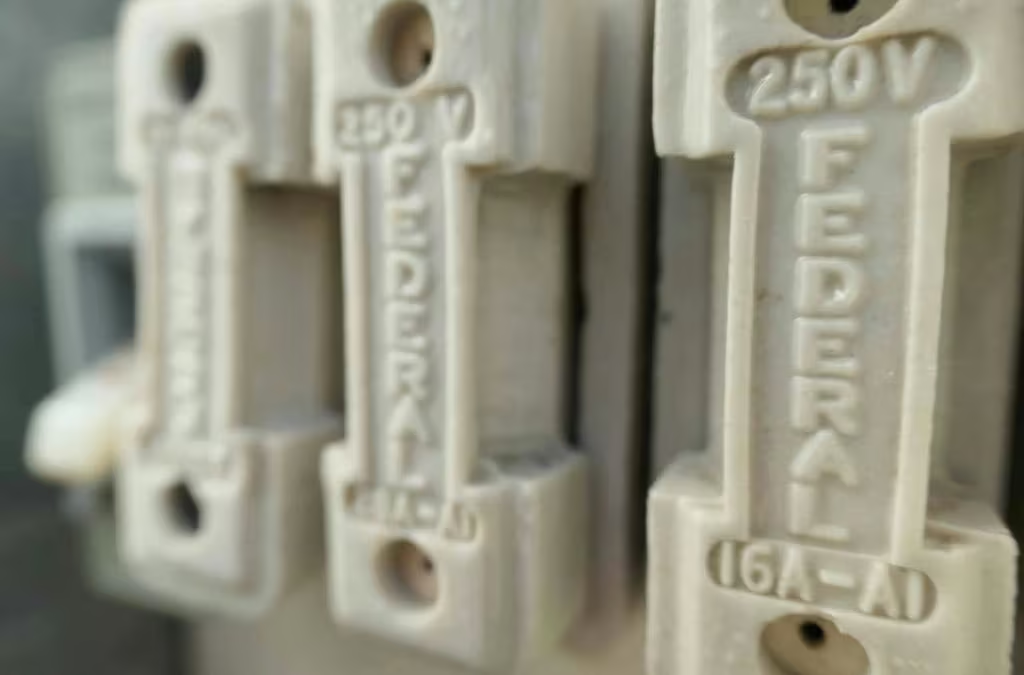
Ceramic fuses are still legal in Queensland when the board was compliant at installation and remains in sound condition. No law forces their removal on age alone. They have to go when new electrical work touches the board, because rewirable fuses can’t be installed in new work and an electrician can’t certify the job around them.
Ceramic fuses in Brisbane turn up most often in older Brisbane homes, Queenslanders and post-war brick in particular, where a renovation stopped short of the switchboard. Some of those boards have been working quietly for decades. Whether yours can keep going depends on what’s been done to it in that time.
Are ceramic fuses illegal?
No. A fuse board that met the rules when it went in, and hasn’t been damaged or tampered with since, can stay where it is. Nobody is coming to pull it out.
Condition is where the legal question turns. Cracked or scorched carriers, loose bases and wire of the wrong rating all take a board out of sound condition. The last of those is the fault we find most.
A board can also be obsolete without being unsafe. Obsolete is still a fair reason to plan the upgrade, so it happens on your schedule, with time to get a quote and pick a date.
Why are ceramic fuses dangerous?
They make over-fusing easy, and they do nothing to stop an electric shock.
Most of why ceramic fuses are dangerous comes down to fuse wire. Anyone with a card of it from the hardware shop can change how much current a circuit is allowed to carry. A fuse that kept blowing gets “fixed” with heavier wire. The fuse holds, and the cable behind it is now protected at a rating it was never sized for. Nothing on the board shows the change.
The protection is only as good as the last person who rewired it.
Shock is the second gap. A fuse is there for the cable. It melts when the circuit draws more current than the wiring is rated to carry for any length of time. A current far too small to blow a fuse can still injure someone.
Shock protection needs a safety switch, or RCD, which compares the current going out on the active with what returns on the neutral. Any mismatch means some of it is leaking to earth. The RCD then cuts the supply within a fraction of a second.
None of us at Dawson would live in a house without safety switches on power and lights.
Here’s where fuses and circuit breakers sit next to a safety switch:
Ceramic fuse | Circuit breaker | Safety switch (RCD) | |
Protects | The cable, from overload and short circuit | The cable from overload and short circuit | People, from electric shock |
After it operates | Rewired by hand | Switch flicked back on | Reset once the fault is found |
Allowed in new work | No | Yes | Required on domestic circuits under AS/NZS 3000:2018 |
Modern boards use RCBOs, a breaker and RCD built into one device, fitted one per circuit. When a kettle lead faults, only the kitchen power goes off.
When does a ceramic fuse box have to be replaced?
When you add a circuit. Rewirable fuses can’t be installed in new work, so a new EV charger circuit has nowhere compliant to connect on a fuse board. Induction cooktops and heat pumps hit the same problem.
Under AS/NZS 3000:2018, a new domestic circuit needs a circuit breaker and RCD protection. Whoever connects it signs off that it complies. We won’t sign for a circuit fed from rewirable fuses, which is why a job quoted as one new circuit turns into a switchboard upgrade once the board is open.
A blown ceramic fuse on an existing installation is a smaller decision. Replacing the fuse wire may be permitted there. We’d rather not put our name to that repair.
Meter changes can bring the date forward. Older Brisbane boards were commonly mounted on asbestos backing panels, and a metering provider won’t drill or modify one to fit a new meter, so the visit can end with an Energex defect notice. When that comes up mid-job, the upgrade happens anyway, on someone else’s timing.
Is a plug-in circuit breaker a safe upgrade?
Only partly. A plug-in circuit breaker swaps the wire in a fuse carrier for a resettable switch, and that’s the whole change. The board still has no shock protection, and the wiring behind the bases is exactly as old as it was.
When one trips over and over, treat it like any circuit breaker that keeps tripping. The breaker is doing its job, and the fault sits somewhere on the circuit it protects.
Some owners ask us to bolt a safety switch onto the fuse board instead. We see that as a false economy. The labour comes close to a proper upgrade, and you finish the job with the same fuses you started with.
How to tell if a ceramic fuse is blown
Turn the main switch off first. Then pull the carrier for the dead circuit straight out of its base.
A blown fuse is broken somewhere between the two screw terminals, sometimes by a gap small enough to miss in poor light. Bad ones blacken the inside of the ceramic fuse holder.
A cracked carrier stays out of the board until an electrician has seen it.
Plenty of people only ever see their fuse board by torchlight, during a storm, holding a card of fuse wire and guessing at the rating. A modern board replaces that with a switch you flick back on, and leaves room for surge protection ahead of storm season.
Do ceramic fuses have to be replaced in a rental property?
The fuses can stay. Every power point circuit in a Queensland rental must have a safety switch, though, and that obligation sits with the property owner.
The Residential Tenancies Authority sets out the rule for owners and tenants. The Electrical Safety Office goes further and recommends RCD protection on every circuit. We agree with the ESO: landlords should fit safety switches to lighting as well as power, whether or not the law forces it.
Fuses are rarely the cause of “power troubles” in a rental. When a tenant reports the power dropping out, find out what’s tripping and why.
On a fuse board with a retrofitted RCD, the answer is often a safety switch that keeps tripping because of a faulty appliance or water in an outdoor circuit.
Should an old house fuse box stop you buying a property?
A fuse board shouldn’t put you off a house you otherwise like. A board upgrade is a contained job with a clear scope. A house rewire is a different scale of cost, and the fuse board on its own doesn’t tell you which one you’re facing.
The cable does. Old rubber-insulated or cotton-braided cable is on borrowed time; decades of Queensland roof-space heat leave the insulation brittle, and it cracks when disturbed. TPS (flat PVC-sheathed cable) in good condition usually isn’t a concern.
Nobody can tell you from a photo. Someone has to open the board and look behind it.
Make your offer subject to an electrical inspection, the same as building and pest. If the inspection finds sound TPS, budget for a fuse box replacement and move on. Queensland sale paperwork also has to state whether an approved safety switch is installed, which tells you something before anyone opens the board.
For a house you’ve already bought, book the upgrade in the first few months. Nothing about the job gets easier by waiting.
What does ceramic fuse replacement involve?
Ceramic fuse replacement means a new switchboard. The old bases come out, and a new enclosure goes in with RCBO protection on each circuit, plus space for surge protection and future circuits.
Every circuit is tested as it’s connected. Replacing ceramic fuses with circuit breakers can expose faults the old board ran with for years, because an RCD picks up leakage a fuse never measured. A circuit that trips on day one had that fault long before the new board arrived.
The number of circuits sets most of the price. An asbestos meter panel adds to it, and so does any circuit that fails testing once the board is open. We quote a fixed price before work starts.
Book a fuse board inspection in Brisbane
If your home still runs on ceramic fuses, our electricians can inspect the board and give you a straight answer on whether it can stay. Dylan and Kristine Dawson have run the business from Woolloongabba since 2007, every one of our electricians is fully licensed, and every quote is a fixed price. Call 07 3324 1447 or book an inspection online.
Frequently Asked Questions
No. A rental can keep its fuses, provided every power point circuit has a safety switch.
Either the circuit is overloaded or something on it is faulty. Older homes have very few circuits, so a heater and a kettle on the same one can be enough. If it keeps going after the load has been cut back, there's a fault, and it needs tracing before the fuse is rewired.
We'd plan it now, so a new appliance doesn't set the date for you. The board comes up again when you sell. A buyer's electrical inspector will list old ceramic fuses in the report, and from there it becomes a line item in the negotiation.
Almost always. A home EV charger needs a dedicated circuit with RCD protection, and a fuse board can't provide that. Your electrician will also check whether the supply can carry the extra load, which matters most in older homes on single-phase power.
The ceramic carriers and bases crack and loosen with age, and the wiring behind them sets the limit for the whole board. A board in sound condition can keep going for decades.
For a standard Brisbane house, the power is off for part of a day. An asbestos panel or meter change adds time.
