

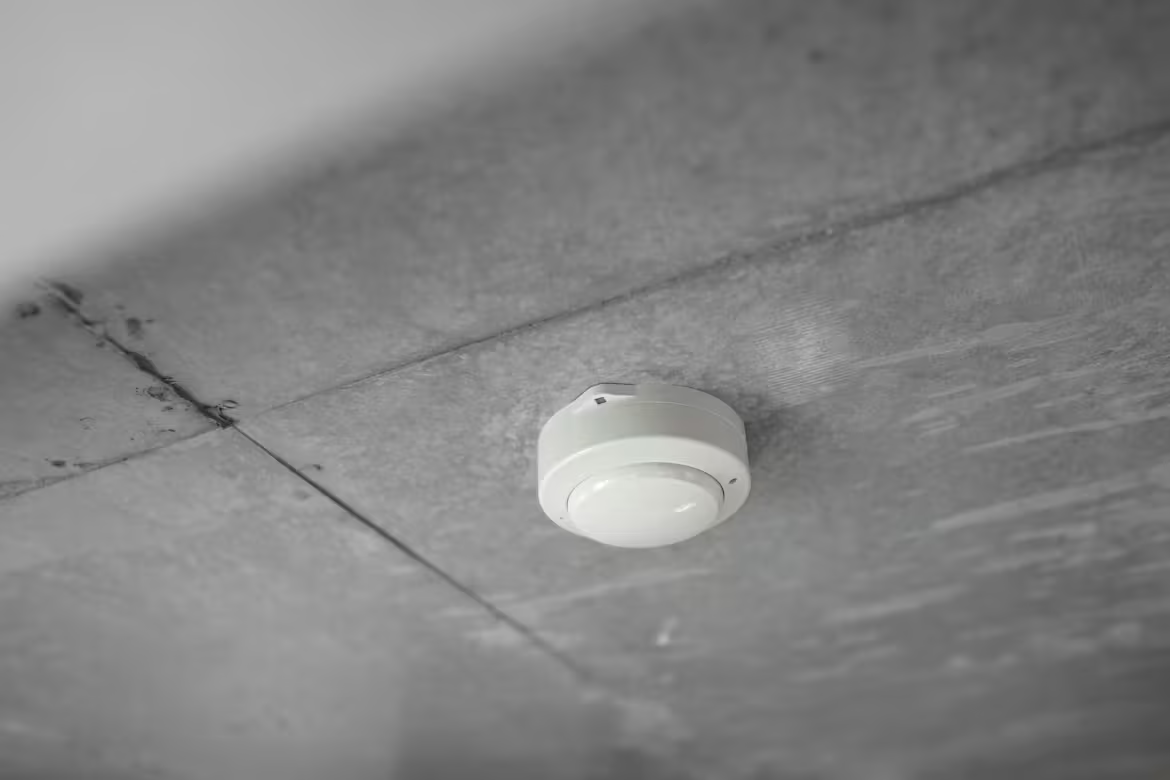
Hardwired smoke alarms are the better choice in any home where cable can reach the ceiling. Mains power runs the alarm. The backup battery covers outages and little else, so it lasts. A 10-year battery smoke alarm suits the ceilings cable can’t reach. Queensland law accepts either, as long as every alarm in the house is interconnected.
From 1 January 2027, interconnected smoke alarms are compulsory in every Queensland home, owner-occupied ones included. Rental properties and homes being sold have had to comply since 2022, so for most Brisbane owner-occupiers the deadline is now under three months away.
Do smoke alarms have to be hardwired in QLD?
No. Queensland accepts hardwired alarms or alarms powered by a non-removable 10-year battery. Homes with existing hardwired smoke alarms are the exception: when those need replacing, the new ones must be hardwired as well.
We get asked fairly often whether a 240V smoke alarm can be capped off and swapped for a battery unit. In Queensland it can’t. It would make little sense anyway, with live cable already sitting in the ceiling ready to use.
Every other part of the Queensland smoke alarm legislation applies whichever power source you choose. Each alarm must be:
- photoelectric, to AS 3786-2014
- under 10 years from its manufacture date
- interconnected with every other alarm in the house
- placed in each bedroom and the hallway outside them, with at least one on every storey
Plenty of older homes still have ionisation alarms on the ceiling. Those come down under the 2027 rules. A smouldering mattress can fill a bedroom with smoke well before there’s a flame, and ionisation sensors are slow to react to that kind of smoke. Queensland made the photoelectric smoke alarm the standard in 2017 for that reason.
Why does interconnection matter more than the power source?
An alarm is only useful if someone hears it. A fire in the kitchen at 2 am does you little good if the only alarm sounding is behind two closed doors.
Interconnected smoke alarms solve that. When one detects smoke, every alarm in the house goes off with it, whether the link runs through cable in the ceiling or over a wireless signal. Hardwired and battery systems perform equally here, and Queensland allows a mix of the two in one house provided they’re all linked.
Two-storey homes are where this counts most, with the kitchen downstairs and everyone asleep up top.
How do hardwired and 10-year battery alarms compare?
On paper, both types last ten years. Hardwired smoke alarms reach that mark more often.
Hardwired (240V) | 10-year battery | |
Power | Mains, with a backup battery | One sealed lithium cell |
Installation | Licensed electrician only | No wiring needed |
Interconnection | Wired or wireless | Wireless |
Battery fails early | Alarm keeps running on mains | Whole alarm is replaced |
Best suited to | Homes with roof access or existing cable | Raked ceilings, slab between storeys, no roof access |
Legal life | 10 years from manufacture | 10 years from manufacture |
The “10-year” on the box describes how long the battery is designed to last. We’ve pulled down plenty of sealed units that started beeping on a low battery at two or three years old. With no way to replace the battery, each of those went straight in the bin.
A hardwired alarm’s backup has an easier life. Mains carries the load every day, so the battery sits idle most of the time and usually goes the distance. Depending on the model, the backup is either a replaceable 9V or a sealed lithium cell. On high ceilings, we’d choose the sealed version every time, because it pays for itself the first time nobody has to drag out an extension ladder to change a 9V.
When is a 10-year battery smoke alarm the right choice?
When there’s no practical way to get cable to the ceiling.
No roof space access is the usual reason. Raked ceilings come next, common in renovated Queenslanders and newer extensions. Townhouses with a concrete slab between storeys have no cavity above the downstairs ceiling at all.
For those homes, we fit wireless interconnected smoke alarms, each one a 10-year lithium battery smoke alarm with the radio link built in. We won’t cut up a finished ceiling to run cable when a wireless link does the same job.
A look in the roof space settles the question for most homes, which is why we check it before quoting any smoke alarm installation.
Do hardwired alarms cause more false alarms than battery ones?
No. False alarms come down to the model and where it’s mounted.
Dust in the sensing chamber sets off a lot of them, along with the odd insect that crawls inside. The other big cause is steam. We regularly find alarms fitted close enough to a bathroom door that a hot shower sets off the whole house. Kitchens manage the same with burnt toast. Shift the alarm a metre or so down the hall. Queensland’s placement guidance keeps alarms at least 300mm from a light fitting. Air-con vents and fan blades need 400mm.
Vacuum the vents a few times a year.
Model quality counts for a lot here. A cheap alarm that keeps false-triggering ends up pulled off the ceiling. Then that room has no alarm at all.
When the whole house is sounding, look for the unit with the flashing indicator. That’s the one that triggered. On most systems, it’s also the only unit whose hush button works.
Test every alarm monthly with the button. A 10-year lithium battery smoke alarm that never chirps also never reminds you it’s there. Ten quiet years prove nothing.
Should a smoke alarm go in the garage?
We’d leave it out. Car exhaust and heat both set smoke alarms off, and a closed-up Brisbane garage in January gets hot enough to do it without any help. A heat alarm suits the space. It reacts to heat and ignores exhaust. Several brands make heat alarms that join the same interconnected system as the smoke alarms.
How long do smoke alarms last?
Ten years from the manufacture date printed on the back, hardwired or battery. An alarm that fails its test before then has to be replaced straight away.
Check the back of a new alarm before it goes up. Stock sometimes sits on a shelf for a year or more first.
A set that went up together wears out together. We do smoke alarm replacement for the whole house in one visit. Two brands on one interconnect circuit often won’t link at all, and even two generations from the same maker can refuse to talk to each other.
Smoke alarm replacement goes quickest when the brand stays the same, since the new alarm often plugs straight onto the existing base. We’d keep the brand unless it’s been giving trouble.
What’s the cost to install hardwired smoke alarms?
Most of the bill for a single alarm is getting an electrician to your door. When we do the whole house in one visit, that cost spreads across every alarm, and the price per alarm drops a long way.
The price gap between a hardwired alarm and a 10-year battery smoke alarm is small. Over ten years, it comes to loose change per alarm, per year.
What shapes the quote is the house. Roof access matters most, because it decides how long the cable runs take. After that, it depends on how many alarms the layout needs and whether the brand already on the ceiling can be matched. We quote a fixed price before any work starts, and that’s what you pay.
Smoke alarms from a Brisbane family business
Dylan and Kristine Dawson opened Dawson Electric on 18 July 2007, which also happens to be their first child’s birthday. They still run it from Woolloongabba. Whoever we send to your door is a fully licensed electrician. Our on-time arrival is guaranteed, and every van carries a Dyson so the house is left cleaner than we found it. We’re proud of the 300-plus five-star Google reviews that came from jobs like these.
If you’re weighing up hardwired against battery for your own home, we’ll check the roof space first and give you a fixed price for the whole smoke alarm installation. Call 07 3324 1447 or contact our team. We cover all of Brisbane from Woolloongabba, Monday to Friday, 7 am to 4 pm.
Hardwired and battery smoke alarm FAQs
Queensland requires one in every bedroom and one in the hallway joining those bedrooms to the rest of the house. A lowset three-bedroom home with a single hallway needs four. Each extra storey adds at least one more, even without bedrooms on it.
One chirp roughly every minute is the low-battery warning. Plenty of hardwired units take a 9V backup. Swap it and hold down the test button until the chirping stops. A unit with a sealed backup, or one close to its 10-year date, needs replacing outright. A full, continuous alarm is a different matter: something has triggered it, so find the unit with the flashing light.
Yes. Every one carries a backup battery to keep it working through a blackout.
Only with an electrical licence. A 240V smoke alarm connects to fixed wiring, and in Queensland that's licensed electrical work.
Plenty of homes end up with exactly that: hardwired alarms where the cable already runs and wireless units where it can't. They all need to link, which means staying within one brand's range throughout. One manufacturer's wireless signal won't talk to another's.
