

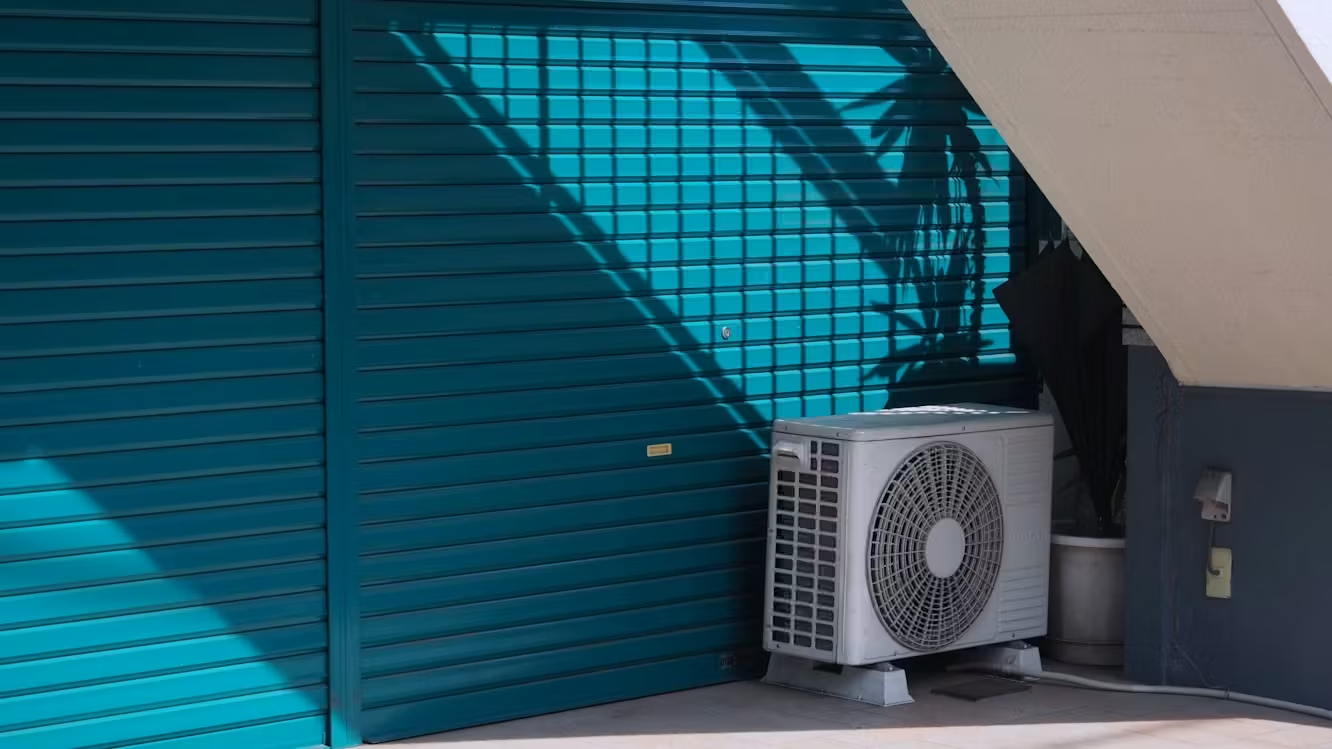
A switchboard upgrade for an air conditioner is rarely optional in an older Brisbane home. The board itself can legally stay as it is. The new air conditioning circuit can’t, because AS/NZS 3000:2018 requires RCD protection on it, and a ceramic fuse board has no way to deliver that. So the board comes off first.
Do I need a switchboard upgrade to install an air conditioner?
Usually, yes. Nothing in Queensland law forces the replacement of a compliant switchboard. The trigger is the new work.
An air conditioner circuit is new electrical work, and new electrical work has to meet the current Wiring Rules. Queensland tightened this further under the Electrical Safety and Other Legislation Amendment Regulation 2024. Since 1 January 2025, new and altered residential switchboards need RCDs or RCBOs across power and lighting circuits, which is a level of protection a rewireable fuse board was never built to provide. A ceramic carrier can’t accept one. Nowhere to mount it, nothing to mount it to.
So the electrician arrives to run a single circuit and finds no compliant place to land it.
Among Brisbane sparkies, the shorthand is blunter. Touch the board, bring it up to code. The Electrical Safety Act 2002 reads more carefully than that, though the outcome on the day comes to the same thing.
Why does one circuit trigger a whole board upgrade?
Because you can’t half-upgrade a fuse board.
Rewireable boards were built around porcelain carriers fixed to a solid panel. Modern protection devices clip onto a DIN rail inside an enclosure. Adding one RCBO means a new enclosure, a new busbar, and every existing circuit re-terminated into it. At that point the job has become a switchboard upgrade with an air conditioner attached to the end of it.
Plenty of electricians would tell you the aircon is beside the point. A board full of rewireable fuses is worth dealing with on its own merits, and the air conditioner has only brought the conversation forward by a few years.
What an old switchboard says about the rest of the house
Ceramic fuses date the wiring as much as they date the board.
In Brisbane homes wired before the 1960s, you’ll still find VIR cable, vulcanised India rubber, where the insulation has gone hard and started shedding off the copper. The terminations go first, since that’s where the cable has been flexed and where the heat has been. You often don’t see it until the old board comes off the wall and the tails start crumbling in your hand. Nobody quotes for that, and nobody can quote for it in advance either, because it’s behind a panel until it isn’t.
The supply side deserves the same look. An air conditioner is a high-draw appliance, and the consumer mains feeding a board that age were sized for a stove, a hot water system and a handful of lights. A maximum demand calculation settles it.
Occasionally the constraint sits before the board entirely, out at the point of attachment. One extra circuit pushes the house past what the supply was sized to carry, the work moves onto the network side, and Energex has its own process and its own charges for that. Air conditioning quotes almost never mention it.
While the board is off the wall, the earthing, the mains and the older circuits are all visible for the first time in decades. Worth checking in the same visit rather than paying for the access twice.
The black panel behind the fuses
Meter boxes in pre-1990 Brisbane homes often have an asbestos-composite backing board. Dark brown or black, rough or wood-like surface, sometimes a tar smell to it. Zelemite, Lebah, Miscolite and Ausbestos are the brand names stamped on the back, and Queensland’s asbestos.qld.gov.au lists every one of them.
Removal follows a documented safe work procedure. Non-friable material within scope can be handled by a trained licensed electrician. Anything friable goes to a licensed asbestos removalist, and nobody can tell you which one you have from a photograph.
Does an air conditioner need its own circuit?
A small split system can legally run off an existing power circuit. Whether it should is a different question, and installers genuinely disagree on it.
The manufacturer’s manual usually specifies a dedicated circuit. Run the unit off a shared one and the warranty conversation gets awkward the day the compressor fails.
Our position is to quote a dedicated circuit by default, and the reason has less to do with the wiring than with the paperwork. The failure we see most often is a homeowner who never knew which one they were buying. The quote said a power circuit was being installed. What went in was a spur off the nearest outlet, which is not the same thing, and by the time anyone notices, the wall is closed up. Getting clear on the electrical half of an air conditioner installation before the unit is ordered avoids most of it.
If it does end up on a shared circuit, keep it off the kitchen and the oven.
What to look for in a switchboard upgrade quote
Quotes for the same house vary more than people expect, and scope is why. Circuit count, the enclosure, an asbestos backing panel, the condition of the mains and earthing, and whether Energex has to be involved are the variables that move a switchboard upgrade cost in Brisbane in either direction.
A few things to confirm before you sign:
- A “from” figure is a starting point, not a price. Read what’s excluded.
- Ask what happens if the wiring behind the board turns out to be perished. Every honest answer to that involves a variation, so the question is how it gets priced and who decides.
- Get the Certificate of Testing and Compliance. Under the Electrical Safety Regulation 2013, a Queensland contractor must issue one for electrical installation work and keep a copy for five years. Your insurer and your conveyancer will both ask for it eventually.
- More than one quote. Compare the scope lines, not the totals.
Adding air conditioning is the moment most Brisbane homeowners find out what their switchboard can and can’t carry, and it’s a better moment to find out than the middle of a January heatwave. Our electricians will look at the board, the mains and the circuit you’re planning before anything is ordered, and tell you what the job involves in writing. Talk to us about your switchboard or call 07 3324 1447.
Frequently Asked Questions
Round porcelain fuse holders instead of switches is the obvious one. No test buttons anywhere on the board is the other. Beyond that: circuits that trip when the kettle and microwave run together, a board with no spare ways left, buzzing or a burning smell at the enclosure, scorch marks around a fuse carrier. Any of those on its own is worth a look. Two or three together and the board is telling you something.
Usually not. AC quotes tend to cover the unit and the install and assume the electrical side is straightforward. Ask before you sign.
A licensed electrician trained in the safe work procedure, where the material is non-friable and within scope. Otherwise a licensed asbestos removalist.
No legal deadline applies to an existing installation. Most electricians would still recommend it, on the basis that a fuse can be rewired with the wrong gauge and a blown fuse takes seconds to clear a fault where an RCD takes milliseconds.
