

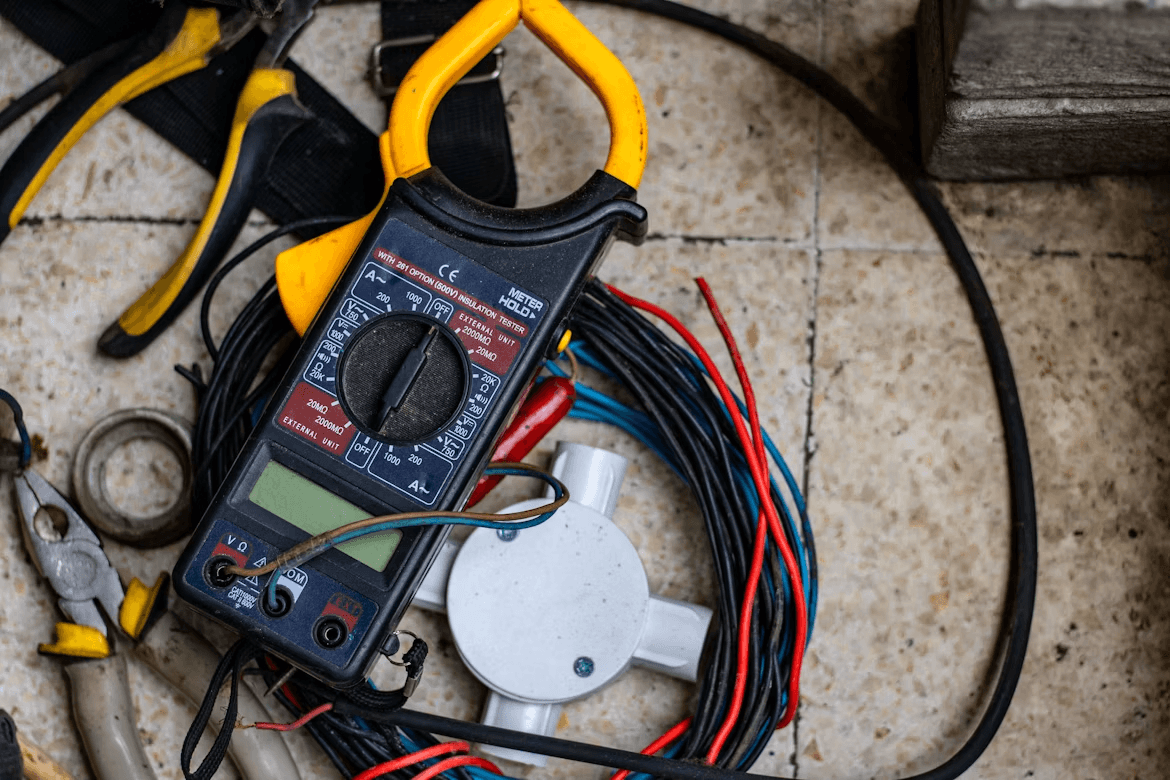
A commercial electrical fit-out is the design, installation, testing and certification of every electrical system in a business premises before it opens for trade. That covers the power distribution, the lighting, the data cabling and the safety systems, all feeding back to a switchboard sized to carry them. In Brisbane, the work moves through five stages and usually takes two to six weeks. It also has to meet AS/NZS 3000, the National Construction Code and Queensland’s electrical safety laws before anyone can sign it off.
That’s the short version.
Most guides stop there, or pad it out with a stage-by-stage walkthrough you could find on any electrician’s website. This one goes further, into the parts that actually trip people up: who’s responsible for what when you’re a tenant, where the money really goes, whether your office needs three-phase power, and why the switchboard is the one item that can quietly derail your whole program.
What’s actually included in a commercial electrical fit-out?
A commercial electrical fit-out covers every system that draws power or carries a signal inside the tenancy. The scope varies with the space, but the core components are consistent.
Power distribution is the backbone: the circuits, sub-mains and outlets that feed everything from workstations to commercial appliances. Commercial lighting and lighting design come next, including general, task and feature lighting, plus the emergency and exit lighting that compliance demands rather than requests. Data cabling and structured cabling run alongside the power, supporting computers, VoIP phones, printers and any server room or comms rack. Then there’s the switchboard, often upgraded or replaced to handle the load, and if you’re unsure whether your board is up to it, the warning signs of an undersized switchboard are worth knowing before design starts. Finally, the security systems, CCTV, access control and alarms that most businesses now treat as standard.
Underneath all of it sits testing and certification. Every circuit gets verified under load before anyone signs off, and the work is documented through to a Certificate of Testing and Compliance. Skip that step, and the space isn’t legally fit for occupation, regardless of how good it looks.
Who pays for what: tenant vs landlord electrical responsibilities
Tenants get caught out here more than on any other part of a commercial fit-out. The split itself is simple enough. The landlord’s side ends at the base building electrical infrastructure, and everything past that point inside the tenancy is yours. The work is on the tenant side. Your lighting layout, your power outlets, the data cabling, the fit-out switchboard feeding all of it: that’s your scope, your cost, and your responsibility to get compliant. The landlord’s part is comparatively small, covering the main switchboard, the supply into the tenancy, and the point where your space connects to the building. Just don’t assume any of this is set by regulation. It’s set by your lease, and two leases on the same floor can draw the line in different places.
That split maps onto two terms you’ll hear from any commercial electrician. A Category A fit-out is the base shell: essential services, basic lighting, a connection point, no customisation. A Category B fit-out is everything tailored to your business on top of it, and that’s the part you’re paying for.
Two things catch tenants out most often. The first is supply capacity. You might sign a lease assuming the existing infrastructure suits your equipment, then find out during design that the base building can’t carry your load, and an upgrade through the building owner costs time and money you hadn’t budgeted. The second is the make-good clause. Most commercial leases want the space returned to its original condition at the end of the term, so the fit-out you pay to install, you can end up paying to strip out.
Worth doing before you sign: read the electrical provisions in the lease, and get a commercial electrician to check the base building capacity during due diligence rather than after the ink’s dry.
What does a commercial electrical fit-out cost in Brisbane?
As a 2026 guide, commercial electrical fit-out costs in Brisbane fall into broad bands by size:
- Small office or retail (under 100 m²): roughly $8,000 to $25,000
- Mid-size commercial (100 to 300 m²): roughly $25,000 to $75,000
- Large commercial or hospitality (300 m² plus): $75,000 and upward
- Industrial or three-phase machinery fit-outs: quoted on scope
Those ranges are easy to find. What no one breaks down is where the money inside them actually goes, so here’s an indicative component split for a typical 200 m² office in the mid band.
Power distribution, meaning the general circuits, modular power, soft wiring and outlets, usually takes the largest share, often $8,000 to $20,000, because it scales directly with the number of workstations and how flexible the layout needs to be. Commercial lighting and lighting design run a close second at around $6,000 to $18,000 once you account for LED fittings, controls and installation. Emergency and exit lighting adds another $2,000 to $6,000, and it’s non-negotiable, a compliance item rather than a design choice. Switchboard upgrades and distribution board works land anywhere from $4,000 to $15,000 depending on whether you’re modifying an existing board or installing a new one, and whether you’re moving to three-phase. Data and structured cabling usually runs $5,000 to $15,000. On larger jobs, a separate cabler handles it, working to the same program as the electrical team. The last line on the quote is testing, certification and the compliance paperwork, somewhere around $1,500 to $4,000.
None of these figures is fixed. A heritage building with no usable existing infrastructure costs more to work in than a recent shell. Build in spare capacity for a fit-out you’ll expand in two years, and the up-front number climbs, though you spend less later. The site and the scope move the total around far more than the per-square-metre rule of thumb most quotes lean on.
So when an electrician hands you a flat per-square-metre figure with none of this itemised, you’re not looking at a simpler quote. You’re looking at one with the assumptions left out.
Single-phase or three-phase: which does your office need?
Most small offices run perfectly well on single-phase power. Once you add a heavy mechanical load, you’re usually looking at three-phase.
Single-phase supply delivers 230 volts and suits domestic-style demand: lighting, general power, computers, a handful of standard appliances. It’s what many older Brisbane commercial tenancies already have. Three-phase supply runs at 400 volts across three conductors. It carries a heavy load far more comfortably than a single-phase, which is why it’s the standard answer for any space pulling serious current. Ducted air conditioning, a server room, EV chargers, machinery with motors in it: once any of those are in the fit-out, three-phase stops being optional and starts being the sensible base you design from.
The decision matters more than it sounds, because changing it mid-project is expensive. Upgrading from single-phase to three-phase isn’t just a switchboard job. It often means a supply upgrade through Energex, the distributor for the Brisbane area, and that process runs on their timeline, not yours. A server room with its own cooling and UPS load, or a commercial kitchen full of three-phase appliances, will almost always justify the upgrade. A standard professional office with split-system air conditioning often won’t.
The right move is to confirm your supply type and load requirements during the site survey, before design locks in. Get it wrong, and you’re either paying to upgrade halfway through or running equipment on a supply that was never sized for it.
Why switchboard lead times can hold up your entire fit-out
Here’s the item that derails more fit-out programs than any other, and it rarely gets a mention: the switchboard. For anything beyond a minor modification, a commercial switchboard is built to order, and that manufacturing lead time can stretch to several weeks.
The problem is sequencing. A fit-out program looks tidy on paper, but the electrical rough-in often can’t be completed, and the space can’t be energised until the new board is installed and connected. If the switchboard is ordered late, every trade behind it waits. Add an Energex supply upgrade, which you’ll need if you’re increasing capacity or moving to three-phase, and you’re now waiting on the distributor’s approval and connection slot as well. [INSERT REAL JOB DETAIL: e.g. a recent Brisbane job where the board lead time or Energex connection delay affected the program, with the actual timeframe.]
The fix is unglamorous but reliable: confirm your switchboard sizing and order it as early in the program as the design allows, ideally the moment the scope is signed off. Don’t leave it to last. It’s the one component where a delay in ordering becomes a delay in opening, and it’s almost entirely avoidable with early planning. A good commercial electrician will flag the lead time at the quoting stage, not surprise you with it later.
Fit-outs that need extra care: hospitality and medical
Not every commercial fit-out plays by the same rules. Two sectors in particular carry requirements that a standard office fit-out doesn’t.
Hospitality venues live and die on their kitchens, and a commercial kitchen is an electrical job of a different order. Three-phase power is almost always needed for the ovens, cooktops, dishwashers and refrigeration running at once during a service. Most of those major appliances want a dedicated circuit of their own. The cabling has to survive a hot, grease-heavy environment for years, and the kitchen exhaust usually has to interlock with the gas and mechanical systems so it all shuts down together when it needs to. Add the front-of-house lighting design, the POS power, and the load all running at once during service, and the demand on the switchboard is significant. This is firmly large-commercial territory in cost.
Medical and dental clinics answer to a stricter standard again. Patient treatment areas fall under AS/NZS 3003, which sets out requirements for body-protected and cardiac-protected areas, installations designed so that electrical faults can’t put a patient at risk during a procedure. Many clinics also need backup power or UPS protection for critical equipment, and a level of testing and certification beyond a standard commercial fit-out. It’s specialised work, and it’s not a corner to cut. If your fit-out is for a clinic, confirm your electrician has genuine experience with AS/NZS 3003 medical installations before you engage them.
The five stages of a commercial electrical fit-out
Once scope and compliance are settled, the work itself follows a consistent path.
It starts with consultation and a site survey, assessing the space, reviewing tenancy plans, and identifying power, lighting, data and high-load equipment needs. Design and compliance come next, where the full electrical layout is drawn up against AS/NZS 3000, the NCC and Queensland’s Work Health and Safety Regulation 2011, with room built in for future load. Then installation: power distribution, lighting, data cabling, switchboards, security and any dedicated circuits, coordinated around the other trades on site. Testing and certification follow, verifying every circuit and safety system under load and producing the Certificate of Testing and Compliance. Finally, handover: a walk-through of the systems, the compliance documentation, and ideally an ongoing maintenance arrangement so the space stays compliant past day one.
Five stages, two to six weeks for most tenancies, with the lead time to start typically two to four weeks after the scope is signed off.
Frequently asked questions
How long does a commercial electrical fit-out take in Brisbane?
Most commercial electrical fit-outs take two to six weeks once work begins, depending on the size of the tenancy and the complexity of the systems. Allow an additional two to four weeks after scope sign-off before work starts, and order any custom switchboard early, since its lead time often sits on the project’s critical path.
Do I need three-phase power for my office?
A standard office with split-system air conditioning usually runs fine on single-phase. You’ll generally need three-phase if you have ducted air conditioning, a server room, EV chargers, or motor-driven or commercial kitchen equipment. Confirm your supply type during the site survey, because upgrading mid-project means an Energex supply upgrade and added cost.
Is the landlord or the tenant responsible for the electrical fit-out?
The landlord typically owns the base building infrastructure, meaning the main switchboard and supply to your tenancy. The tenant owns the fit-out inside the space: the lighting, the power, the data, and the fit-out switchboard that feeds them. Where the responsibility actually lands is written into your lease, so go through the electrical provisions and the make-good clause before you sign anything.
What certification do I receive when the work is finished?
A Certificate of Testing and Compliance for the installation, issued by your licensed electrician once it’s tested and signed off. It’s the document confirming the work meets AS/NZS 3000 and Queensland’s electrical safety laws, and without it the space can’t be legally occupied. You’ll also get the supporting compliance paperwork and any product warranties that came with the gear installed.
Can I keep operating while the fit-out is underway?
Depends almost entirely on how much of your existing supply has to come offline. Plenty of fit-outs are staged around a working business, with the disruptive work pushed to after hours and the space handed back in sections. A full rewire or a switchboard changeover is harder to work around, because at some point the power goes off. Raise it early, and it gets planned into the program instead of becoming a problem on-site.
Planning a commercial fit-out? Start before the lease is signed.
The cleanest fit-outs are the ones where the electrical scope is understood before the program locks in: supply capacity confirmed, switchboard ordered early, and responsibilities clear between tenant and landlord from the start.
At Dawson Electric, we handle commercial electrical fit-outs for offices, retail, hospitality and medical spaces right across Brisbane. Every job is built to AS/NZS 3000 and Queensland’s electrical safety requirements, and documented through to your Certificate of Testing and Compliance. If a new space or an upgrade is on the horizon, get in touch during your due diligence, while the electrical strategy can still shape the rest of the project rather than react to it.
