

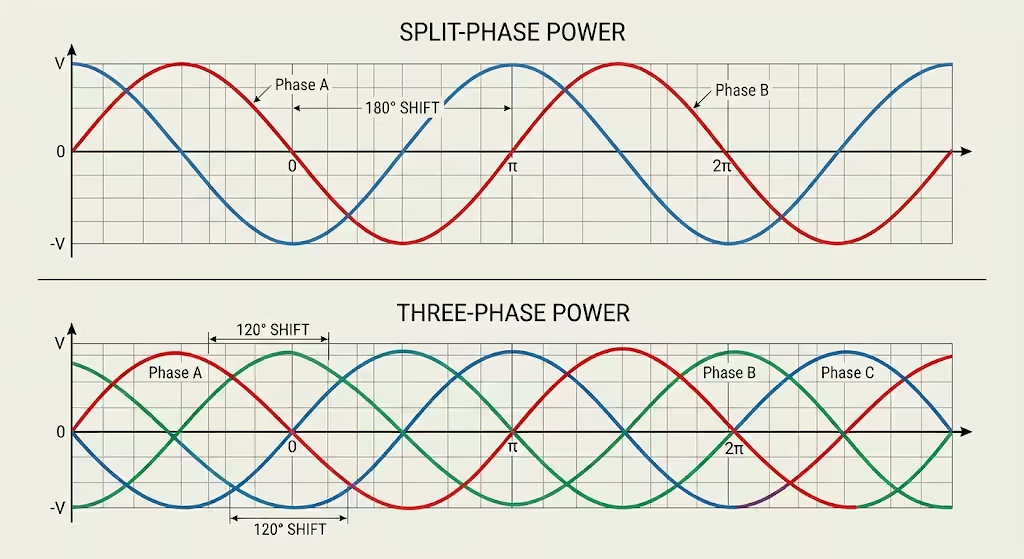
Most Brisbane homeowners only meet the split-phase vs 3-phase question after watching an American video or reading a US spec sheet. True split phase is a North American system, and Energex doesn’t supply homes that way. A Brisbane house is on single phase, two phase or three phase. When a local quote mentions “split phase”, the writer nearly always means two-phase.
If you’re planning an EV charger, a ducted system or a pool heat pump, the comparison that counts is the supply you already have against three-phase. What’s on the pole out the front usually settles more than the house does.
What is split phase power?
Split phase is a single-phase supply divided at the transformer. A centre tap on the transformer winding produces two 120V legs sitting opposite each other, with 240V across the pair. Homes across the US and Canada are wired this way.
Despite the name, there’s still only one phase. Both legs come off the same winding, so a split-phase supply can’t produce the rotating field a three-phase motor needs.
Energex’s suburban network is built around three-phase, and each house connects to one, two or all three of the phases on its street. A small number of rural properties on long single-wire lines get a centre-tapped arrangement similar to the American one. You won’t find it in a Paddington workers’ cottage or a post-war brick home in Coorparoo.
The term still turns up locally as shorthand. Some electricians and retailers say split phase power when they mean 2-phase power, and US-made equipment manuals list “240V split phase” as the supply requirement. Neither describes what Energex delivers. When a quote or spec sheet uses the term, ask what voltage sits between the actives. Anything written for an Energex supply will say 400V.
What is 3-phase power?
Three-phase power is three separate 230V actives, each running a third of a cycle behind the one before, with 400V between any two of them. The three waveforms overlap, so delivered power never drops to zero. Large motors start and run more smoothly as a result.
The bigger advantage for a house is current. Three-phase carries the same power at a much lower current per wire. Once a single-phase supply gets pushed toward its limit, the cable and protection needed to keep up get expensive fast.
A house on 3-phase power still runs its lights and power points on single-phase circuits. They’re spread across the three actives so no one phase carries everything.
How split phase compares with 3 phase power
In Brisbane, split phase isn’t on the menu. The realistic alternatives to three-phase are single-phase and two-phase.
US split-phase | Two-phase (Brisbane) | Three-phase (Brisbane) | |
Phases | One, centre-tapped | Two of the street’s three | All three |
Voltage to neutral | 120V | 230V | 230V |
Voltage between actives | 240V | 400V | 400V |
Runs three-phase motors | No | No | Yes |
Where you’ll see it | North America | Homes where three-phase isn’t on the street | Larger homes, EV and pool loads, workshops |
Two-phase brings most of the hassle of three-phase (extra wiring, loads to balance across phases) without the continuous power that makes three-phase useful for motors. At the same amps per phase, the 2-phase and 3-phase difference is 50% more capacity for one extra conductor. Nobody chases two-phase on purpose. 2 phase power in Australia is usually what a house ends up with when three-phase isn’t available on the street.
EV charging shows the gap most clearly. A single-phase home EV charger tops out around 7kW, while the same wall box on three-phase can deliver 22kW to a car that can accept it.
Do you need to upgrade to 3-phase power?
Most Brisbane homes don’t. A single-phase supply handles a typical household comfortably. The case for an upgrade starts when large loads run together for hours.
EV charging tips more homes over than anything else. One car on a 7kW charger overnight is manageable. Two cars, or a car plus a home battery charging from the grid, start to look like a load the supply was never sized for. If you’re running two EV chargers and two batteries, you’re not a typical household, and three-phase power starts to earn its keep.
Big motors are the other trigger: large ducted air conditioning, pool heat pumps, workshop gear. A big motor will run on single-phase, but it isn’t pretty. Starts are harder, and the voltage dips every time the motor kicks in. Modern inverter air conditioners convert to DC internally, so a new ducted unit cares less about phases than the older systems it replaces.
Larger solar systems often need three-phase as well. Energex sets inverter and export limits by supply type and revises them, so confirm the current limits before anyone quotes you a system size.
For many households, the single-phase vs 3-phase choice ends up being financial more than technical. Load management, which stops the EV charger running while the oven and air conditioner are on, can keep a single-phase house under its limit. Work out the payback first. If the only three-phase load is one machine in the shed, a VFD (variable frequency drive) or phase converter can run it from single phase for far less than a supply upgrade. A house already on 2-phase power has a shorter step to three-phase than one starting from single-phase.
The board decides a lot too. A three-phase supply needs a three-phase main switch and circuits balanced across the actives. An older board with ceramic fuses and no spare space will need a switchboard upgrade before any of that can happen.
Why amps matter more than kilowatts
Your supply limit is set in amps per phase, so plan around that number. A load that looks fine in kilowatts on paper can push current past what the service fuse and consumer mains are rated for.
Voltage drops under heavy load, and appliances draw more current to make up the difference. On a hot afternoon, with half the street running air conditioning, you can see it in lights that dim when a compressor starts. On 3-phase power, heavy loads spread across the phases, so the sag is smaller for you and for neighbours on the same transformer.
A single-phase supply isn’t designed to sit at full load for hours. Networks plan around short peaks. A house that charges everything overnight at the limit slowly cooks its service fuses and mains. Nothing fails in the first week. The damage shows up years later as a hot fuse holder or a discoloured termination.
Find this out at the design stage. The worst time to learn you need an upgrade is mid-renovation, after the air conditioner or heat pump has been specified.
What does a 3-phase power upgrade cost in Brisbane?
The cost to install 3-phase power in Brisbane depends more on your street than on your house. With three-phase already on the pole or in the pit out front, the job is modest. Trenching under a driveway, or Energex network work to bring three-phase to the property, pushes the price up quickly.
On the house side, 3-phase power installation usually means new consumer mains sized for three-phase, a board that can take it and a three-phase meter, plus Energex’s own charge for the connection work. Get the quote before assuming the answer either way.
An Energex 3-phase upgrade is lodged by your electrician as an Electrical Work Request, under the supply upgrade category, which covers installing additional phases. The request states the maximum demand needed in amps per phase and whether the supply is overhead or underground. If the street network can’t support the request, a Supply Availability Enquiry has to go in first, and some jobs wait on a pillar upgrade or traffic control before connection. Before you upgrade to 3-phase power, get a load calculation done. That number shapes the request, and it tells you whether you need the upgrade at all.
Which supply should you plan around?
On split-phase vs 3-phase, Brisbane homeowners can take the first option off the list. The decision that remains is whether your current supply can carry what you’re adding over the next few years. A load calculation answers that before any money goes into the street.
Our electricians can check what’s on the pole outside your home and work out whether your planned loads need 3-phase power or better management of the supply you already have. Quotes are free, and the pricing is fixed. Book an assessment or call 07 3324 1447.
Frequently Asked Questions
Through a licensed electrician, who works out your maximum demand and lodges the upgrade request with Energex. Energex then confirms whether the street can supply it.
Probably not, unless you're adding a second EV or a home battery to a house that already runs hard.
No. Split phase is one phase divided at the transformer into two 120V legs, the standard American setup. Two-phase takes two separate phases from a three-phase network, each at 230V with 400V between them. Australians sometimes swap the names, which is where most of the confusion on local forums starts.
No. The kettle, oven, TV and lights run on single-phase circuits, whatever supply the house has.
Not as it comes. North American equipment is built for 60 Hz, and a 120V leg to neutral, and an Australian supply gives it neither. Buy the Australian-market version.
Three-phase changes how much you can draw at once. Each kilowatt-hour costs the same. Some retailers charge a different daily supply rate for a three-phase meter, so check with yours before upgrading.
