

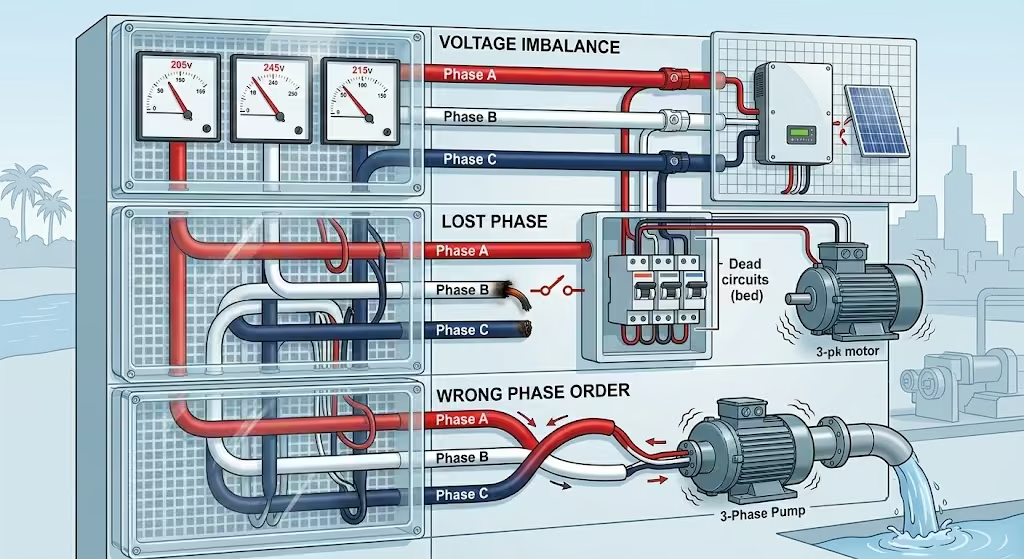
Most 3-phase power problems come down to one of four faults: voltage imbalance between the phases, a lost phase, wrong phase order, or too much load piled onto one phase. Before anything gets fixed, work out where the fault sits. Upstream of your meter is the network’s responsibility. From the main switch onwards, it’s yours.
Plenty of callouts end with the electrician confirming the problem is out in the street.
Is the fault in your switchboard or on the Energex network?
A 3 phase electrician answers this by turning off every circuit breaker and measuring each phase at the meter. A phase that’s missing, or sitting well below the others with nothing connected, points to the network.
A home on three-phase power has three active conductors coming in from the street, protected by service fuses at the pole or in the meter box. The incoming readings are the quickest way to tell whose problem you’ve got, and the test takes minutes.
Storms shift the odds. After a severe afternoon cell moves through Brisbane, suspect the street first. High winds can push overhead lines into each other. A blown fuse on the pole-top transformer is harder to pick, because it can leave two of your phases running low and effectively sharing one supply. Lights dim on some circuits and look normal on others. Anything 3-phase struggles to start.
Supply faults go to Energex on 13 62 62. A fallen line, or a tingle from a tap or appliance, is an emergency, so call 000 or 13 19 62 and keep everyone well clear.
Voltage imbalance: why one phase runs higher than the others
Voltage imbalance means the three phases aren’t sitting at the same voltage. On the network side, rooftop solar is the usual driver in Brisbane. Inside the property, the cause is usually years of add-ons.
Most home solar systems use single-phase inverters, including plenty connected to three-phase power. When enough of them on one street export through the same phase, that phase’s voltage climbs through the middle of the day. Inverters built to AS/NZS 4777.2 respond by cutting output or disconnecting. Solar that drops out on clear afternoons is the classic sign.
Inside the switchboard, the pattern looks different. A board in an older home, extended over twenty years, tends to have each new circuit landed on whichever phase was closest at the time. Nobody planned the split. One phase ends up carrying the oven and the pool pump. Another runs a few bedroom lights. Uneven boards cause more 3-phase power problems than most owners expect, and the faults look random until someone maps which circuit sits on which phase.
Inverter-driven equipment takes the worst of it. Variable speed drives, which control many modern pumps and compressors, have internal capacitors that run hot on an unbalanced supply and fail early. 3 phase air conditioning compressors are often set to lock out once the phases drift too far apart. The unit throws a fault code. Someone resets it. The next hot afternoon, it locks out again.
When the network is at fault, and the first report goes nowhere, ask to speak with the power quality team. Australian Standard AS 60038 sets nominal supply at 230V phase to neutral, with an allowed range of plus 10% to minus 6%, and the network publishes its own supply standards. Hold them to those. A week of logged readings outside the range is hard to argue with, and unresolved complaints can go to the Energy and Water Ombudsman Queensland.
Balancing 3-phase power across your switchboard
Balancing 3-phase power means spreading the load so each phase carries a similar share. A house on 3-phase power with no 3-phase appliances still needs it.
With everything on one phase, a single set of service fuses and conductors does most of the work while the other two sit nearly idle. That phase sags first at peak demand. It also fails first.
A generator shows up a lopsided board fast. A 3 phase generator splits its rated output evenly across the phases, so one overloaded phase will trip it while most of its capacity goes unused. During an outage, shed the big load on the overloaded phase first. Hot water and the oven are the usual candidates.
Induction cooktops are a decision for the build or renovation stage. Many can be wired across more than one phase, which stops the cooktop dominating a single phase and lets solar and battery systems carry more of its load.
Rebalancing an existing board usually means moving circuits between phases and labelling everything properly. On an older board with ceramic fuses or no room for RCDs, it makes more sense as part of a 3-phase switchboard upgrade rather than a tidy-up of a board that’s due for replacement anyway.
What happens with a loss of phase in 3-phase power?
Losing a phase means one of the three supplies drops out while the other two stay live. At home, part of the house goes dark. In a business, motors are the bigger worry.
Building owners who’ve had 3-phase power for a decade or more have usually been through it more than once. The cause is often small, such as a single service fuse or a connection at the meter that ran warm for years until it burnt open. Overhead supply adds the occasional branch to the list.
At home, a partial 3-phase power outage is the giveaway. Roughly a third of the circuits die. The kitchen works, but the bedrooms don’t, or the lights stay on while the ducted air stops. Check for a tripped breaker before assuming the worst. If nothing has tripped and everything dead shares a phase, the supply is the problem.
After hours, with a full fridge or medical equipment on the dead phase, an emergency electrician can confirm in one visit whether the fault is yours or the network’s.
Motors are where loss of phase in 3-phase power gets expensive. A 3-phase motor that loses a phase mid-run often keeps spinning on the remaining two, pulling far more current than it was built for. It overheats quickly. Once stopped, it won’t start again on two phases.
Equipment split across phases carries the most risk. A coolroom with its compressor on one phase and its fans on another can lose half its system and keep running the other half, and nobody notices until the stock is warm.
A phase failure relay prevents most of this. It monitors all three phases and disconnects the load when a phase drops out or arrives in the wrong order, for a fraction of what the motor costs to replace. Small, cheap drives often have no phase-loss protection built in. Don’t assume the equipment will look after itself.
Wrong phase order and the swapped neutral
Phase order decides which direction a 3-phase motor turns. Reverse it and motors run backwards. Swap a phase with the neutral and 230V equipment gets 400V.
Heating elements don’t care about phase order. Motors do. A pump with two phases reversed spins the wrong way, and scroll compressors, found in most 3-phase air conditioners, are damaged by running in reverse.
Wrong rotation tends to appear after someone has worked on the supply, often a meter change or a network repair. Every licensed electrician should check rotation before reconnecting 3-phase equipment. With a phase sequence tester, the check takes seconds.
The swapped neutral is far more serious. With a phase conductor where the neutral belongs, single-phase appliances see 400V across parts designed for 230V. Electronics fail instantly. Some appliances catch fire.
Plug-in and portable gear carries its own risk. Welders and site compressors move between outlets wired by different people at different times, so never trust the rotation of an outlet you haven’t tested.
Why do 3-phase drives keep faulting when they slow down?
A drive that trips during slow-down is usually being pushed by its own load. A heavy fan keeps turning after the drive tells it to slow, and that momentum feeds energy back into the drive. Its internal voltage climbs until it trips. Either lengthen the ramp-down time or fit a braking resistor to absorb the extra energy. The supply is fine.
Faults that come and go need data. A power quality logger left on the supply for a week usually reveals a pattern, often at the same time each day, and saves several callouts spent chasing the fault by feel. Sites on 3-phase power with a lot of drives and refrigeration benefit from logging as part of routine commercial electrical maintenance.
How to test 3-phase power safely
Owners can check which circuits are dead and whether anything has tripped. Testing with a meter is licensed work.
Here’s how to check 3-phase power without opening anything. A home with 3-phase power has a main switch with three poles joined together, and the circuit breakers below it are fed from different phases. Note which circuits are dead. A cluster of dead circuits with nothing tripped, especially if the neighbours have lost part of their power too, points to the supply. Energex’s outage map shows reported faults by area.
An electrician’s test goes further. They measure each phase to neutral, which should read close to 230V, then phase to phase, close to 400V. A phase sequence tester confirms rotation. Full voltage going into a fuse with a low reading coming out points to the fuse carrier or a loose termination.
Under the Electrical Safety Act 2002 (Qld), this is licensed electrical work. It starts with isolating the supply and proving it dead. Insulated gloves and arc-rated clothing come after that, because PPE is the last line of defence.
When to call a 3-phase electrician
On 3-phase power, partial loss of supply with nothing tripped is the most common reason to call an emergency electrician, and the one where speed matters, because motors and refrigeration cope badly on two phases. Repeated lockouts on 3-phase air conditioning come a close second. Most trace back to the supply or a tired connection at the board.
Our electricians start every 3-phase job at the meter. If the problem is on the network side, we’ll tell you so, hand over the readings and leave the repair to the people responsible for it. If it’s ours to fix, you get a fixed price before work starts. Every Dawson electrician is fully licensed, and the team brings more than 40 years of combined fault-finding experience to Brisbane homes and businesses.
If part of your property has lost power, or 3-phase equipment keeps faulting, our team will test at the meter first and tell you straight whose fault it is. Call 07 3324 1447 or book a 3-phase electrician online. We look after homes and businesses right across Brisbane.
Frequently Asked Questions
Look at your main switch. On a 3-phase supply, it's three switches joined by a bar so they turn off together. The meter box will usually have three service fuses as well.
Yes. Homes and most businesses in Australia get a four-wire supply: three phases plus a neutral. The neutral matters more than people give it credit for. If it breaks or comes loose, the voltage on each phase drifts with the load, so some circuits run high while others run low. Lights brighten and dim as appliances switch on. Taps or metal fittings can give a tingle, and that's an emergency, so call 13 19 62 straight away.
230V from each phase to neutral and 400V between phases. Older paperwork often says 240V and 415V.
Usually a motor. A compressor or pump that's failing, or running on two phases after a supply fault, draws more current than the breaker allows. Repeated resets can finish off a struggling motor, so leave it off and get it tested.
Ducted air conditioning first, then any 3-phase pump or machinery. Once all three phases are back, wait a few minutes before restarting them, as supply can drop again while the network restores the area.
The network repairs faults on its side of the meter. Anything from the main switch onwards is the owner's cost.
