

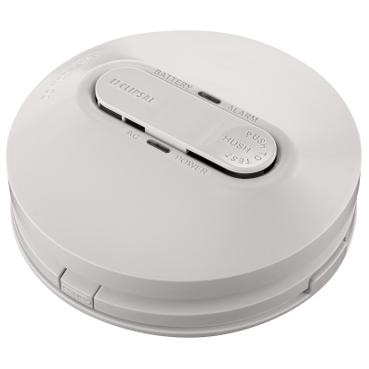
Smoke alarms beep when their battery runs low. That’s the most common reason people are reading this. Changing the battery is straightforward for most household alarms. For the AC hardwired ones, you’ll need to kill the power at the switchboard first. Sealed 10-year lithium units are the odd ones out. The battery in those is locked inside the housing and can’t be changed at all. When it runs flat, the whole alarm gets binned.
What type of smoke alarm do I have?
The answer determines everything else here.
Look at the LED indicator on the front of the alarm. A steady green LED light means the alarm is AC-powered. These are mains-powered alarms, wired into your home’s mains electricity.
The battery in these alarms is a backup. Your home’s electrical circuit handles the primary supply, which keeps the LED sitting steady green during normal operation.
If your alarm is flashing roughly every half-minute or so, it’s a battery-only unit. The flash is just the alarm checking in. No mains involved.
The sealed 10-year lithium battery smoke alarm is the third category. From the ceiling, these look much the same as a standard battery-operated alarm. The difference is internal. The lithium cell inside is welded into the housing for the life of the unit. Ten years, give or take. After that, the whole alarm gets replaced. You don’t open it. You don’t service it. You install a new one.
Queensland’s smoke alarm laws shifted in January 2022. New builds and homes undergoing significant renovation now have to be fitted with interconnected photoelectric smoke alarms. These need to be either AC hardwired into the mains or running on non-removable 10-year lithium batteries. The legislation is administered by the Queensland Fire Department and built around AS 3786-2014, the Australian standard smoke alarm requirements set by Standards Australia. The same rules cover rental properties at lease changeover and homes at sale settlement. From January 2027, the requirement extends to every dwelling in Queensland regardless of age or status.
Identifying which type is fitted to your ceiling isn’t always obvious from below. The model number printed on the back of the housing is the most reliable starting point.
How do I remove a smoke alarm from its mounting bracket?
The mounting bracket stays on the ceiling. Only the alarm head detaches, which is why the correct removal motion matters. Forcing the wrong direction can crack the housing or snap the bracket clips.
Removal varies by model. Most alarms made in the last fifteen years use a quarter-turn release: grip the alarm and rotate it about 90 degrees anti-clockwise until you feel it disengage. Older Clipsal and Brooks units use a horizontal slide release with a small directional arrow on the mounting plate. A horizontal flat-head screwdriver inserted into the removal slot, kept parallel to the ceiling, gives the leverage needed to slide the smoke alarm off its base cleanly. Click-in-place brackets turn up occasionally in homes that haven’t been rewired since the late 90s; these need a firm downward press before the alarm comes free.
For an AC hardwired alarm, the mains supply has to be killed before any of this starts. Turn off the relevant circuit at the switchboard. The steady green LED on the alarm face will drop out within a few seconds. That’s how you know the circuit is dead. Some alarms hold residual charge from the battery backup briefly afterwards, which is normal.
How do I replace the 9-volt battery?
With the alarm off the bracket, open the battery compartment. Two configurations are common.
Rear-loading batteries are accessed through a compartment door on the back of the alarm. Remove the old 9V battery and set it aside for proper disposal. Most local councils maintain battery collection points. Drop the fresh 9-volt into the compartment. The contacts have to line up: positive on the battery against positive on the alarm, negative against negative. Only one orientation fits, because the negative terminal opening is slightly wider than the positive one. If the battery won’t seat flat in the drawer, it’s the wrong way around. Forcing it bends the contact plates inside the compartment.
Front-loading models are designed for a battery change on the ceiling. The compartment door is on the face of the alarm. You don’t have to take the alarm down.
Press down on the door. It pops open. The old 9-volt comes out. Drop the new one in. The contacts face outward. There are labelled markings inside the drawer to line them up against. Push the door shut. It should snap closed without resistance.
The brand of 9V battery matters more than most homeowners realise. Cheap supermarket alkalines fail early in smoke alarms because the constant low-draw current of a standby alarm eats through them faster than rated. Duracell MN1604 is the most reliable choice for this application; Energiser 6LR61 and Varta 6LR61 perform similarly. For properties where ladder access is awkward, the Ultralife U9VL-J lithium 9V doubles the service interval.
Rechargeable 9V cells don’t belong in smoke alarms. The voltage curve sits about half a volt lower than alkaline, and most alarm circuits read that as a low-battery condition the moment they’re fitted. The result is a constantly chirping alarm with a perfectly good battery inside. Skip them.
What about changing the battery in a hardwired smoke detector?
Mains-powered alarms run on the household circuit but carry a battery backup for power outages. The backup battery comes in different forms depending on the alarm. Older mains-powered units take a standard 9-volt alkaline, which gets replaced annually. The newer sealed models use a rechargeable lithium cell that’s built into the housing. There’s no way to access it, and it’s designed to last the alarm’s 10-year service life. AS 3786-2014 requires it: removing the backup battery entirely would leave the alarm without any power during a grid outage. After that, the whole alarm gets replaced.
For the replaceable 9V backup, the process is the same as outlined above. Turn the power off first, slide the alarm off its base using a horizontal flat-headed screwdriver, replace the battery, and restore power.
One behaviour worth understanding: if a mains-powered alarm has been without power for an extended period, like during a renovation, or after a prolonged power cut, it may chirp for several hours after power is restored. That’s the rechargeable lithium backup running low and beginning to recharge. It isn’t a fault. The beeping stops once the battery reaches minimum charge.
How do I test a smoke alarm after replacing the battery?
Test the alarm before you reinstall it. Press and hold the test button. Three to five seconds is enough. You should hear how it sounds.
No sound usually means a contact issue. Open the compartment. Check that the battery is the right way around. Reseat it.
Now for the harness. Squeeze the plastic prongs on the connector. Push it in. There’s an audible click when it locks home.
The alarm itself goes back the way it came off. If you twisted it free, you twist it back. Restore power at the switchboard. Wait for the green LED to come back on.
Test it once more. Press and hold the test button. You want to hear the alarm sound on its own. That confirms both the mains feed and the battery backup are doing their jobs.
Why is my smoke alarm still chirping after I changed the battery?
Usually, it’s one of a few things.
Sometimes the battery isn’t sitting flush. Take it out, check that the positive and negative are the right way around, and push it back in properly.
Sometimes the alarm needs a reset. Hold the reset button down for about 15 to 20 seconds. Some of the older models hang on to residual charge after a battery change. The reset clears that out.
Then there’s dust. Sensor chambers get clogged surprisingly fast in Brisbane homes, since the humidity and the ceiling fans don’t help. A soft brush vacuum attachment, run gently across the alarm every six months, keeps the chamber clear. When dust does build up in the chamber, it scatters the photoelectric beam. The alarm reads that scatter as smoke or a low battery and chirps for no good reason.
There’s a point where the battery isn’t the issue at all. If the alarm has been on the ceiling longer than ten years, it’s done. Replace the unit.
If you need a hardwired alarm replaced or your home assessed for compliance ahead of the 2027 deadline, contact us.
Frequently Asked Questions
Once a year for a standard 9-volt alkaline. Daylight saving is a useful prompt. Clocks change, batteries change. The same goes for the 9V back-up in older mains-powered alarms. With the sealed 10-year lithium units, there's no battery work at all. When the alarm reaches the end of its life, the whole unit gets swapped out.
No. The voltage on a rechargeable 9V is lower than what the alarm circuit expects. It reads as a flat battery the moment you fit it. You end up with constant chirping from a battery that's technically fine. A standard alkaline does the job properly.
Depends what kind of flash. A short pulse every 30 to 45 seconds is a battery-operated alarm in standby. It's checking the cell. A steady green LED light is something else. That's a mains-powered alarm drawing constant current from the household circuit. The two look different from a glance, once you know what you're looking at.
Some do. Older AC hardwired alarms run a replaceable 9-volt alkaline as their battery backup, and that gets changed yearly. The newer sealed models use a rechargeable lithium cell that's built into the unit. Nothing to change on those ones.
Every residential smoke alarm sold here must comply with AS 3786-2014. That covers the build quality and how the alarm performs in a fire. Queensland goes further than the national standard. The Fire and Emergency Services Act sets out where photoelectric alarms have to go inside a Queensland home: bedrooms, the hallways linking them, and each storey of the dwelling. Interconnection is mandatory too, so when one alarm triggers, the rest sound with it. New builds and major renovations have been held to this since 1 January 2022. Every other dwelling in the state has until 1 January 2027 to comply.
