

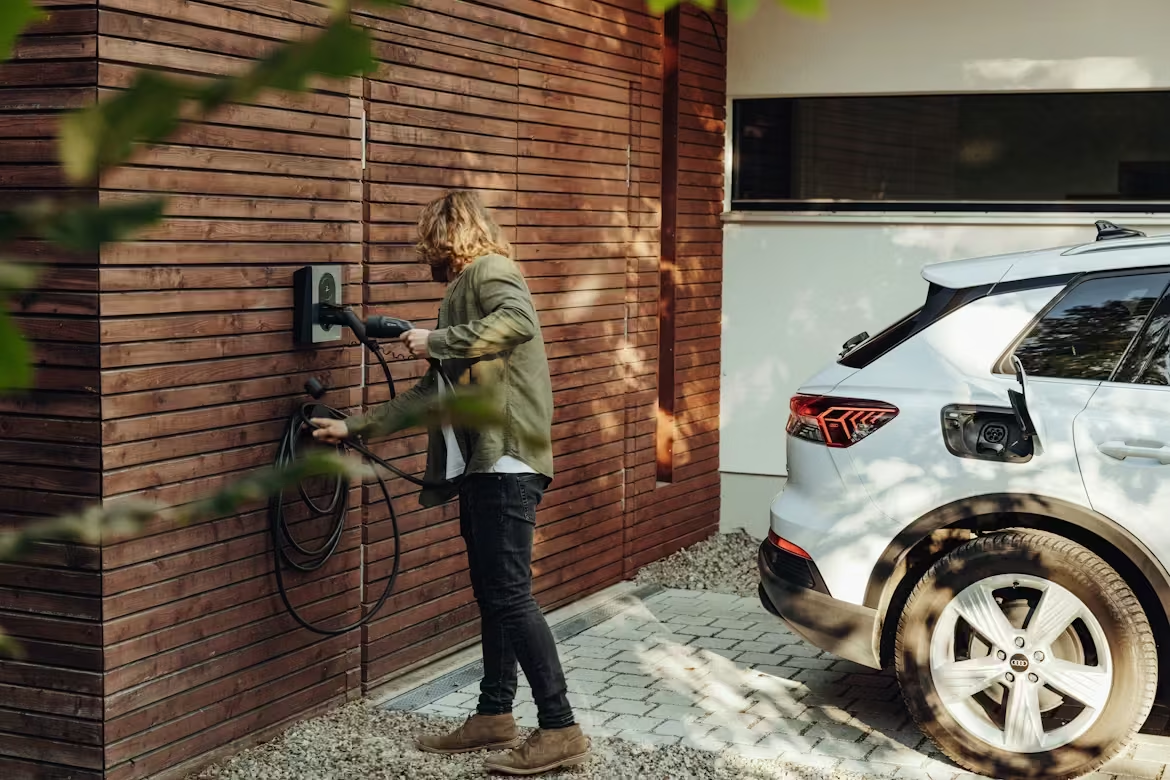
The cost to charge an EV in Brisbane depends far more on where you plug in than on the car you drive. The same EV costs about $1.20 per 100km on a cheap overnight rate at home and $10 to $17 per 100km on a highway fast charger. Some Brisbane households now charge for nothing at midday.
Those figures assume around 15kWh per 100km, normal for a mid-size EV driven around the suburbs.
Where you charge | What you pay per kWh | Cost per 100km |
Solar Sharer plan, 11 am to 2 pm | Nothing, up to 24kWh a day | $0 |
Your own rooftop solar | The feed-in tariff you give up, around 4c | About 60c |
Overnight window on an EV plan | Around 8c | About $1.20 |
Standard flat-rate home plan | Around 30c | About $4.50 |
Public DC fast charger | 60c to 80c | $10 to $17 (highway driving) |
How much does it cost to charge an EV at home?
The cost to charge an EV at home is set by your tariff and the hour the car draws power. Battery size hardly moves it.
A standard flat-rate plan charges the same at 2 pm as at 2 am, close to 30c/kWh in south-east Queensland. Simple, and the dearest way to charge at home.
Overnight EV plans cut the rate during set hours, often into single digits. The other end of the day pays for it. Cheap overnight rates usually come with a dearer peak rate, and a household that runs hard from 4 pm to 9 pm can lose on the house what it saves on the car. Before switching, ask your retailer for your interval data and look at what the house draws on a hot summer evening.
Since 1 July 2026, south-east Queensland households have had a third option. Under the federal Solar Sharer Offer, the free-power window in south-east Queensland runs from 11 am to 2 pm, capped at 24kWh a day, and you need a smart meter to sign up. A full day’s allowance covers about 160km of driving. The car has to be home in the middle of the day to use it, and the plan’s other rates apply the rest of the time. IEEFA found the offer shouldn’t be assumed to be the cheapest option for every household, so compare the full bill before you switch.
Do you need a wall charger to charge an EV cheaply?
Not on day one. A standard power point keeps the cost to charge an EV at home low for most commuters, and a wall charger earns its place once your cheap window gets short.
A 10A power point adds 100km or more overnight, several times the average daily commute. Plenty of owners run on nothing else.
Older homes need a check first. A car pulling steady current for eight hours on a tired circuit that also feeds the laundry will trip it, and in Brisbane homes still running ceramic fuses the fix often starts with a switchboard upgrade. Get the circuit looked at before the car arrives.
Where a wall charger pays is timing. A six-hour off-peak window gets you about 75km from a 10A plug and 250km or more from a 7kW charger. Squeeze the same comparison into the three-hour Solar Sharer window, and the gap widens, roughly 40km against 140km.
A 15A outlet sits between the two. It adds about half as much charge again as a standard point, at a fraction of the install cost of a wall box, and at under 20A it stays clear of Energex’s rules for larger chargers.
Install quotes vary because houses vary. The cost to install an EV charging station at home moves with the cable run and the state of the switchboard far more than with the charger you pick. A detached garage adds to both.
Which tariff does a home EV charger go on in Queensland?
In Brisbane, a 7kW wall charger can’t sit unmanaged on your normal household tariff. Energex rules put it under network control, and the set-up you choose decides which cheap charging windows the car can use.
The rule covers any single-phase dedicated EV charger drawing more than 20 amps, so a standard 7kW home EV charger is caught by it. From there, most households pick one of two set-ups.
The first puts the charger on a controlled load tariff. Tariff 31 supplies power for at least 8 hours a day and Tariff 33 for at least 18, and both bill below the general household rate. A charger on a controlled load can’t charge from your solar, and it sits outside any Solar Sharer window on your main tariff.
The second keeps the charger on your main tariff with a network control device that still allows full 32A charging, while giving Energex the ability to limit it. Your solar and a Solar Sharer plan both stay available to the car.
A household that drives a lot and charges overnight will usually come out ahead on Tariff 31. With panels on the roof or a car home at midday, the main tariff makes more sense. Settle this when the charger goes in, since switching later means rewiring and a fresh request to Energex.
Is charging an EV from solar free?
Close to free, but not quite. Each kWh the car takes from your panels is a kWh you no longer sell to the grid.
With retail feed-in tariffs in south-east Queensland down in low single digits, power from your own roof is the cheapest fuel you’ll ever buy. Even regional Queensland’s regulated feed-in tariff for 2026–27 is just over 6c per kWh, 31% lower than the year before.
Solar only helps if the car is home while the sun is up. A car that spends the working day in a city car park will do better on an overnight EV rate than on panels. A charger wired to a controlled load circuit can’t use solar at all, whatever time the car gets home.
How much does it cost to fully charge an EV?
A full charge of a 60kWh battery costs about $5 on an overnight EV rate and around $18 on a standard home rate, before losses.
For reference, the BYD Atto 3’s larger battery holds 60.48kWh. Expect to lose roughly a tenth of the energy as heat when charging at home, so add 10% to any figure you work out.
Few people charge from near empty. A 40km commute uses about 6kWh, under $2 to replace even on a flat rate.
Fast chargers change the maths. Most cars slow sharply past 80%, so a road trip stop usually runs from 10% to 80%. On the Atto 3, that adds about 42kWh, near $29 at 70c.
How much does it cost to fast charge an EV?
The cost to charge an EV at a public charging station runs 60c to 80c per kWh on most DC fast chargers, which puts highway driving around $14 per 100km. Public fast chargers are a road trip tool.
The price reflects what sits behind the plug: a heavy grid connection, cooling gear, network demand charges and the lease on the bay. You’re paying for convenience, priced the way servo food is priced.
Public rates also move. Some networks have nearly doubled their prices in a year, and time-of-use pricing at public sites is spreading. Your home rate is the one charging cost you control, and it doesn’t jump 20c on a Thursday afternoon.
The highway works against the EV as well. Consumption is lowest around town and highest at 110km/h, in summer heat or when towing, so budget over 20kWh per 100km for a road trip against about 15 around Brisbane. At those prices, a fast-charged road trip runs level with petrol and behind a good hybrid.
A few road trips a year barely dent the annual total. The owners who miss most of the saving are the ones relying on public chargers every week.
No off-street parking? Do the sums before you buy. Street parkers make EVs work by charging wherever the car already sits for an hour or two, like a shopping centre or a workplace car park, but it takes planning, and the savings are thinner.
How do you calculate the cost of charging an EV?
Here’s how to calculate the cost of charging an EV for your own car: multiply its consumption per 100km by your rate per kWh.
A large SUV using 19kWh/100km on a 25c rate costs $4.75 per 100km. The consumption figure sits in the car’s trip computer, and your power bill lists the rate against each tariff period.
For a quick comparison with petrol, double the per-kWh price to get a rough per-litre equivalent. So 8c power is like buying fuel at 16c a litre, and a 70c fast charger like $1.40/L. The rule assumes town driving. On the highway, it flatters the EV.
Our electricians install home EV chargers across Brisbane, and each job starts with your switchboard and a straight answer on which tariff the charger should sit on. Dylan and Kristine have run Dawson Electric as a family business since 2007, with fixed pricing and free quotes. Book an EV charger assessment or call 07 3324 1447
Frequently Asked Questions
On standard home electricity rates, the cost to charge an EV in Australia works out at roughly $4 to $6 per 100km. Queensland's average rate sits toward the cheaper end, with South Australia the most expensive. Overnight EV plans and solar pull the average cost to charge an EV down sharply for households set up to use them.
At home, by a long way. A petrol car using 8L/100km at $2 a litre spends $16 per 100km, about three and a half times the cost of charging on a standard Brisbane rate and more than ten times an overnight EV rate. Public fast chargers close most of that gap on the highway.
A 7kW charger running for eight hours adds about 50kWh. At an 8c overnight EV rate, that comes to $4 for around 300km of driving. On a flat-rate plan, the same night costs closer to $15.
Around 1,800kWh a year for 12,000km of driving. The cost of electricity to charge an EV over that distance is about $540 a year on a flat 30c rate, or $1.50 a day.
Yes. Plug the car's portable charger straight into a standard 10A outlet, and never through an extension lead or power board.
