

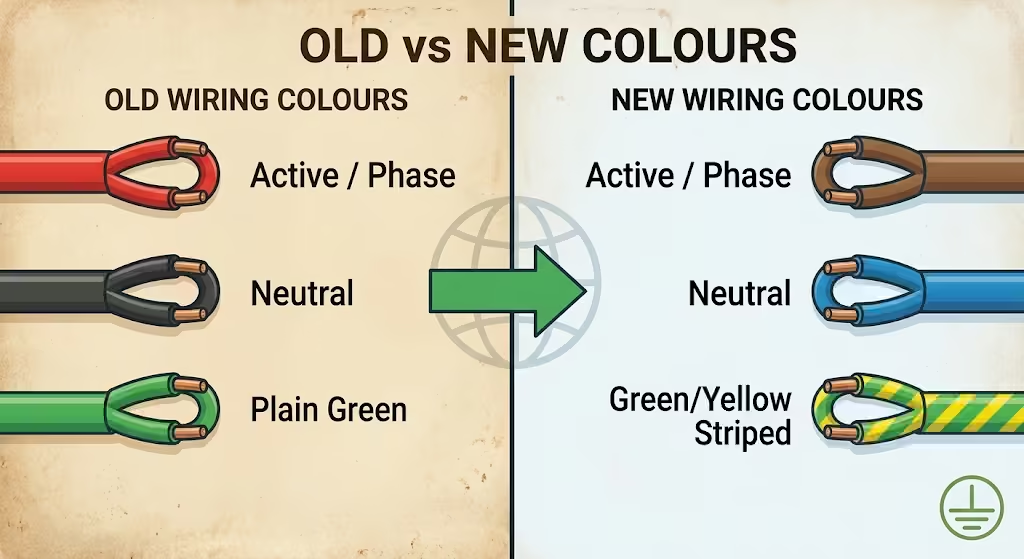
Current Australian electrical wiring colours are red for active and black for neutral. Earth is green/yellow. Older homes used the same red and black, but the earth was plain green, and three-phase boards used yellow where white sits now. Colour tells you what the last installer intended, not what the wire is doing.
What are the 240V wire colours in Australia?
In single-phase 240V wiring, the active is red, the neutral is black or light blue, and the earth is green/yellow. AS/NZS 3000:2018, known in the trade as the Wiring Rules, sets this electrical wiring colour coding for fixed wiring. Appliance cords, including the leads checked during test and tag, use brown and blue.
Conductor | Fixed wiring (walls, ceiling, switchboard) | Flexible cords (appliance leads) |
Active | Red (preferred) | Brown |
Neutral | Black or light blue | Light blue |
Earth | Green/yellow | Green/yellow |
Red is the convention for an active. The Wiring Rules permit any colour except green/yellow, plain green, yellow, black or light blue, so brown falls inside the allowed range. You’ll rarely find it in a house.
On the voltage itself, Australia adopted 230V as its nominal supply under AS 60038 in 2000. Nearly everyone, electricians included, still says 240V.
What were the old electrical wiring colours in Australia?
Old electrical wiring colours in Australia used red for active and black for neutral, the same pairing as today. The earth was plain green. Very old cable may have no readable colour left at all.
The wire colours red and black came straight from DC practice, where red marked positive and black marked negative. Early AC installers kept both and gave them new jobs. Three-phase added two more bright colours to the set.
Plain green is the easiest way to date an earth. Green/yellow stripes replaced it so the earth could never be confused with another conductor, and plain green is no longer permitted for an earth in new work. Some older light points have no earth conductor at all. You can match red to red and black to black perfectly and still leave a metal fitting unprotected. A safety switch on the lighting circuit adds protection, though the missing earth still needs attention whenever that fitting is replaced.
Homes wired before PVC-sheathed cable became standard often still have runs of rubber-insulated cable, called VIR in the trade. The rubber hardens and cracks with age. When we open a ceiling with VIR in it, red and black have usually darkened to the same shade, and the insulation is the more pressing problem.
A 1960s house with a 1970s extension and a 2015 kitchen will have three generations of cable in it. We expect mixed colours in most homes older than about 40 years, and a Queenslander that has been raised and extended can hold more again. Every circuit meets at the board. A switchboard upgrade is often the first time in decades anyone traces and tests each one.
What are the 3-phase wire colours in Australia?
Current 3-phase wire colours in Australia add white and dark blue actives alongside red. Older installations used yellow where white is now.
Conductor | Current | Older installations |
Active, phase 1 | Red | Red |
Active, phase 2 | White | Yellow |
Active, phase 3 | Dark blue | Blue |
Neutral | Black or light blue | Black |
Earth | Green/yellow | Plain green |
Yellow made sense while earth was plain green. Once earth went to green/yellow, a yellow active sitting beside a striped earth was asking for trouble. The middle phase became white.
The two blues need more care than anything else on this chart. Dark blue is an active, 230V to earth and 400V to the other phases. Light blue is a neutral. Under a torch in a dusty meter box, they look closer than they should.
Three-phase is uncommon in older homes. We see three phase power more on newer builds and on properties that have added ducted air conditioning or a fast EV charger.
Is blue or brown active?
In an Australian appliance cord, brown is active and blue is neutral. Blue and brown wires turn up in fixed house wiring far less often. In a three-phase board, dark blue is active.
Your appliance lead is brown and blue. The cable in your ceiling is red and black. Nothing is wrong with either. Flexible cords and fixed wiring follow different colour rules, and the mismatch is where DIY light fitting jobs tend to come unstuck. A new pendant arrives with brown and blue tails, the ceiling offers red and black, and somebody guesses.
When one of our electricians fits that pendant light, brown goes to the red active and blue to the black neutral. In Queensland, any connection to fixed wiring is electrical work under the Electrical Safety Act 2002 and needs a licensed electrician, however obvious the colours look.
Flexible cords are the one place where electrical wire colours in Australia match Europe’s exactly. Inside a cord, the 240V wire colours in Australia stay brown and blue whether the appliance is a kettle or a pedestal fan. Australian plug wiring follows the same scheme, with the green/yellow earth on the vertical pin.
Why does black mean something different in overseas wiring diagrams?
Black is the colour that catches people out. In your walls, black is neutral. European three-phase cable uses black as one of its actives, and in the American wiring videos that dominate a YouTube search, black is the hot wire.
Most wiring advice online is written for another country. If the diagram you’re following shows white as neutral, close the tab. In a Brisbane light switch, the white is usually a switched active, carrying power back down to the light when the switch closes. Electrical wire colours in Australia share very little with American practice.
Britain shows what a colour change leaves behind. The UK moved to the European scheme in the mid-2000s, and its old neutral colour, black, became a phase colour. Older British homes still hold the previous scheme, so a UK video on live neutral earth colours could be describing either system. A single worldwide code sounds tidy. Every changeover leaves around fifty years of mixed wiring behind it.
Imported appliances carry their own version of the problem. A new European cooktop can arrive with brown, black, grey and blue tails, and the manufacturer’s connection diagram decides how they’re linked for a single-phase supply. Grey looks like it ought to be a neutral.
It isn’t.
Can you trust the wire colours in an older Brisbane home?
No. Treat colour as a starting point.
Every electrician on our team tests each conductor before touching it. The circuit is isolated and locked off, and the voltage tester is proven on a known live source first. Insulation colour was chosen by whoever ran the cable, on the day, with whatever was on the van. A tester reading doesn’t rely on anyone’s memory.
Green/yellow is the one colour whose meaning has held. Every other colour in the Australian set has changed jobs at some point or means something else on imported gear. Earth has never been reused for anything else. We test it anyway, because an earth conductor can carry current when something upstream has failed.
A homeowner who knows the Australian electrical wiring colours can describe a problem clearly over the phone, and that alone saves time on the day.
Talk to a licensed Brisbane electrician
Dylan and Kristine Dawson have run Dawson Electric from Woolloongabba since 2007, and our electricians work in everything from rubber-wired Queenslanders to new builds. If the Australian electrical wiring colours in your ceiling or meter box don’t match anything on these charts, leave the cover on and get in touch with our team or call 07 3324 1447. We’ll test what’s there, explain what we find in plain terms, and quote a fixed price before any work starts.1
Frequently Asked Questions
Black, in Australian fixed wiring. Light blue is also permitted, and light blue is the neutral in every appliance cord.
Positive, in DC systems such as a car battery, a caravan's 12V setup or a solar battery bank, where black is negative. Household AC has no positive or negative side. Red there marks the active, and the current reverses direction fifty times a second.
Green/yellow stripes, in house wiring and appliance cords alike.
Not on their own. A plain green earth or a yellow phase tells us roughly when a circuit went in, and plenty of wiring from those years is still sound. Condition is what pushes a house toward rewiring: rubber insulation that cracks when it's moved, light points without an earth, scorch marks at a terminal, circuits nobody can trace back to the board. Our electricians look for those during an inspection, and age is one input among several.
