

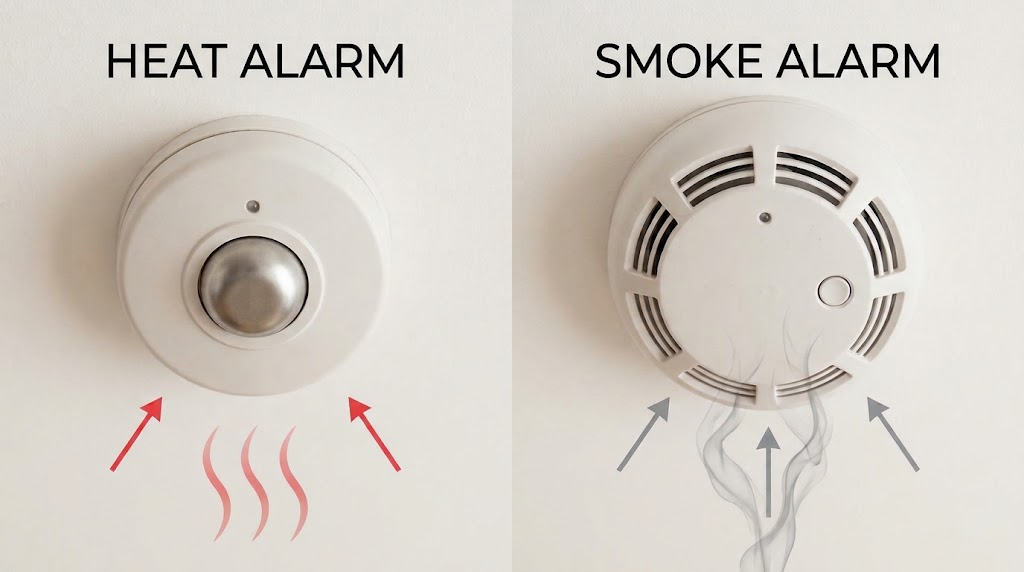
A smoke alarm reacts to smoke particles and gives you an earlier warning. A heat alarm waits for the room to reach roughly 55 to 60°C, when the fire is already well developed. Most homes are best served by both: smoke alarms where people sleep, heat alarms where smoke alarms false-trip.
Under Queensland smoke alarm laws, every home must have interconnected photoelectric smoke alarms in place by 1 January 2027. A heat alarm doesn’t count toward that requirement.
What is the difference between a heat alarm and a smoke alarm?
Smoke alarm | Heat alarm | |
Reacts to | Smoke particles | Temperature |
Warning | Early, often while a fire is still smouldering | Late, once the fire is producing serious heat |
Suits | Bedrooms, hallways, living areas | Kitchens, garages, laundries, workshops |
False alarms | Steam, cooking fumes, dust | Rare |
Meets Queensland’s requirements | Yes, if photoelectric and interconnected | No |
A photoelectric smoke alarm uses a light beam inside a small chamber. Smoke scatters the beam onto a sensor and the alarm sounds. An ionisation smoke alarm works differently and tends to respond better to fast-flaming fires than to smoke from a slow burn. Queensland no longer accepts that type under the new rules, so any ionisation unit still on your ceiling has to go.
A heat alarm has no chamber. Its heat sensor reads the air temperature and nothing else.
Which is safer, a heat alarm or a smoke alarm?
The smoke alarm, because time is what gets people out of a house. Modern synthetic furniture smoulders before it burns. A couch can fill a house with toxic smoke while the temperature at the ceiling barely moves. Your heat alarm won’t make a sound through any of that.
Because it rarely goes off by mistake, a heat alarm can seem like the safer choice. It just stays quiet for longer.
Treat a heat alarm as property protection. By the time it sounds, you have a fire.
Can you replace a smoke alarm with a heat alarm?
No, not in any location where a smoke alarm is required by law.
Queensland requires photoelectric alarms that comply with AS 3786-2014, the Australian Standard for smoke alarms. Those alarms must sit in each bedroom and in hallways connecting bedrooms to the rest of the home, or between the bedrooms and the rest of the storey where there’s no hallway. A storey with no bedrooms still needs at least one, positioned on the path out.
A heat alarm sits outside all of this. Add as many as you like, but your home still needs the full set of smoke alarms. The rental smoke alarm requirements have applied to leased properties since 2022. Fit a heat alarm where one of those smoke alarms should be, and the property fails.
What should you do if a smoke alarm keeps going off?
Try moving it before you swap anything. Most repeat offenders are simply too close to a kitchen or bathroom door. Heat doesn’t set off a smoke alarm on its own, but the steam and fine particles that come with cooking and showering can, along with burnt toast and dust.
Queensland’s rules allow for this. If steam or cooking fumes make the required spot impractical, Queensland lets the owner put the alarm somewhere else that will still warn the household.
Nuisance alarms are a safety issue in their own right. Once one has gone off during dinner for the fifth time, people pull the smoke alarm battery, bag the unit or tape over it, and the home has lost its protection without anyone quite deciding to. Preventing that is the heat alarm’s most useful job. Fitted in the kitchen, it covers a room where a smoke alarm would keep getting disabled.
Where should heat alarms be placed?
Heat alarms belong in rooms where steam, fumes or dust make a smoke alarm impractical, with smoke alarms everywhere else. Here’s how that looks room by room:
- Bedrooms and hallways: Smoke alarms, every time. These positions are non-negotiable.
- Living areas: Also smoke, unless the room opens straight onto the cooktop and the alarm can’t be moved far enough away.
- Kitchen: A heat alarm for kitchen coverage is the standard choice, since toast and frying will keep setting off a smoke alarm in there.
- Garage: Exhaust fumes and dust rule out smoke sensing, so fit a heat alarm for garage coverage. Garages with a workbench, stored fuel or a home battery have the strongest case.
- Laundry: Dryer lint and humidity make heat the better fit.
- Bathrooms: Usually nothing. There’s little to burn, and steam is constant.
- Roof spaces and workshops: Heat, where you want coverage at all.
Mount it on the ceiling. The manufacturer’s instructions give the distance to keep from walls and light fittings.
How do heat alarms work, and what temperature do they go off at?
Most heat alarms sound at about 55 to 60°C. The exact figure varies by model, and Red’s RHA240RF, for example, activates between 55°C and 59°C.
Two designs are on the market. A fixed-temperature heat alarm, sometimes called a thermal heat alarm, sounds when the room hits its set temperature. A rate-of-rise model also responds if the temperature climbs unusually fast, which can buy a little time. Neither will notice a smouldering couch in the next room.
Why should smoke and heat alarms be interconnected?
A heat alarm in the garage won’t do much if nobody in the bedrooms can hear it. With interconnected smoke and heat alarms, one unit sounding sets off the whole house, which turns a late warning from a closed-off room into one that can wake everyone.
Compatibility is the catch. Interlinked alarms generally need to come from the same brand or system, and not every smoke alarm range includes a matching heat alarm. Clipsal’s 755HA5L, a 230V unit with a 10-year battery backup, links wirelessly to existing Clipsal smoke alarms. Check the model on your ceiling before buying anything.
A combined heat and smoke alarm is sold as a neat alternative, but it usually keeps the smoke sensor that was causing your false alarms. For a kitchen, a dedicated heat alarm is the cleaner answer.
How can you tell which alarm you have?
Read the label or model number. From the floor, the two look much the same. An electrician can also identify it during a smoke alarm installation or compliance check.
Some apartments have only a heat detector. Most tenants wouldn’t know until a technician pointed it out. There can be a legitimate explanation. A detector usually connects to a building’s wider fire system, while an alarm sounds on its own, and an older installation may simply have stayed in place. It still doesn’t settle whether the apartment meets the current rules. Put the question to your property manager in writing, and contact Tenants Queensland if you don’t get a clear answer.
The Queensland Fire Department sets out what owners and tenants must do, including a tenant’s duty to test each alarm at least every 12 months.
How long do heat alarms last, and who can install them?
Replace both types every 10 years. Most people know this about smoke alarms, but few realise the same limit applies to heat alarms. Sensors drift with age, and a heat alarm that only ever gets tested with the button tells you the horn works and little else.
A 240V heat alarm or any other mains-powered heat alarm needs a licensed electrician, the same as a hardwired 240V smoke alarm. Models with a 10-year lithium battery need no wiring, which helps in a detached garage with no cable nearby.
Heat alarms generally cost slightly more than battery smoke alarms, but the difference shouldn’t decide which one you choose. The room should.
Dawson Electric installs interconnected smoke and heat alarms across Brisbane, and we’ll tell you which rooms need which before we quote. Call 07 3324 1447 or contact our team. We work from Woolloongabba, Monday to Friday, 7 am to 4 pm.
Frequently asked questions
No. One reads temperature, and the other looks for smoke. In a smouldering fire, the smoke alarm will usually sound long before the heat alarm.
No. Queensland’s domestic rules are written around smoke alarms, so a heat alarm is an optional extra in most homes. Ask the body corporate if you’re in an apartment. Your building may have fire safety requirements of its own.
No, a standard photoelectric smoke alarm has no heat sensor.
Choose a smoke alarm. If the hallway connects your bedrooms to the rest of the house, one is required there. If cooking keeps setting it off, look at its position and at your rangehood before anything else. A range of photoelectric models also handle steam better than older units, so replacing a very old alarm can help as well.
