

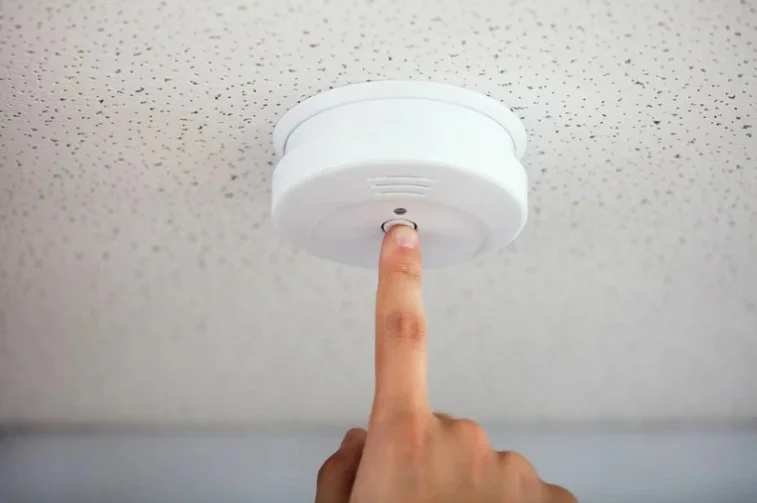
For smoke alarm placement in Queensland, start with the bedrooms. Every one needs a photoelectric smoke alarm, and so does the hallway outside them. A storey with no bedrooms still gets one. Heat alarms sit outside all of this. Put one in a kitchen or garage if you like, but it won’t count toward the legal minimum.
Rentals and homes being sold already have to meet the current rules, and owner-occupied homes follow on 1 January 2027. Queensland smoke alarm legislation sets the minimum for all of them. Most people looking up a heat alarm or smoke alarm have one that goes off every time someone cooks, and they want it gone. Swapping it often won’t solve that. Sometimes the alarm you have is the right type and just sits in the wrong spot.
Heat alarm vs smoke alarm: what is the difference?
A smoke alarm responds to smoke particles, while a heat alarm responds to temperature. That gives the smoke alarm the earlier warning in most house fires.
Inside a photoelectric smoke alarm, a beam of light runs through a small chamber. Smoke knocks some of that light onto a sensor. Very little heat is involved, which is why this type can pick up a smouldering couch long before the room warms up. Older ionisation alarms work differently, and Queensland’s 2027 rules exclude any alarm containing an ionisation sensor.
Heat alarms do nothing until the room gets hot. For fixed temperature models, that means roughly 55 to 60°C, so check the rating on the one you’re buying. Some also have a rate-of-rise function and will go off sooner if the temperature climbs quickly. The packaging might say thermal heat alarm or heat detector. Same idea.
Modern synthetic furniture is why the timing matters. It can smoulder and give off thick, toxic smoke well before flames appear, or the temperature at the ceiling reaches a heat alarm’s trigger point. A heat alarm is mainly there to protect the property. Once one sounds, the fire is already established.
Where does Queensland law require smoke alarms?
Every storey needs them, and the bedrooms set the layout. The Queensland rules call for alarms:
- in every bedroom
- in hallways connecting bedrooms to the rest of the home
- between the bedrooms and the rest of the storey, where there is no hallway
- in the most likely path out of the home, on any storey without bedrooms
If someone sleeps in an enclosed verandah, treat it as a bedroom. Built-in lower levels are the other one we’d check. A rumpus added under a high-set home makes that level a storey of its own, so it needs an alarm on the way out, and many of those conversions predate the current rules.
The alarms themselves have to comply as well. Look for AS 3786-2014 on the label. Anything over 10 years old has to be replaced, even if it still passes the test button, and every alarm must trigger the others. Hardwired alarms have to be replaced with hardwired ones. Otherwise, you’ll need a non-removable 10-year lithium battery, so the old 9V type won’t qualify.
How far from lights, fans and vents should a smoke alarm be?
Mount it on the ceiling where you can, with 300mm or 400mm of clearance depending on what is nearby.
The prescribed minimum distances are:
Keep the alarm clear of | Minimum distance |
Corner where the ceiling meets a wall | 300mm |
Light fitting | 300mm |
Air-conditioning vent | 400mm |
Ceiling fan blades | 400mm |
Small Brisbane bedrooms make this harder than it looks. Add a ceiling fan, downlights and a split system, and the legal position can shrink to a narrow strip of ceiling. Measure before anyone drills, particularly if you are moving to a new set of alarms and the old base isn’t in a compliant spot.
Queenslanders and raked ceilings have their own rules. On a sloping ceiling, the alarm sits 500mm to 1,500mm from the apex. An exposed beam or joist can carry it if the depth is 300mm or less, and where a ceiling won’t work, a wall position must be 100mm to 300mm below the ceiling and over 300mm from the corner of two walls. In a stairwell, nothing can stand between rising smoke and the alarm.
For mains-powered alarms, our smoke alarm installation work includes checking these positions against what is in the ceiling space, since a compliant spot still has to be reachable with cable.
Which alarm goes in which room?
Use smoke alarms wherever they will work, and always on the escape route.
Area | Alarm | Why |
Bedrooms | Smoke alarm | Required, and the first warning for anyone asleep |
Hallways to bedrooms | Smoke alarm | Required, and part of the way out |
Living areas | Smoke alarm where it is required or on the route out | Soft furnishings tend to smoulder first |
Stairwells | Smoke alarm | Smoke rises through them early |
Kitchen | Heat alarm for kitchen use, as an extra | Cooking fumes and burnt toast trip smoke alarms |
Garage | Heat alarm for garage use, as an extra | Exhaust fumes and dust |
Laundry | Heat alarm, as an extra | Steam and lint |
Bathrooms | Usually neither | Steam, and a low fire risk |
Roof space or workshop | Heat alarm, as an extra | Dust and temperature swings |
Most homes end up with both, interconnected.
Where should heat alarms be placed?
Put them in the rooms where smoke alarms nuisance-trip and fire would be slow to reach anyone’s attention. A garage suits this best: the WA fire service specifically encourages heat alarms there, and the under-house garages common in Brisbane sit directly below the rooms people sleep in. Mount the heat alarm on the ceiling and follow the manufacturer’s spacing instructions, because the Queensland clearances above are written for smoke alarms.
A kitchen is the other common spot. Keep the required smoke alarm in the nearby hallway and let the heat alarm cover the cooktop end of the house.
Why does a smoke alarm go off when you cook or shower?
Steam and cooking fumes scatter the light beam the same way smoke does, so the alarm can’t tell them apart. Most false alarms come down to position.
Move it before you swap it. A smoke alarm just outside a bathroom door can often shift further along the hallway and stop tripping, while still meeting the requirement. Product sellers rarely lead with this, since it doesn’t sell a heat alarm.
The fix matters because an alarm that keeps sounding tends to get disabled. People pull the battery, tape it over or bag it, and the hallway ends up with no protection at all. Where a heat alarm helps most is in removing the reason for doing that.
Can you replace a smoke alarm with a heat alarm?
No, not in a position where a smoke alarm is required by law. Queensland’s rules specify photoelectric alarms complying with AS 3786-2014, and a heat alarm has no photoelectric chamber. Clipsal’s own brochure also cautions against using heat alarms as a direct replacement for required smoke alarms.
Are heat alarms a legal requirement in Queensland homes? The Queensland Fire Department’s smoke alarm guidance centres on photoelectric smoke alarms, so treat a heat alarm as an addition to that system. Fewer false alarms don’t make one safer in a bedroom. A quiet alarm that responds late is still responding late.
Do interconnected smoke and heat alarms work together?
They can, and a heat alarm is far more useful when its signal reaches the bedrooms. A fire in the garage at 2 am helps nobody if the only alarm sounding is in the garage.
Compatibility decides this. Interlinked systems generally work within one manufacturer’s range, so confirm that any heat alarm will link with your existing smoke alarms before buying it. Wireless units from different brands usually won’t talk to each other.
A mains-powered heat alarm, typically sold as a 240V heat alarm, needs a licensed electrician to install or remove it. Many also carry a 10-year lithium battery as backup. Replace heat alarms on the same 10-year cycle as smoke alarms, which catches a lot of people out.
Book a smoke alarm check in Brisbane
We can walk through your home, check each position against the Queensland rules and tell you plainly what needs to change and what can stay. Every electrician on our team is licensed, and you’ll have a fixed price before any work starts. Call 07 3324 1447 or contact our team. We work across Brisbane from Woolloongabba, Monday to Friday, 7 am to 4 pm.
Frequently asked questions
Probably not, if that is the only alarm covering the hallway. Queensland rentals have had to meet the photoelectric requirements since 1 January 2022, so raise it with your property manager in writing and ask for the alarm details. The landlord’s smoke alarm requirements in Queensland set out who is responsible for what. Tenants Queensland can help if you don’t get an answer.
Heat alone generally won’t, since a photoelectric smoke detector senses particles and most have no heat sensor. So do smoke alarms detect heat? Not as a rule. When people say heat sets off a smoke alarm, the cause is usually steam or fumes carried along with it, such as an oven door opening below a nearby alarm.
You’ll need to read the label, because the two can look almost identical from the floor. AS 3786-2014 means smoke alarm. If the label has worn off or you can’t reach it safely, ask an electrician to take a look.
For a required position, the smoke-sensing side has to meet the same rules, including photoelectric sensing to AS 3786-2014, with no ionisation sensor and with interconnection. Check those details on the product itself. A combined unit also won’t suit a kitchen, because its smoke sensor still reacts to cooking.
