

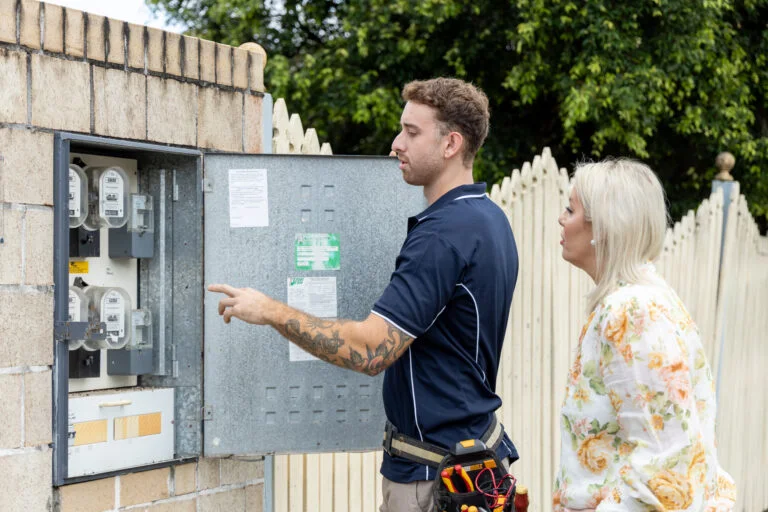
An electrical switchboard splits the single supply coming into your home across separate circuits: lights on one, power points on others. Safety switches and circuit breakers guard those circuits, with the main switch above them all. A fault trips whichever device protects that circuit.
Early telephone networks had a similar wiring problem, because every phone needed a line to every other phone until a central exchange gave each house one line. A home switchboard does the same job with power: one supply in, many protected circuits out.
What is a switchboard used for?
Everything wired into your house runs through the electrical switchboard. Most weeks nobody opens its door. Its important work happens in a fraction of a second during a fault, when the correct device has to disconnect the correct circuit.
You may also hear it called a fuse box, power box, breaker box or electrical panel. Breaker box and electrical panel are mostly American terms. The fuse box vs switchboard question comes down to age: fuse box only fits a board that still has fuses.
The meter box vs switchboard question causes more confusion. The meter box is the enclosure that houses the meter, and many older Brisbane homes have the household switchboard in the same box. Others have the meter outside and a residential switchboard indoors. Try the garage or laundry.
How does a switchboard work?
To see how switchboards work, start at the street and follow the power in. In most homes, the parts of a switchboard sit in this order:
- Consumer mains bring power in from the Energex network.
- A service fuse sits on that incoming supply.
- The meter measures it.
- Then the main switch, which you can turn off yourself.
- From there, a busbar, or looped cables on an older board, feeds the safety switches and circuit breakers.
- Last, the circuits themselves: lights, power points, appliances.
Current returns through the neutral bar. The earth bar stays out of normal operation and comes into play during a fault.
What are the parts of a switchboard?
The main electrical switchboard components are the main switch, busbar, safety switches, circuit breakers, neutral bar and earth bar. Age changes which switchboard parts you’ll see: fuses on an old board, RCBOs or surge protection on one fitted or upgraded more recently. A photo of someone else’s board can only tell you so much about how a switchboard works in your home.
Consumer mains and service fuse
The consumer mains are the cables that bring power from the network to your board. A service fuse usually sits on this incoming supply, ahead of the main switch. Leave it to an electrician or Energex. If it’s scorched, smoking or melted, keep clear and call Energex.
Meter
The electricity meter records what the house uses, and a smart meter sends those readings remotely. Neither type protects a single circuit.
Main switch
The main switch, also called the main isolator, disconnects the household circuits it controls. Turning it off doesn’t make the whole board dead. The incoming side of the switch stays live, as do the consumer mains and the meter.
Some circuits can also sit outside it. Off-peak hot water and pool equipment may have a separate switch, and a solar main switch isolates the inverter’s connection at the board. The cable from the panels can stay live in daylight.
This catches people out during kitchen and bathroom renovations. One switch labelled “main” doesn’t mean every conductor behind the cover has been isolated, and only testing confirms that.
Busbar
A busbar is the conductive bar or comb that carries power from the main switch across a row of devices. Older boards often do the same job with short looped cables. You won’t see either with the cover on, and a look inside a switchboard is a job for an electrician.
Safety switch (RCD)
A safety switch, or residual current device (RCD), compares the current going out on a circuit with the current coming back. When the two differ, some of that current is escaping, possibly through a person. A household 30mA RCD has up to 0.3 seconds to disconnect at its rated leakage. Higher leakage, faster trip.
Most confusion here is with the breaker. A safety switch protects people. A circuit breaker protects cables, and it won’t trip on the small current that can injure a person.
Press the test button every three months, as Queensland’s Electrical Safety Office recommends. An RCD that won’t trip, or won’t reset afterwards, needs an electrician. Check the labels while you’re there. On some older boards, the power circuits have an RCD, and the lighting circuits don’t, which was allowed when the board was installed.
Circuit breakers (MCBs)
A miniature circuit breaker (MCB) disconnects a circuit during an overload, when the current goes above what its cable is meant to carry. Plug a heater and an air fryer into the same circuit, and the breaker may take a little while to trip. A short circuit trips it almost instantly.
Flicking it back on once is reasonable. When a circuit breaker keeps tripping, the cause needs to be found, because the breaker is reporting a problem rather than creating one.
RCBO
An RCBO puts an RCD and a circuit breaker into one device for one circuit. A fault on the kitchen power then stays on the kitchen power. With one RCD shared across several circuits, the same fault can put a large part of the house in the dark.
Fuses
Older boards use a wire or cartridge that melts under excessive current. Ceramic fuses offer no shock protection, and cracked porcelain holders can leave conductors exposed.
A card of spare fuse wire beside the board tells its own story. That circuit may have been blowing fuses for years.
Neutral bar and earth bar
The neutral bar, or neutral link, gathers the conductors that carry current back from each circuit. The earth bar takes the protective earth conductors from appliances and metal parts in the house. Neither bar looks like much. A strip of metal, a row of screws.
Earth electrode
An earth electrode, or earth stake, connects the installation to the ground. People often describe switchboard earthing as a drain for spare electricity, and that’s wrong.
Australian homes use the Multiple Earthed Neutral (MEN) system. Inside the house, earth and neutral meet in one place: the MEN link at the main switchboard. A loose active wire touching a metal appliance case sends current along the earth wire to that link, then back along the neutral. Hardly any of it goes through the soil. A current that size trips the breaker or RCD within moments.
Surge protector
A surge protector diverts brief voltage spikes away from connected equipment, including spikes from storms. Surge protection is usually optional on a home switchboard, and it can’t stand in for an RCD or circuit breaker.
Enclosure and labels
The switchboard enclosure, or switchboard box, houses the switchboard parts and stops people from touching live conductors. Switchboard labels tell you which device controls which circuit. In a blackout, a clear label saves a lot of guesswork. Faded switchboard labels are a simple fix, so ask for them to be redone during any board work.
Neat boards are safe boards. Look for labelled circuits, covered neutral bars and phase colours you can identify. Exposed conductors and bundles of cable jammed into one terminal are signs of poor work, whatever the age of the board.
What do the numbers on a switchboard mean?
A number on the main switch is that device’s rating, and it doesn’t prove how much supply your house has. Buyers looking over a 50-year-old home often read “40A” on the board and assume that’s their limit. It might be. The service fuse and consumer mains have ratings of their own, and we’d look at all three before telling anyone what the house can take.
Marking | Usually found on | What it tells you |
40A or 63A | Main switch | The current that the switch is rated to carry |
C16 or C20 | Circuit breaker | Its trip curve and current rating |
30mA | RCD or RCBO | The earth leakage at which it’s designed to trip |
10kA or 6kA | Breaker or RCBO | The fault current it’s rated to interrupt |
Why does my switchboard keep tripping?
When a switchboard keeps tripping, the cause is usually an overload, a short circuit or earth leakage. Look at which device went off.
Fault | Device that usually reacts | What you notice |
Overload | Circuit breaker | One circuit drops out, often with several appliances running |
Short circuit | Circuit breaker | One circuit drops out immediately, sometimes with a bang from the appliance |
Earth leakage | Safety switch or RCBO | Several circuits at once if they share an RCD |
Unplug everything on the affected circuit and reset the device once. A second trip with nothing plugged in points to the fixed wiring. Leave that one off and call a licensed electrician.
If your switchboard is not working at all and every device is still on, ask whether the neighbours have power. The fault may be on the street. Any burning smell, heat, scorching or buzzing changes the job. Don’t touch the board.
What’s the difference between a switchboard and a distribution board?
In most homes, switchboard vs distribution board is a naming difference. A distribution board usually refers to a board that feeds a group of circuits. The main switchboard is the one where the supply enters the installation, and the MEN link is made.
A subboard is a smaller board fed from the main board. You’ll find them in sheds, granny flats and extensions, where a sub board lets an electrician add circuits close to where they’re needed.
Search for a switchboard diagram or switchboard wiring diagram, and many results show American panels, or commercial gear far removed from an electrical switchboard for home use. Electrical switchboards in Brisbane homes are built to AS/NZS 3000, the Wiring Rules. A US drawing is no use for checking your switchboard layout.
Do I need a new switchboard for a new appliance?
Not automatically. Your board’s age matters less than what you’re about to connect to it. Split systems, induction cooktops, EV chargers and batteries are what push an old house switchboard past its limits, particularly once several are running together.
People adding an air conditioner and an induction cooktop often worry they’ve opened Pandora’s box. Sometimes they have. We’d look at the supply and incoming cables first. A full board is the cheaper problem.
Some older boards are simply old and can be planned around. Others shouldn’t wait: exposed conductors, cracked fuse holders, heat damage and a defect notice from Energex all need prompt attention. When the board can’t take the work, a switchboard upgrade is the usual fix.
Could my switchboard contain asbestos?
Possibly, in a pre-1990 home. The mounting panel is the main suspect, and Queensland’s asbestos guidance also names zelemite boards and the wadding in some porcelain fuse holders.
Don’t drill, cut or sand an old backing panel. An asbestos switchboard doesn’t need to be treated as an emergency if it’s intact. A licensed electrician can remove a small package board under Queensland’s safe work procedure.
What does a switchboard do in a power outage?
During a network outage, nothing. The board loses its supply along with the rest of the street, and its devices usually stay switched on. Energex’s outage finder will confirm it.
If you’d like your own board checked, our electricians can go through each part with you and explain what needs attention and what can wait. Dylan and Kristine Dawson have run the business from Woolloongabba since 2007; every one of our electricians is fully licensed, and every quote is a fixed price. Call 07 3324 1447 or book an inspection online.
Switchboard FAQs
No. In Queensland, electrical work has to be done by a licensed electrician or electrical contractor. You can still operate the main switch, reset a tripped device and press the RCD test button.
Since 1 January 2025, Queensland's roof space rules have generally required workers to isolate the electricity before entering a domestic roof space. Plumbers, air conditioning installers and pest controllers are all covered, not only electricians. Expect the power to go off, and expect the worker to stay clear of cables, because some circuits can remain live.
Not on every older home. Power point circuits must have one in rentals and when a home is sold. New work has a higher bar: AS/NZS 3000 calls for RCD protection on final subcircuits rated up to 32A, with limited exceptions. Lighting circuits on an older household switchboard may still be unprotected, and we'd fix that even where the law doesn't force it.
Yes. We test a like-for-like swap the same as any other job on the board. AS/NZS 3000 Section 8 and AS/NZS 3017 make no exception for it. Ask for your Certificate of Testing and Compliance when we finish.
Under the current Wiring Rules, a cupboard housing a board has to be dedicated to it and can't double as storage. Clearance in front is 600mm for most domestic boards. Yours may have met the rules of its day. Have an electrician assess it before you move it or build around it.
No. Your appliances use the same energy whichever board supplies them.
The inverter has its own labelled solar main switch, separate from the household one. An electrician turns off both, then tests for dead before touching anything.
