

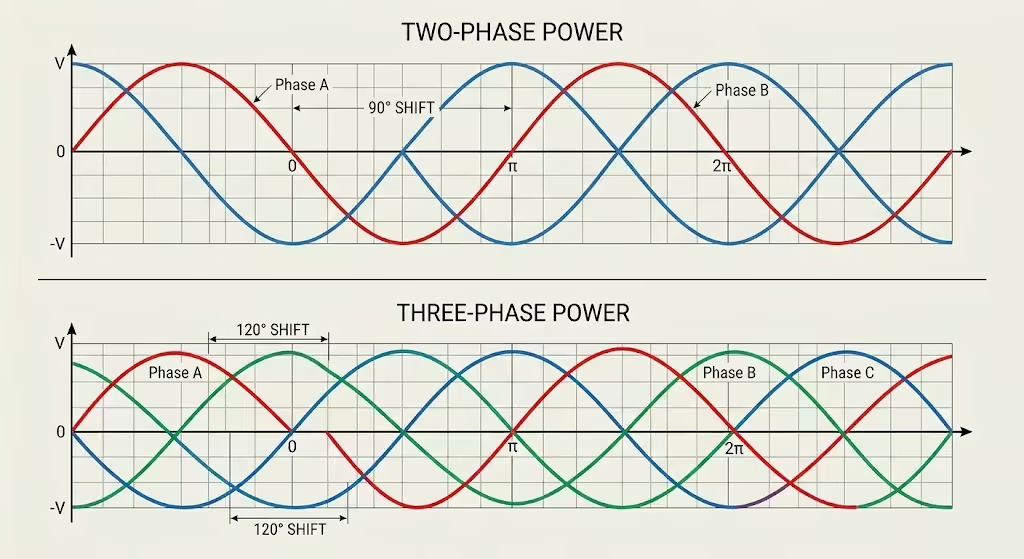
For most Brisbane homes, the 2-phase vs 3-phase question comes down to whether you run heavy motor-driven equipment. Two-phase connects two of the street’s three phases to your switchboard. Three-phase connects all three, and that’s what large ducted air conditioning, pool heat pumps and workshop machinery are built to run on. Lights and power points gain nothing from either.
If you can’t name what you’d run on three-phase, you probably don’t need it.
What Is 2 Phase Power?
A two-phase supply means two of the three phases running along your street are connected to the property. The electricity is no different. The label gets used loosely, but that’s all it describes.
Each phase delivers 230 volts to neutral, the same as any power point in Australia, with 400 volts between the two. Houses usually end up on 2-phase electricity because the pole or pit outside had only two phases when they were connected, or because a previous owner added a second phase for one large load and stopped there.
What 2 phase power can’t do is run a three-phase motor. Those need all three phases to start and turn. A two-phase supply sits in an awkward middle, with more capacity than single-phase and none of the equipment compatibility.
A full connection brings all three phases, which is why 3 phase power is the standard for commercial kitchens and workshops.
Is Three Phase Three Times the Power?
No. Your power points still see 230 volts. A load spread across three phases draws less current through each conductor, so the supply has more headroom before anything trips.
You’ll notice the difference when a compressor starts. Boiling the kettle, you won’t.
2 Phase vs 3 Phase: What Changes in Practice?
2 phase | 3 phase | |
Phases connected | Two of three | All three |
Voltage at power points | 230V | 230V |
Runs three-phase motors | No | Yes |
Solar limits (set per phase) | Two phases’ worth | Three phases’ worth |
Fastest home EV charging | 7kW single-phase charger | Up to 22kW, if the car accepts it |
Two-phase power suits a house with a couple of heavy single-phase loads that can be split across the phases. Anything with a three-phase motor needs the full set.
Who Needs Three-Phase at Home?
Homes with large motor loads, mainly bigger ducted air conditioning and pool heat pumps. Motors start with less strain on three-phase and run smoother once going.
Ducted air conditioning is the load people overestimate most. A 16kW rating describes how much heat the system moves out of the house. What it draws from your board is about 5kW, and a single-phase or two-phase supply carries that more often than people expect. The figure you want is labelled power input on the spec sheet. Read that one first. Some of the bigger ducted units are also sold in a single-phase version, so the supply you already have can decide which model ends up on the quote for your air conditioning installation.
Imported commercial gear is the other trap. Plenty of second-hand kitchen equipment and lathes are built for three-phase only, and no adapter changes that. Read the nameplate before you buy.
Businesses should size the supply for where they’re heading. A café that turns into a bakery meets three-phase ovens and mixers quickly, and a supply change after the fit-out costs more than one done during it.
What Are the Advantages of Three-Phase?
The lights dim for a moment every time a big compressor or welder starts on a single-phase supply. Give that load its own phase, and the dip goes.
Solar limits rise as well, because Energex applies them per phase. A single-phase home typically gets approval for up to 10kVA of inverter capacity and 5kW of export.
EV charging is where people overspend. A three-phase charger can deliver 22kW, but most cars on Australian roads won’t take more than 11kW from an AC charger, and a fair few are limited to 7kW on a single phase. Check the onboard charger rating in the car’s specs before you pay extra for a three-phase EV charger installation.
Single-phase appliances keep running as before.
The best time is during a build or major renovation, when three-phase costs far less than a retrofit and adds value to a larger home. If you can upgrade to 3 phase power while the service is being replaced anyway, take it.
What Are the Downsides?
Three-phase only pays off when the load is spread evenly across the phases, and balancing a house is harder than it sounds. An electrician can split circuits neatly on paper. Then the air conditioner and the oven both run at dinner time.
Each phase also has its own limit. One large single-phase appliance can trip its phase while the other two sit half empty, which surprises owners who upgraded expecting the tripping to stop. The same applies to 2-phase power.
Three-phase breakers and metering cost more than single-phase equipment.
Energex approval and the meter change run on their own timeline. Don’t order equipment that depends on the upgrade until the upgrade is confirmed.
How Do I Know If I Have 3 Phase Power?
Check the main switch on your switchboard. A three-phase supply usually has a main switch three poles wide, joined by one bar. A two-pole main switch points to 2-phase electricity.
Other giveaways: three service fuses in the meter box, or a meter marked 3-phase. Leave the switchboard covers on. One of our electricians can confirm it in a few minutes on site.
What Does It Take to Upgrade to 3 Phase Power in Brisbane?
Your electrician checks the street supply and the switchboard, then applies to Energex for the new connection. The on-site work is short. Most of the wait is network approval and the meter change, which your retailer arranges.
Any quote given before someone has looked at your street connection is a guess. The Energex 3-phase upgrade cost depends mostly on what’s outside your boundary. Where the pole or pit already carries all three phases, the network side is straightforward. Where it doesn’t, Energex may need to extend its own infrastructure, and that becomes the largest part of the bill.
Inside the property, the cost to install 3-phase power in Brisbane is driven by the consumer mains: how far the cable runs from the street to your meter box, and whether it goes overhead or underground. Older Brisbane boards with ceramic fuses rarely have room for three-phase breakers, so a switchboard upgrade often goes in with the new supply.
Is There a Cheaper Option Than a Full Upgrade?
Often, yes. An upgrade doesn’t always mean a new switchboard. The existing board can stay on one phase while a second board takes the new three-phase equipment, which leaves the old circuits alone and keeps the job smaller.
Load management can avoid the upgrade entirely. A load controller stops the EV charger and air conditioner from running flat out together, so a single- or two-phase supply copes with both. For a house that only runs short of capacity at peak times, we’d try this first.
Talk to a Brisbane Electrician
The 2-phase vs 3-phase decision gets simple once you have two things in hand: the spec sheet for whatever you plan to run, and a photo of your switchboard. Dawson Electric has been a family-owned Brisbane electrician since 2007, run by Dylan and Kristine Dawson. Our licensed electricians will tell you plainly when a sub-board or load controller does the job without a full upgrade. Send us the spec sheet or call 07 3324 1447, and we’ll give you a fixed-price quote once we’ve seen the street connection.
2-Phase and 3-Phase FAQs
Not very. Most Australian homes are single phase, and three phase is the usual step up. Two-phase supplies turn up mainly on older properties where only two phases ran past the house.
No. A three-phase motor running on two phases can overheat and burn out.
Your appliances use the same energy on any supply. Some retailer plans charge a different daily supply rate for a three-phase meter, so compare plans after the meter changes.
For a normal commute, yes. A 7kW single-phase charger runs off one of your phases and refills a day's driving overnight. Faster 11kW and 22kW chargers need all three phases. A household with two EVs covering long distances is where that starts to matter, and load management usually solves it before an upgrade does.
