

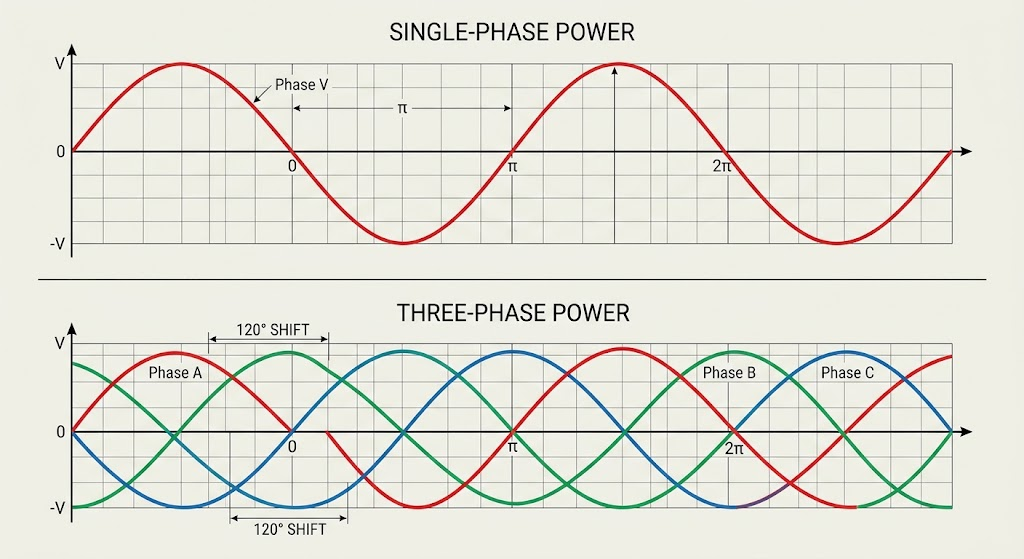
Single-phase vs 3 phase comes down to how much power your home can draw at once. Single-phase power is one active connection to the grid. Three-phase is three, giving roughly three times the capacity. Three-phase isn’t better power, just more of it, and most Brisbane homes don’t need it until they go fully electric.
Gas cooking and a petrol car kept household demand modest for decades. Swap them for induction and an EV, and the practical difference between single-phase and three-phase starts to show, usually around dinner time.
What is 3-phase power?
Three-phase power brings three active conductors into the property, plus a neutral, whereas a single-phase home has one active. Both single-phase and three-phase power deliver 230 volts on each phase. Ask about 3 phase voltage in Australia, and you’ll also hear 400 volts, measured between two phases. Only large equipment connects that way.
A rowing boat is the easiest way to picture the difference between single-phase and three-phase. One rower gives a stroke, then a gap, then another stroke. Add two more rowers, each timed a third of a stroke apart, and someone is always pulling. Electric motors notice. On three-phase, they start more easily and run smoother, which is why factories and large commercial air conditioning are built around it.
Inside the house, surprisingly little changes. Almost every one of your lighting and power circuits stays single phase after an upgrade. We spread them across the three phases so no one phase carries the load, and the kettle never knows the difference. Large equipment, such as a big ducted system or a fast EV charger, is the exception and connects across all three.
Does your home need 3-phase power?
Probably not. Most homes run comfortably on single-phase. If nothing you own needs it and you aren’t running short of capacity, an upgrade to 3-phase power is money spent on bragging rights.
Air conditioning used to be the main reason people upgraded, because larger ducted systems were often only available in three-phase. Modern inverter ducted systems changed that. Single-phase models now cover most house sizes, so air conditioning alone rarely justifies the upgrade. Replacing an old three-phase ducted unit? Check whether a single-phase equivalent exists before assuming you’re locked in.
Home workshops come up often, and they rarely need it either. A couple of 15-amp outlets on their own circuits will run most welders and compressors sold for home use. A lathe or dust extractor built for an industrial supply is a different conversation.
When does a home outgrow single-phase power?
When it goes all-electric. An induction cooktop, EV charger, ducted air conditioning, pool heating and electric hot water can all want power at 6 pm on a summer evening, a combination no single-phase supply was sized for.
The kitchen alone can tip it over. Two induction cooktops at 32 amps each don’t fit on a 63 amp supply before anything else in the house is switched on. One cooktop is more common. Add a car on charge in the garage, and the margin goes quickly.
You’ll usually notice before any calculation does. Households start choosing between a hot shower and another appliance, or the main breaker trips around dinner time. Either one means you’ve hit the ceiling.
The single-phase vs 3-phase decision itself should come from a maximum demand calculation, the method set out in Appendix C of AS/NZS 3000. We add up what you’ll run at the same time, including anything you’re planning to add. The number tells us whether the existing supply still works.
Sometimes it does, with help. A load management controller can switch off the hot water or slow the EV charger when demand peaks, which keeps plenty of homes on single phase for years longer.
Single phase vs 3 phase: which is better for solar, batteries and EV charging?
Three-phase gives solar and EV charging more room. Batteries are where it gets awkward.
Solar
Under Energex’s standard limits, a single-phase home can install up to 10kVA of inverter capacity but export only 5kW. A three-phase home can go to 30kVA and export up to 15kW. For a large roof, that difference is the whole argument for three-phase. The inverter costs only slightly more in three-phase form.
Existing solar is the catch. Energex limits how unevenly a system can feed each phase, so a single-phase inverter can fall outside the rules once the supply changes. Plan for a replacement inverter as part of the upgrade.
Batteries
Fewer batteries are made for three-phase homes, and they cost more. Compare single-phase vs three-phase on batteries alone, and single-phase wins. Some households get more from putting the upgrade money into a battery and staying where they are, so price both.
EV charging
Single phase caps a home charger at about 7kW. A 3-phase EV charger can deliver up to 22kW, but plenty of cars can’t accept it. Many popular models top out at 7kW or 11kW on AC charging, so check the car’s onboard charger rating before paying for a bigger supply. Overnight, 7kW comfortably covers a normal day’s driving.
How much does it cost to upgrade to 3-phase power?
The 3-phase power upgrade cost depends mostly on what sits between the street and your switchboard, which is why quotes vary so much from house to house. A price given without a site visit is a guess.
Underground supply makes the biggest difference. If your house is fed from a pit in the footpath, a new three-phase consumer mains cable may need trenching across the front yard, and concrete driveways or established gardens add labour. Overhead supply is usually simpler, with Energex replacing the service line from the pole. Distance matters as well, mostly on larger blocks.
The switchboard comes next. Three-phase breakers take three times the space of single-phase ones, and older boards rarely have room, so a switchboard upgrade often comes with the job. A board still running ceramic fuses will need replacing regardless.
Part of the Energex 3-phase upgrade cost sits outside your electrician’s quote. Energex may charge for work on its side of the connection, and your retailer arranges the new meter. Your electrician lodges the request and coordinates both.
Timing matters most. During a build or major renovation, when the mains are being run or moved anyway, the cost to install 3-phase power in Brisbane is a small part of the job. A retrofit later means redoing that work. If you’re building now and still weighing up single or 3-phase, we’d put it in.
How do I know if I have 3-phase power?
Look at the main switch on your switchboard. A single-phase home has a one-pole main switch. A three-phase home has three poles linked together, or three main switches side by side.
The service fuses and the meter confirm it. Three service fuses mean three-phase, and the meter label will usually show it too.
Extra wires in the conduit don’t mean three-phase. Off-peak hot water circuits account for most of those.
Don’t open the sealed meter panel or pull service fuses to check. That’s licensed work, and the seals belong to Energex.
Get the numbers before the quote
A single vs three-phase decision is easier with the numbers in front of you. Our licensed electricians run a maximum demand check on your home and tell you plainly whether single phase will cope with your plans. When an upgrade makes sense, the quote is fixed-price, switchboard included. Dawson Electric is a family-owned business that has been working on Brisbane homes since 2007. Call 07 3324 1447 or book a maximum demand check.
Frequently Asked Questions
In most established suburbs, yes. The low-voltage network in the street usually carries all three phases even when each house takes only one. Whether your property can connect depends on the nearest pole or pit and the spare capacity on the local transformer, which Energex confirms when your electrician applies.
No. You pay the same rate per kWh on either supply.
Keep it. A downgrade costs money and gives up capacity you may want later for an EV or a pool heat pump, so be wary of any quote that recommends one.
Buyers rarely compare 3-phase vs single-phase at an open home. For one, planning a big shed or an EV charger, though, three-phase already in place removes a job they'd otherwise factor into their offer.
No. A three-phase unit needs a three-phase supply. For a single appliance, a single-phase model of similar capacity is usually cheaper than upgrading the whole supply, and those models now cover most homes.
