

An air conditioner won’t turn on most of the time because power isn’t reaching it. A tripped breaker at the switchboard, a safety switch that’s gone, or an isolator someone flicked off and forgot. Work through every point where power can stop before you start suspecting the unit itself. You often won’t get that far.
Not a satisfying answer when it’s 34 degrees, and the house is closed up. Honest, though, and it’s why a no-power callout starts at the board and works outward.
Why won’t my air conditioner turn on?
There are three places power to a split system can be interrupted, and most homeowners know about one.
The first is the switchboard, where a correctly installed air conditioner sits on a dedicated circuit with a breaker or RCBO to itself. The second is the isolator on the external wall near the condenser, a small grey box with a lever or a pull-out handle. On ducted systems there’s a third, usually in the roof space or mounted beside the indoor fan coil, and plenty of people have lived in a house for a decade without knowing it exists.
Pull-out handles in outdoor isolators get put back upside down after unrelated work, and the job comes up several times a summer. Looks connected. Isn’t.
Then there’s the seasonal version, which is close to a Brisbane tradition. The unit gets switched off at the board somewhere around May, nobody touches the thing through winter, and the first hot day in October arrives with a dead air conditioner and a five-month-old switch position nobody remembers changing. If you cover your outdoor unit for winter or shut it down at the board, write it somewhere. A note on the switchboard door does the job.
The controller lights up, so the power must be fine
No. The single most common wrong conclusion homeowners land on before picking up the phone.
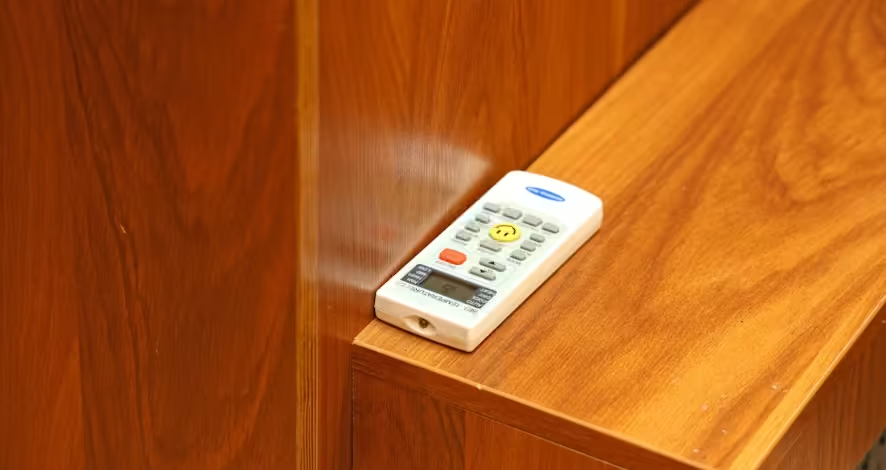
A wall controller lights up because it’s running on batteries or on a low-voltage control line. A remote beeps because the batteries in the remote are good. Neither tells you whether 230 volts is arriving at the head unit or the condenser outside. The display is reporting on itself.
If the controller responds and nothing else happens, that’s consistent with a total loss of supply. Go and look at the board.
Circuit breaker or safety switch: which one tripped?
These get used interchangeably in conversation and they are not the same device, and the difference changes what you should do next.
A circuit breaker protects the wiring. It trips when the circuit draws more current than the cable is rated to carry, usually from an overload or a short. A safety switch, the RCD, protects people. It monitors the current going out against the current coming back, and when a small amount goes missing to earth, it cuts supply in well under a tenth of a second.
Telling them apart at the board takes a second. Safety switches have a test button, marked T or TEST. Circuit breakers don’t.
Now the part that matters. A breaker that keeps tripping on the air conditioning circuit points at the load, most often a compressor drawing hard on startup or a motor on its way out. Worth a look, rarely dangerous in itself. A safety switch tripping is a different message. Something is leaking current to earth, and in Brisbane that’s very often moisture, either in the outdoor unit after a storm or in a cable run through a roof space that’s had rodents in it.
Reset it once. If it goes again, leave it and call someone.
Worth knowing about older homes here: safety switches only became compulsory on new Queensland dwellings in the early nineties, and on lighting circuits around the turn of the century. Hardwired equipment like air conditioning has historically sat outside the mandatory list. So in a fair few post-war and eighties Brisbane houses, the aircon circuit runs on a breaker with no RCD behind it at all. Those older boards rarely have the spare width to retrofit one either, which is how a small safety job turns into a switchboard upgrade. Once the board is open, fitting safety switches on every circuit is what the current wiring rules expect anyway.
Air conditioner won’t turn on after a power outage
Storm season does two things to air conditioners. The obvious one is the outage itself. The less obvious one is what happens on the way down and back up.
Some units go into a lockout state after an abrupt loss of supply and need a full power cycle to clear, not a remote press. Kill it at the isolator, leave it a few minutes, restore. If the breaker or RCD at the board tripped during the event, reset that first.
Brownouts do more damage than blackouts and get blamed less, because the lights only dimmed and everything seemed fine. Voltage sags hit motors and control boards hardest.
Air conditioner outside unit won’t turn on
Indoor unit runs, fan blows air at room temperature, and the condenser outside sits there doing nothing. Classic presentation.
The causes range from a tripped isolator to a failed contactor, a dead run capacitor, or a control fault. Here’s some unsolicited advice: don’t buy parts yet.
This happens constantly, and it’s an expensive habit. Someone reads that contactors and capacitors are the two common failures, replaces both, and discovers the fault was neither. A weekend gone and two working parts in the bin. Measure for voltage at the unit before replacing anything in it. If there’s no supply arriving, the most expensive contactor in Brisbane won’t help.
There’s a hard safety line in this section too. A capacitor holds a charge after the power is off. It doesn’t care that you flicked the isolator. That’s a physics problem, not a skill problem, and it’s a reasonable place for a homeowner to stop.
Air conditioner fan won’t turn on
Two versions of this, and they’re separate faults.
Indoor fan dead while the unit clearly has power usually points at the fan motor, its capacitor, or the indoor control board. Outdoor fan still while the compressor hums is more often the fan capacitor or a seized motor bearing, and it will cause the system to shut down on high pressure fairly quickly if it’s left running that way.
Turn it off if you hear the compressor labouring with a still fan.
Has anyone been in the switchboard lately?
If the air conditioning stopped working within a week of a switchboard upgrade, a solar install, a new circuit, or any other electrical work, start there. Timing that tight is almost never coincidence, and the fix is usually small.
Circuits get relabelled, and isolators get left open at the end of a long day. Mention the recent work up front. It saves forty minutes of hunting.
Where the homeowner checklist stops
Breaker and safety switch positions are fair game. So are the outdoor and roof isolators, the remote batteries, and a filter that hasn’t been cleaned since the last owner.
Past that you need a meter and a licence, and enough experience to know what the reading means. Both of the first two are non-negotiable in Queensland for anything involving fixed wiring.
One more thing, because it comes up and it deserves a straight answer. If someone tells you the unit needs replacing, ask which component failed and what reading condemned it. Plenty of good technicians will give you that in thirty seconds. If nobody can, get a second opinion before you spend on a new system, because houses on their third replacement quote have a habit of turning out to have a loose termination in the isolator.
Book a licensed Brisbane electrician
If you’ve been through the switches and the unit is still dead, our team can trace the supply properly and tell you exactly where it stops. Dylan and Kristine have run Dawson Electric out of Woolloongabba since 2007, and the 300-plus five-star reviews largely come down to two things: turning up when we said we would, and leaving your house the way we found it.
Fixed pricing, free quotes, and every electrician on the team is fully licensed. Call 07 3324 1447 or get in touch, and we’ll get someone out to you.
