

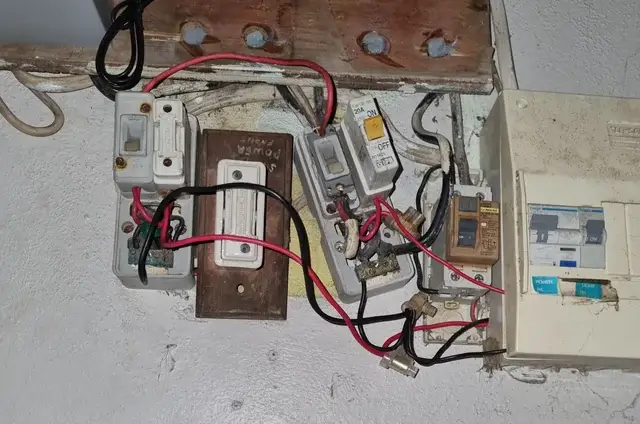
Most Brisbane homes built before 2019 don’t fully meet AS/NZS 3000:2018, the national wiring rules currently enforced in Queensland by the Electrical Safety Office. Compliance gets triggered the moment any electrical work happens. Selling. Leasing. Renovating. Even adding a single power point. The rules that apply now are tighter than most property owners realise.
The Queensland-specific angle most people miss: safety switches are mandatory on the power circuit before you can sell or rent a home here. That’s not advisory. It’s law under the Electrical Safety Regulation 2013.
What does electrical compliance mean in Brisbane?
Electrical compliance in Brisbane means the installation meets AS/NZS 3000:2018, enforced in Queensland by the Electrical Safety Office under the Electrical Safety Regulation 2013. For most property owners, the issue surfaces when they’re selling or having electrical work done.
Touching an old circuit triggers the current standard. Pre-2019 installations were done under AS/NZS 3000:2007, and the rules changing since then don’t retroactively fail older work. But add a power point to an existing subcircuit, move a switch, replace the board. Any of that brings the affected circuit under AS/NZS 3000:2018. For most Brisbane homes built before 2019, that means fitting 30mA RCDs on circuits that currently have none. Post-war lowsets in Wavell Heights, Queenslanders in Paddington, 1980s brick in Carindale. A lot of them are running without safety switches on lighting circuits at all.
The Electrical Safety Office sits within Workplace Health and Safety Queensland, drawing authority from the Electrical Safety Act 2002 and the Electrical Safety Regulation 2013.
Are safety switches legally required on Queensland homes?
Yes, and Queensland has a tougher rule than most states. Under the Electrical Safety Regulation 2013, a safety switch must be installed on the power circuit before a Brisbane home is sold or leased. The seller has to declare it on the Form 24. Landlords have to ensure one is in place before a new tenancy starts. The exact timing rules have shifted over the years, so worth confirming the current regulation with your sparkie before listing.
That’s separate from the wiring rules. AS/NZS 3000:2018 Clause 2.6.3.2.2 requires 30mA RCDs on all final subcircuits in new domestic installations: lights, power, the lot. The Queensland regulation goes further on existing homes. It makes the safety switch a precondition of selling and leasing, not just a requirement for new wiring.
For older homes (a 1960s lowset in Wavell Heights, a post-war brick in Coorparoo, a worker’s cottage in Paddington), this is usually the first thing that needs sorting. Most still have the original switchboard with ceramic fuses or early MCBs. Plenty of overcurrent protection. Zero shock protection.
Circuit breakers protect wiring. When the current exceeds the breaker’s rating, it trips. That’s the job they do. A fault where current leaks to ground through a person or through wet timber won’t necessarily trip the breaker at all. Not if the leakage current isn’t high enough to exceed the rating. That’s what an RCD catches. Also called a safety switch, or residual current device, it measures the difference between current going out on the active conductor and current returning on the neutral. A divergence of 30 milliamps cuts the circuit in under 30 milliseconds.
Brisbane homes with old ceramic fuse boards (rewirable fuses, no RCDs, sometimes no MCBs either) often have nothing protecting against electric shock. The wiring is protected from overload. The people using it aren’t necessarily protected at all.
What triggers a switchboard upgrade in Brisbane?
A few things, depending on what you’re doing.
If the existing switchboard is being replaced, even like-for-like, every final subcircuit it supplies has to come up to current standard. That means 30mA RCD protection on everything. Lights, power, hot water, air con, oven, pool pump. Under AS/NZS 3000:2018 Clause 2.6.3.2.5, there’s no exemption. Replace the board, upgrade the protection across the lot.
Selling or leasing the property triggers the safety switch requirement on the power circuit at a minimum. Lights aren’t covered by the Queensland sale/lease rule, but the wiring standard pushes toward broader coverage whenever work is being done.
Adding or moving anything on a circuit counts as an alteration. New downlights in a Queenslander renovation. A second power point in the renovated kitchen. A subcircuit extended to a new shed out the back. These all modify the circuit’s characteristics, and Clause 2.6.3.2.5 pulls the affected subcircuit into the current RCD requirement.
People get tripped up on the like-for-like exception. Replacing a single fitting in the same location doesn’t trigger an upgrade if the circuit itself stays unchanged. Swap a worn GPO for a new one in the same wall position. Replace a light fitting with an equivalent. Clause 2.6.3.2.6 treats that as a repair, not an alteration. No RCD required.
The word “equivalent” matters, though. Swapping a 10A GPO for a 15A GPO draws the line somewhere different. Replacing a hardwired light with a pendant on a flex changes the circuit. These look small. They aren’t.
What certification does your Brisbane electrician have to give you?
Under the Electrical Safety Regulation 2013, a licensed electrical contractor must issue a Certificate of Test for the work performed. It’s not the paperwork the electrician chooses to provide. It’s a legal obligation, covering everything from a single power point installation through to a full rewire.
The certificate confirms the work was performed by a licensed electrical worker, tested in accordance with AS/NZS 3000:2018, and signed off by someone authorised to sign it off. For notifiable electrical work (the kind that goes beyond minor repair), there are additional submission requirements through the Electrical Safety Office.
What this means practically: if work has been done on your property and you can’t produce certificates, you’re carrying a documentation gap that matters when you sell, when you claim on insurance, or when a defect notice arrives from Energex.
Energex notices are worth knowing about. As the distributor for South-East Queensland, Energex periodically issues defect notices on properties where the installation doesn’t meet supply standards. Once a notice lands, you’ve got a defined window to fix the issue. Ignoring it ends in disconnection. A clean certificate trail makes that situation far easier to manage.
Does adding a power point require a safety switch upgrade?
Yes. Adding a power point to an existing circuit is an alteration, not a repair. It changes the circuit. Under AS/NZS 3000:2018 Clause 2.6.3.2.5, that alteration brings the subcircuit into the current RCD requirement at 30mA.
There’s a workaround Clause 2.6.3.2.3.2 allows. A socket-outlet RCD installed at or adjacent to the new outlet itself, if the existing circuit has compliant mechanical protection. It’s not the preferred approach. An RCD at the switchboard protects the whole circuit. An RCD at the outlet protects only that outlet. For budget-tight renovations, it’s a legitimate option, but the better solution is upgrading at the board.
This is where homeowners get caught up in quote comparisons. The electrician quoting cheaply is sometimes the one not pricing in the RCD upgrade. The job looks straightforward. Drop in a new power outlet in the kids’ bedroom. Then the switchboard work appears in the second quote, and the first quote stops making sense.
Ask up front. Get it in writing. The rule applies regardless of who’s quoting.
What isolation switch does a Brisbane hot water or air con need?
Lockable. Adjacent to the unit. Not mounted on the unit itself.
That’s the short answer. The detail sits in AS/NZS 3000:2018 Clauses 2.3.4.5, 4.8.2.3, and 4.19. Every fixed-wired hot water system, every air conditioner, every heat pump needs an isolating switch you can lock. Within arm’s reach of the equipment, accessible without obstruction, and not screwed to the side of the compressor housing.
“Adjacent” has a defined meaning in the standard. Within arm’s reach. Roughly 1.25 metres. Accessible without moving anything to get to it. Mounted on the unit fails the rule even if everything else passes.
Systems plugged into a GPO follow a different rule. If the GPO is readily accessible, reachable without obstructions and no more than 2 metres above the floor, the GPO satisfies the isolation requirement. No separate switch needed. That covers portable air cons, heat pump hot water units plugged in rather than hardwired, and similar setups.
Common failures we see in Brisbane installations: isolators screwed to the unit, isolators tucked into the roof space behind insulation, isolators hidden behind built-in cabinetry. All non-compliant. All are easy to spot once an inspector knows where to look.
This is the area where the heat pump rebate scheme has surfaced a lot of older non-compliance. When the old electric storage tank gets replaced under one of the rebates, the isolator question gets asked properly for the first time in twenty years. Most pre-2019 installations don’t have lockable isolators on the hot water at all.
How close can a power point sit to your cooktop?
Clause 4.7.3 of AS/NZS 3000:2018 prohibits any GPO or switch within 150mm of a cooktop, gas or electric. The 150mm runs from the edge of the cooking surface. The prohibited area then extends upward: to the rangehood, or the underside of an overhead cupboard, or 2.5 metres above the floor directly below the cooktop, whichever you reach first.
This requirement came in with the 2018 edition. Brisbane kitchens wired before 2019 regularly have GPOs sitting right next to the hob. Not because the work was done poorly. The requirement didn’t exist under AS/NZS 3000:2007. The previous electrician wasn’t cutting corners. Pre-2019 kitchens aren’t retrospectively non-compliant for this reason. Any new electrical work in that kitchen, though, has to meet the current standard.
A combined gas-and-electric cooker has its own clause. It needs an isolating switch within 2 metres of the appliance, switching both active and neutral, in a readily accessible position. Not on the cooker itself.
When the rule gets enforced is during the next compliance event, a sale, a renovation, or an insurance assessment. Until then, non-compliance sits dormant.
What about external power points and verandah lights?
Most Brisbane homes have something outside that’s questionable. A GPO on the patio. A light under the deck. An outlet on the side of the carport that’s been weathering since the place was built.
The IP rating rule under Clause 4.1.3 works on geometry. Draw a line from the outer edge of your eave or verandah down to the wall at 30 degrees. Inside that wedge, standard accessories without specific IP marking are fine. Outside it, anything electrical needs a minimum IP rating of IP33.
Meter boxes get a small concession. IP23 instead of IP33.
The practical problem in Brisbane is humidity. Condensation builds inside outdoor enclosures, and the temptation is to drill a drain hole in the bottom of the box to let moisture escape. That destroys the IP rating instantly. Purpose-made condensation drainage that maintains the IP rating is the only legitimate option.
For Queenslander stock with verandah lighting and external GPOs installed forty years ago, this is worth a look. The IP rules have moved forward several times since those installations went in, and most of them sit well outside the 30-degree protected zone.
What are the bathroom and shower rules?
The wet area rules are stricter than people expect. Under AS/NZS 3000:2018 Section 6.2, bathrooms are divided into zones. Zone 0 inside the bath or shower base, Zone 1 immediately around it, Zone 2 extending further out. Each zone has its own restrictions on what can be installed.
Power points and switches are prohibited in Zones 0 and 1. Zone 2 allows them with appropriate IP ratings and protection. The exact zone dimensions shift depending on the shower configuration: hinged door, fixed barrier, ceiling-mounted head, or open floor drain.
Amendment 2 in 2021 expanded the equipotential bonding requirement. Every exposed conductive part within reach of someone using the bath or shower needs to be bonded back to the earthing system. Metal pipes. Tap fittings. Towel rails. Bonding stops a fault elsewhere in the property from putting a dangerous voltage on something a wet person is touching.
This rarely gets checked in older Brisbane bathrooms. The renovation that re-tiled the shower didn’t usually involve an electrician looking at the bonding situation under the floor. When it does get checked, it usually fails.
Why is any of this worth dealing with now?
Three reasons.
Insurance is the first. An insurer investigating an electrical claim (fire, shock, anything) looks at whether the installation was compliant and whether work was certified. Missing certificates, absent safety switches, and undocumented alterations all give the insurer grounds to deny. A claim that should have been straightforward becomes a personal loss.
The sale and lease rule is the second. Queensland makes safety switches a condition of selling or leasing residential property. There’s no quietly deferring it until the conveyancer asks. The Form 24 covers it. The agent’s checklist covers it. The first compliant tenant covers it. Eventually, someone catches it, and by then, you’re working under time pressure rather than getting it done properly.
The third reason is simpler. The rules exist because people get hurt when they’re not followed. Bathroom shocks. Switchboard fires. Kitchen GPOs caught fire from the cooktop heat because they were sitting too close to a gas burner. The standard tightens after enough incidents accumulate to justify it. The 2018 edition wasn’t written in a vacuum. Neither was Amendment 2.
FAQ
Not necessarily. The Queensland sale rule requires a safety switch on the power circuit, which can usually be added to the existing board if there’s room. A full switchboard replacement is a bigger trigger. Clause 2.6.3.2.5 pulls every subcircuit into the RCD requirement when the whole board comes out. Contact us to look at what you’ve got before assuming the worst.
Yes. Adding the outlet is an alteration, which means Clause 2.6.3.2.5 applies. The RCD can go at the switchboard or at the outlet, depending on what the existing circuit looks like. Cheap quotes that don’t mention this are usually about to surprise you.
The document a licensed electrical contractor gives you after testing electrical work in Queensland. Required under the Electrical Safety Regulation 2013. If work has been done on your property and you can’t put your hands on the certificate, that’s a gap worth closing, particularly before a sale, claim, or audit.
Not unless someone’s doing new work in it. Pre-2019 kitchens were installed under AS/NZS 3000:2007, and a rule introduced in the 2018 edition doesn’t fail older work retrospectively. The trigger is the next job. An electrician fitting a new point, extending a circuit, or moving a switch. That work has to comply with the current standard, including the 150mm clearance from the cooktop. So an old GPO sitting next to the hob stays put until someone works in that kitchen, and then it gets addressed as part of the job.
Energex defect notices typically relate to something on the network’s side of the meter. Occasionally, the fault involves the installation too. That’s when the network’s equipment and the property’s wiring share a problem. In that case, the property owner has to fix their end before Energex will close the notice.
A licensed electrical contractor does the work and issues a Certificate of Test confirming it’s been done. That’s what gets the notice cleared.
A safety switch on the power circuit is a requirement under Queensland law before a residential property can be leased to a new tenant. The Electrical Safety Regulation 2013 sets this out. The timing rules around exactly when it has to be in place have shifted under different versions of the regulation. Worth confirming the current requirements with a Brisbane electrician before listing. The core obligation hasn’t changed.
