

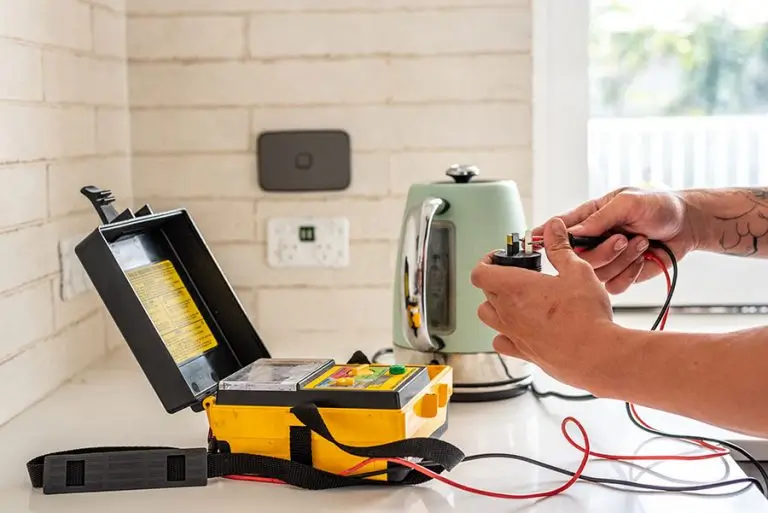
Test and tag costs Brisbane businesses somewhere between $3 and $6 per item, with a minimum call-out of around $120. RCDs are billed separately, and volume discounts kick in past the 50-item mark. Those are the numbers. What most pricing guides won’t tell you is that in Queensland, the Electrical Safety Regulation 2013 overrides the Australian Standard everyone quotes, and that changes how often you actually need to retest. Get the interval wrong in either direction, and you’re paying for testing you don’t need, or carrying a compliance gap you don’t know about.
What Does Test and Tag Cost in Brisbane? (2026 Rates)
Here’s how the pricing works. No ranges are wide enough to be meaningless, just the way the invoice is actually built.
| Service | Rate (inc GST) |
| Standard item (leads, tools, appliances), first 50 | $4 to $5 per item |
| Standard item, 51 and beyond | $3 to $4 per item |
| Portable RCD (push-button plus operating time) | $10 to $12 per unit |
| Minimum call-out | around $120 |
| Failed-item retest after repair | standard item rate |
The per-item rate is only half the picture. A few things move the final test and tag cost up or down, and it’s worth knowing which before you compare quotes:
| Factor | Effect on price |
| Total item count | More items, lower per-item rate |
| Site access | Multi-level or restricted access adds time, and time is what you’re buying |
| After-hours testing | Loading applies, usually worth it for kitchens and retail |
| Multiple sites | Quoted as one job where scheduling allows |
| Failed items | Retest billed after repair, not bundled into the original visit |
What Does Test and Tag Pricing Include in a Brisbane Quote?
A proper test and tag service has six parts, and every one of them should be in the price: visual inspection of the lead and casing, the electrical test itself, a durable tag on the item, a written report, a certificate of compliance, and a retest reminder before your next interval falls due.
The visual inspection matters more than people expect. A good proportion of failures are picked up before the tester comes out of the van. Cracked plugs, taped-over leads, crushed insulation. The machine confirms what a trained eye already suspects.
What’s usually not included, with us or anyone: repairs to failed items, replacement leads, out-of-hours loadings, and travel to remote suburbs. Any quote that looks unusually cheap has generally moved one of those into the fine print. When you’re comparing test and tag pricing between providers, ask what happens after an item fails. That’s where the quotes stop matching.
What Three Brisbane Businesses Actually Paid
Per-item rates answer nothing on their own. What a business actually pays depends on item count, interval, and RCDs.
Small office, Fortitude Valley, around 40 items. At $4 to $5 per item, the visit lands somewhere in the $160 to $200 range. Under the Electrical Safety Regulation, office equipment without safety switch protection sits on a five-year cycle, so that works out to roughly $35 to $40 a year. Most offices are set in the right direction.
Café with a commercial kitchen, around 25 items, tested twice yearly. Twenty-five items fall under the minimum call-out, so each visit is around $120. Two visits a year put the annual figure near $240. Kitchens run hot, wet and hard on equipment, and the shorter interval reflects that. Businesses on a commercial electrical maintenance schedule usually roll testing into the same visits, which trims the call-out cost.
Construction site, around 60 items plus four portable RCDs, quarterly. Sixty items plus the RCDs put each visit somewhere around $300. Four times a year, that’s an annual spend in the $1,200 to $1,300 range. This is the number that catches builders out. The test and tag cost per visit looks modest, but quarterly testing compounds. Budget annually, not per job.
How Often Do You Need Test and Tag?
Queensland sets intervals by type of work, not by the “hostile environment” language you’ll find in most guides. That framing comes from the national Standard. The QLD regulation does it differently, and the regulation is what applies here.
| Type of work (ESR framing) | Retest interval |
| Construction and demolition | 3 months |
| Manufacturing and workshop | 6 months |
| Service work (equipment regularly moved) | 12 months |
| Office and administrative | 5 years, or safety switch protection instead |
| Amusement devices | 6 months |
| Hire equipment | Inspected before each hire |
Two lines in that table catch people out. Office equipment only needs five-yearly testing where there’s no safety switch on the circuit, and plenty of Brisbane offices are paying for annual testing they aren’t required to have. Hire equipment goes the other way: inspection before every single hire, which surprises operators who assumed a yearly tag covered them. Getting test and tag frequency right is mostly about knowing which column of the regulation your work actually falls under, and that’s a five-minute conversation, not a judgment call. We’ve covered the broader test and tag guidelines for the workplace separately if you’re setting up a program from scratch.
Set your test and tag intervals from this table and diarise them. Missed retests are the most common gap we find on new sites.
Test and Tag Requirements QLD
Here’s the correction this page exists to make. Nearly every pricing guide, including ones written by testing companies, quotes AS/NZS 3760 as the governing document. In Queensland, it isn’t. The Electrical Safety Regulation 2013 takes precedence, and where the two disagree, the regulation wins. It’s a distinction we’ve been explaining since we first wrote about testing and tagging electrical equipment in Queensland, and it still trips up providers today.
The gap is real money in both directions:
| Workplace | AS/NZS 3760 recommends | QLD regulation requires |
| Office (no safety switch) | 5 years | 5 years, or safety switch protection with no testing |
| Commercial kitchen | 12 months | 6 months |
| Construction tools | 3 months | 3 months, plus daily RCD push-button checks |
A provider scheduling your retests purely off the Standard may have your kitchen on a cycle twice as long as the regulation requires. That’s a compliance exposure. Or they may have your office on annual testing, the regulation never asked for, which is money out the door every year for nothing. Test and tag requirements QLD businesses actually have to meet come from the regulation, so that’s the document your schedule should be built from. When you’re getting quotes, ask which document the intervals are based on. The answer tells you a lot about who you’re dealing with, and it’s the fastest way to sort providers who know the test and tag requirements QLD enforces from providers running a national template. For test and tag cost Brisbane-wide, the wrong interval schedule costs more than any per-item rate difference ever will.
Who Can Test and Tag Electrical Equipment in Queensland?
Not necessarily a licensed electrician, and any provider implying otherwise is wrong. Under Queensland law, testing and tagging can be done by a competent person appointed by the employer: someone with the training and equipment to do the work properly, typically through a one-day course and a calibrated tester.
The line is under repair. The moment a failed item needs rewiring, a new plug, or any work beyond the test itself, that’s electrical work under the Electrical Safety Act 2002, and it requires a licence. Testing tells you the item failed. Fixing it is a different trade, and the dangers of unlicensed electrical work are exactly why the Act draws the line where it does.
So, should you train someone in-house? Honest answer: It depends on volume. A course and a decent tester will run you somewhere around $1,500 up front. At typical test and tag pricing, that’s roughly the cost of outsourcing 300 items, so a business testing 60 items a year takes about five years to break even, before counting the staff time. Past a few hundred items a year across sites, in-house starts making sense. Below that, it usually doesn’t. We’d rather tell you that now than have you work it out later.
Safety Switch and RCD Testing Intervals in QLD
RCDs, better known as safety switches, sit on their own schedule, separate from your appliances. If you’re not sure what they do or why they matter, we’ve explained RCD protection and why you need it in plain terms. For testing purposes, what matters is that they’re checked two ways: the push-button test anyone can do, and the operating-time test that needs proper equipment.
| RCD type | Push-button test | Operating-time test |
| Fixed (switchboard), construction work | Daily before use | 12 months |
| Fixed, other workplaces | 6 months | 2 years |
| Portable | Before each use (construction: daily) | 12 months |
This split is why quotes look inconsistent between providers. RCD test and tag work is billed separately from appliance testing because it’s a different test on a different cycle. A quote that bundles everything into one per-item figure has usually flattened these test and tag intervals into a schedule that matches neither. If your provider can’t tell you which RCDs on site are fixed and which are portable, the schedule is a guess.
Tags, Colours and Your Compliance Register
A compliant tag needs the tester’s name or company, the test date, and the retest due date, on a durable tag that survives the workplace it’s in. Paper tags in a commercial kitchen don’t.
On colours: Queensland does not mandate tag colours. Worth saying outright, because plenty of sites treat the colour rotation as law. Test and tag colours QLD wide are a scheduling convention borrowed from construction. Useful for spotting an out-of-date tag across a site at a glance, but a correctly detailed tag in any colour is compliant.
Your register is the part that matters in an audit. It should record each item, its location, test dates, results, failures and repairs, and retest due dates, kept for the life of the equipment. A test and tag register QLD auditors will accept doesn’t need software. A maintained spreadsheet does the job.
Get a Fixed Number for Your Site
Count your items, use the calculator above, and you’ll have a fair idea of what test and tag cost Brisbane providers should be quoting you before you ever call anyone, including us. If the number stacks up, send through your item count and suburb, and we’ll confirm it as a fixed quote, scheduled around your hours. And if you’re a small office with safety switches on every circuit, you may not need us at all. We’ll tell you that too.
Frequently Asked Questions
Somewhere between $3 and $6 per item is the going range, depending on volume, with rates dropping past the 50-item mark and a minimum call-out of around $120. RCDs are billed separately at around $10 to $12 per unit because they're a different test.
It depends on the type of work, under Queensland's Electrical Safety Regulation: every 3 months on construction sites, 6 months in manufacturing and commercial kitchens, 12 months for service work, and 5 years for offices without safety switch protection.
New equipment doesn't need electrical testing before first use. It needs a visual check and a "new to service" tag recording the date it entered service, with its first full test falling due at the normal interval for your workplace type.
Yes. Queensland allows a competent person appointed by the employer to test and tag, so a licensed electrician isn't required for the testing itself. Repairs to failed items are different: that's licensed electrical work under the Electrical Safety Act 2002.
Only if it isn't protected by a safety switch. Where there's no safety switch on the circuit, office equipment sits on a five-year test cycle. With safety switch protection in place, routine testing isn't required for low-risk office environments.
For businesses, yes. The Electrical Safety Regulation 2013 requires specified workplaces to test, tag and maintain records for electrical equipment, with intervals set by type of work. The test and tag cost of compliance is small against the penalties and insurance exposure of skipping it.
