

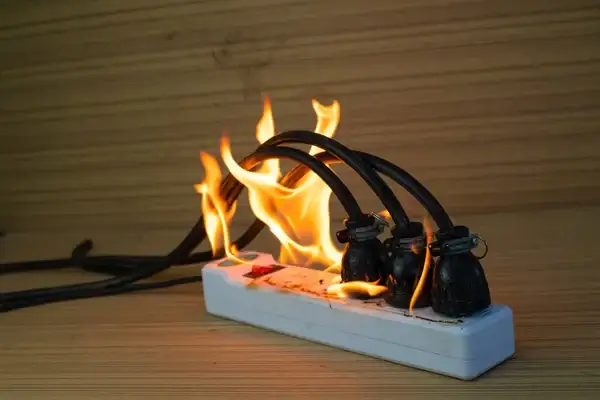
A burning smell with no obvious source. A circuit breaker that won’t stay reset. An outlet that’s gone faintly brown around the edges. These are the early signs of an electrical fire, and in most Brisbane homes, they show up well before anything catches alight. Queensland Fire and Emergency Services consistently lists electrical faults among the leading causes of accidental house fires. Almost everyone starts with a sign that was there to be noticed.
This isn’t a scare piece. Catch the problem early, and it’s usually a switchboard fix, handled in an afternoon. Miss it, and that’s how a fault becomes a fire.
What Are the Warning Signs of an Electrical Fire?
Most homeowners will run into at least one of these at some point, often without realising what it’s pointing to.
A burning smell that doesn’t have an obvious source is usually the first one people notice. Outlets and switch plates can also discolour or scorch, sometimes faintly, sometimes more than that. If a circuit breaker keeps tripping no matter how many times you reset it, that’s the breaker doing exactly what it’s built for. Lights that flicker or dim when an appliance switches on point to a circuit being asked to carry more than it comfortably can. Buzzing or crackling from a wall, switch, or light fitting. And outlets or switch plates that feel warm, sometimes even when nothing’s plugged in.
Visible sparks when plugging in or removing an appliance belong on this list too, and they’re not something to wait on. A spark that happens once might be static. A spark every time you use that outlet is a short circuit announcing itself.
Any one of these on its own is worth a phone call. More than one together, and it’s worth switching off that circuit at the switchboard until someone’s had a look.
Burning smell, no obvious cause
This is usually the first sign, and the easiest to dismiss. If it fades and doesn’t come back, fine. If it lingers or returns, that’s insulation breaking down somewhere it can’t be seen. Often inside a wall or roof space.
Scorched or discoloured outlets
A power point that’s gone brown, yellow, or slightly melted-looking around the slots has had heat building up behind it. That’s arcing, small, repeated sparks from a loose or failing connection, and it doesn’t fix itself.
A breaker that won’t stop tripping
A circuit breaker tripping once isn’t unusual. One that trips every time you reset it is doing exactly what it’s designed to do: cutting power before something overheats. Usually that’s an overload, too many appliances on one circuit, but it can also mean a short circuit, where current is taking a path it shouldn’t, often through damaged insulation or a faulty appliance. Treat the third trip as the one that gets an electrician involved, not the tenth.
Flickering lights
Occasional flicker during a storm, ignore it. Flickering every time the air conditioner or oven switches on is a different story. That’s a sign the circuit is being asked to do more than it comfortably can.
Buzzing or crackling
Electricity should be silent. Any sound at all from a switch, power point, or light fitting means current isn’t moving the way it should.
Warm switch plates or outlets
A power point or switch plate that’s warm to the touch, particularly if nothing’s even plugged in, points to heat building up inside the wall, not from whatever’s connected to it.
What Does an Electrical Fire Smell Like?
Sharp, acrid, and a bit like melting plastic: that’s the smell of wire insulation breaking down under heat, and it’s usually the earliest warning you’ll get before anything else shows.
The smell happens because most household wiring is insulated with PVC or similar plastic. When a connection runs hot, from a loose terminal, an overloaded circuit, or ageing insulation, that plastic starts to soften and off-gas before it visibly burns. It can be hard to pin down. A wall cavity, the back of a switch plate, a power point that seems unrelated to anything plugged in nearby: the smell doesn’t always come from where you’d expect.
Toaster left too close to the wall, something on the stovetop, a heater running close to fabric. Rule out the obvious first. If nothing accounts for it, that’s a switchboard call: cut power to the affected area and get a licensed electrician out before the smell has a chance to turn into something worse.
What Causes Electrical Fires in Brisbane Homes?
Most electrical fires don’t come out of nowhere. They’re the endpoint of a fault that’s been developing for weeks or months, sometimes longer.
Overloaded power boards and double adapters
Brisbane homes, particularly older Queenslanders with limited power points, lean hard on power boards and double adapters. Stack enough devices on one board, and the cable starts carrying more current than it’s rated for. That generates heat, and heat without anywhere to go is how fires start.
Daisy-chained extension cords
Plugging one extension cord into another to reach a power point further away seems harmless enough. It isn’t. Each cord is rated for a certain load, and chaining them together strips that rating away: the weakest link in the chain is now carrying everything plugged in beyond it. Extension cords are built for temporary use, not as a permanent fix for a house with too few outlets.
Old or damaged wiring
A lot of older Brisbane homes still have wiring from well before current standards. Pre-1980s housing stock can have rubber or cloth-insulated cabling that’s become brittle with age, sometimes with live conductors closer to exposed than anyone would want. AS/NZS 3000, the wiring standard electricians work to, has moved a long way since some of these homes were built.
Loose connections
At outlets, switches, and inside the switchboard itself, a connection that’s slightly loose will arc. Tiny amounts of arcing, repeated over months, generate enough heat at that one point to become a real risk. It’s invisible until something discolours or smells.
Faulty or ageing appliances
Worn cords, internal faults, motors drawing more current than they should, and older appliances are quieter contributors to house fires than most people assume. Electric blankets are a particular seasonal risk: ageing internal wiring, folded or compressed storage, and a heat source left running for hours overnight is not a forgiving combination.
Outdated switchboards without safety switches
A switchboard still running ceramic fuses, with no RCDs (safety switches) fitted, won’t respond to a fault the way modern switchgear will. Ceramic fuses are slow. RCDs aren’t optional anymore under current safety expectations; they’re one of the cheapest fire-risk reductions available for an older home.
Safety Switch vs Circuit Breaker: What’s the Difference, and Why It Matters
These get used interchangeably, and they shouldn’t, because they’re protecting against two different things.
A circuit breaker protects the wiring. It trips on overload or short circuit, too much current flowing where it shouldn’t, and its job is to stop a circuit from overheating before it becomes a fire risk.
A safety switch, or RCD, protects people. It trips on earth leakage, a tiny imbalance that usually means current is finding a path through something (or someone) it shouldn’t. It reacts in milliseconds, fast enough to prevent a fatal shock.
Some older Brisbane homes still run on ceramic fuses, which do neither job particularly well. They’re slow to react, and they don’t detect earth leakage at all. If your switchboard still has fuses rather than circuit breakers, and no RCDs fitted, that’s worth raising with an electrician. Not because fuses are inherently dangerous, but because they’re a generation behind what’s protecting most homes now.
How to Check Your Home’s Electrical Wiring: Without Touching Anything
There’s a useful homeowner-level check you can do without opening a switchboard or going anywhere near fixed wiring, which only a licensed electrician should touch.
Walk through the house and look at outlet and switch plates; warm, discoloured, or cracked is worth noting. Check visible cords for fraying, tape repairs, or cords run under rugs where heat can build up unseen. Look at power boards for daisy-chaining or stacked adapters drawing more than they should. And if you can see the switchboard, note whether it’s ceramic fuses or circuit breakers, and whether there are RCDs fitted.
What you won’t be able to check yourself, and shouldn’t try to, is anything behind a wall, in the roof space, or inside the switchboard itself. That’s licensed-electrician territory, both for safety and because it’s a legal requirement in Queensland.
What to Do If You Smell Burning or See Sparks
Switch off the power at the main switchboard. Unplug anything nearby that could still be drawing current. Don’t reset a tripped breaker just to get power back. If it tripped, something caused it to. Call a licensed electrician. If there’s visible smoke or flame, call 000 first.
That’s the order. Power off, devices unplugged, breaker left alone, electrician called. No improvising past that point.
How Do You Put Out an Electrical Fire?
Never use water. Never use foam. Both conduct electricity and can make the situation worse, not better.
A fire bigger than what a small extinguisher could realistically handle isn’t one to fight. Get out, and call 000 once you’re clear.
CO₂ and dry powder (ABE) extinguishers are the two rated for electrical fires in Australia, falling under Class E. Both work by cutting off the fire’s oxygen rather than relying on water or foam, which is exactly why they’re suited to anything live. There’s no conductive agent involved that could send current back toward you. A CO₂ unit works by displacing oxygen from a sealed cylinder, leaving no residue behind. That makes it useful around switchboards and electronics where powder residue would cause its own damage. If you can safely reach the switchboard, cutting power first reduces the risk before you even need the extinguisher.
When to Call a Licensed Electrician
Some of this is preventative, some of it’s urgent. A switchboard upgrade to fit RCDs is worth doing on its own merits, not just after a fault shows up. Rewiring is worth raising for any pre-1980s Brisbane home that hasn’t had it done. And any of the warning signs above, smell, scorching, tripping, flickering, buzzing, warmth, is reason enough to get someone qualified to look, sooner rather than later.
Only a licensed electrician can legally inspect, test, or work on a home’s fixed wiring and switchboard in Queensland. That’s not a formality. It’s the difference between a fault being found and fixed properly, and one being patched over. If any of these issues sound familiar, get in touch with our team, and we’ll get someone out to take a look.
Frequently Asked Questions
Yes. Worn cords, ageing internal wiring, and motors drawing more current than they should are common contributors. Electric blankets in particular carry seasonal risk. Check cords and fabric condition before each winter, and never leave one running unattended overnight.
No. Extension leads are built for temporary use. Left in place long-term, especially under furniture or rugs, or carrying a high-draw appliance, they're more prone to overheating than fixed wiring designed for that purpose.
Sharp and acrid, similar to melting plastic. That's wire insulation breaking down under heat. Often, the first sign anyone notices, well before anything else does.
Older blankets in particular, where the internal wiring has had years to wear, or storage has left the heating element folded and compressed. A quick check each season, cord condition, fabric, and any pinched spots is worth the few minutes it takes. Replace anything that looks doubtful before it goes anywhere near a bed for winter.
Every five to ten years for most homes, sooner for anything pre-1980s, recently renovated, or showing any of the warning signs covered here. An inspection is a small cost against the alternative.
