

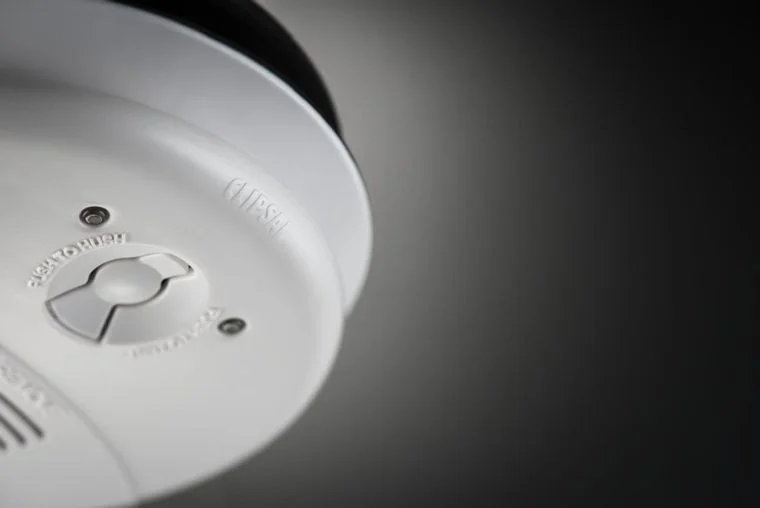
Smoke alarm placement in homes across Queensland starts with the bedrooms. Each one needs its own alarm, and so does the hallway outside them. A storey with no bedrooms still gets one. They go on the ceiling wherever it allows, with 300mm between the alarm and any light or corner, or 400mm for fans and air-conditioning vents.
Homes being sold or rented must already comply, and every other home has until 1 January 2027 under Queensland’s smoke alarm legislation. Treat that as the minimum. Fire services in Victoria and NSW recommend going further, and so do we.
Where should smoke alarms be placed in a home?
Inside each bedroom, in the hallway those bedrooms open onto, and on the path out of any storey without bedrooms. Queensland doesn’t leave where to put smoke alarms to judgment. These QLD smoke alarm locations come from the Building Fire Safety Regulation 2008:
Part of the home | Where the alarm goes |
Each bedroom | On the bedroom ceiling. The centre of the room is preferred, but not required |
Storey with bedrooms and a hallway | In the hallway the bedrooms open onto |
Storey with bedrooms and no hallway | Between bedrooms and living areas, or whatever else makes up the rest of the home |
Storey with no bedrooms | On the most likely path to an exit |
Kitchens, bathrooms and laundries aren’t on the list. Where to position smoke alarms inside each room is a separate matter, and the clearances further down cover it.
Anyone asking where to put smoke detectors is asking the same question. People use both names for one device, so smoke detector placement and smoke detector locations in a house follow this table. Fire alarm placement in offices and other commercial buildings is a different system under AS 1670.1.
How many smoke alarms do I need?
Start with your bedrooms, at one alarm each. Add the hallway they open onto, plus a second hallway alarm if the bedrooms sit at opposite ends of the house. Any storey without bedrooms gets one as well. For a single-storey, three-bedroom home with one hallway, that’s four. Move those bedrooms upstairs, with living areas and a garage below, and the number becomes five.
Five can look like padding on a quote, and “one hallway alarm wakes the whole house” is the usual objection. That argument fails when the fire is behind a closed door. The CFA in Victoria says research shows a hallway alarm won’t trigger for a fire in a closed bedroom, and 60% of fatal Victorian house fires over the past decade started in a bedroom or living area. Most people who die in house fires are found on or beside their bed.
Smoke alarms in bedrooms are law in Queensland. In Victoria and NSW, they’re a recommendation.
Anything above the required count is optional, and a smoke alarm installation quote should label it that way. The Queensland Fire Department warns that some traders overstate how many alarms the law requires.
What is the recommended smoke alarm placement?
Nothing in the smoke alarm regulations stops you from fitting more. Fire and Rescue NSW recommends them in bedrooms, living spaces, hallways, stairways and even the garage. For anyone deciding where to place smoke alarms beyond the required count, that list is a good place to start. Its preferred position is the ceiling between sleeping and living areas.
We’d add one where phones, laptops, e-bikes or power tools charge. The CFA now recommends this because of lithium-ion battery fires, and most older advice doesn’t mention it.
Exhaust fumes make a smoke alarm in a garage prone to false alarms, so a heat alarm suits that room better. Queensland’s regulation still calls for a smoke alarm on each storey, so have your electrician confirm the setup if the garage is the whole level.
Should you put a smoke alarm in the kitchen?
No. Queensland doesn’t require a smoke alarm in the kitchen, and Fire and Rescue NSW advises keeping alarms out of and away from kitchens and bathrooms. Queensland’s regulation gives no set distance from a cooktop, so kitchen smoke alarm placement is a judgement call about the nearest required alarm.
Open-plan homes are the hard case. With hardly any wall between bedrooms and living areas, the hallway alarm can sit close enough to react to dinner. Some owners then want to leave it out altogether. Position and alarm type solve most kitchen false alarms. Move it further from the cooktop and check you’ve got a photoelectric smoke alarm, the type Queensland now requires. Older ionisation units are more prone to false alarms from cooking.
Queensland’s Act gives owners some room here too. If the shower sets off the hallway alarm every morning, the alarm can move, as long as the new spot still warns the household. Kitchen fumes get the same allowance. Often it only needs to go a little further along the hall.
How far should a smoke alarm be from lights, fans and walls?
At least 300mm from lights and wall corners, and 400mm from fans and air-conditioner outlets. The same figures apply to smoke detector placement.
Keep clear of | Queensland minimum |
Any light fitting, including LED downlights | 300mm |
The corner where the ceiling meets a wall | 300mm |
Air-conditioner or forced-air supply opening | 400mm |
Ceiling fan blades | 400mm from the blade edge |
Those are legal minimums, and manufacturers ask for more room. Clipsal’s recommended smoke alarm distance from a ceiling fan or air conditioner is 1000mm where the room allows it. Family First puts a return air vent at 900mm or more. Moving air is the concern because it can carry smoke past the sensor.
The smoke alarm distance from a wall is quoted everywhere, usually without the reason. Hot air gets trapped where a wall meets the ceiling, and smoke can’t get through that pocket to an alarm mounted inside it. Exposed joists and the apex of a raked ceiling create the same dead air space. The 300mm from the wall keeps the alarm out of it.
People often ask whether the light clearance applies to a small LED downlight. The regulation says “light fitting” and makes no exception, so it does. That holds wall or ceiling.
A small bedroom with four downlights and a fan can leave no compliant position at all. Drop a downlight, swap to a fan/light combination or move to the wall. A tidier ceiling isn’t worth a non-compliant alarm.
Can smoke alarms be mounted on walls?
Yes, when a smoke alarm on the ceiling isn’t practicable. Queensland sets an order: the ceiling first, then the underside of an exposed joist or beam up to 300mm deep, then the wall.
The wall figure causes real confusion. Queensland’s regulation gives 100mm to 300mm below the ceiling, and more than 300mm from the corner of two walls. The National Construction Code, which contains the Building Code of Australia, gives 300mm to 500mm, and plenty of product manuals repeat that number. An alarm with its position set at 300mm satisfies both.
So, on a wall or ceiling, take the ceiling whenever you have the choice. A smoke alarm on a wall is the fallback.
Where does a smoke alarm go on a sloped or cathedral ceiling?
Measure 500mm to 1500mm from the apex and mount the alarm on the ceiling within that band. You’ll find other numbers online, but the Queensland regulation and the National Construction Code agree on this one. Right at the peak of a cathedral ceiling, trapped air keeps smoke away from the alarm.
Where does the alarm go on a storey without bedrooms?
On the route people would take to get out. With bedrooms upstairs, that usually means the ground floor near the stairs. A stairway alarm also has to sit where nothing blocks rising smoke.
Every storey counts, even one that holds only a garage, laundry or bathroom. That includes an enclosed lower level under a high-set Queenslander.
When should you fix alarm positions on a renovation?
Before the downlight and fan layout is locked in. Once lights are cut in, the alarm has to fit around them, and that’s how a bedroom ends up with nowhere legal to mount one.
Check builder plans against the count above as well. Plans showing two alarms for a five-bedroom home turn up on trade forums, and placement can fall between trades: one electrician’s certificate may cover only the wiring and interlinking. Mark the smoke alarm locations on the plan and have the builder and electrician sign off before rough-in. A new build or major renovation needs hardwired smoke alarms. Those cables go in at rough-in, while the ceiling is still open.
Do smoke alarms need to be interconnected?
Yes. Queensland homes need interconnected smoke alarms, so when one sounds, they all do. An alarm downstairs won’t reliably wake anyone upstairs in time, and that gap is why the law asks for the link.
The connection can be wired, wireless or a mix. Hardwired smoke alarms and other mains-powered units need a licensed electrician, and a hardwired alarm must be replaced with another hardwired alarm. Wireless interconnected smoke alarms with a sealed 10-year battery can be fitted without one, but the placement rules don’t change.
Smoke alarms in rental properties are the landlord’s to install. Testing is split. The landlord tests each alarm within 30 days before a tenancy starts, and the Queensland Fire Department treats a lease renewal as a new tenancy. After that, the tenant tests and cleans them at least every 12 months. The landlord smoke alarm requirements go further, but the smoke alarm locations stay the same.
Which smoke alarm regulations cover what?
Four documents get mixed up constantly, and asking for “the link” often gets you the wrong one.
Document | What it controls |
AS 3786 | The alarm itself. Look for AS 3786-2014 printed on the unit |
Building Fire Safety Regulation 2008 | Smoke alarm location requirements for Queensland homes |
National Construction Code | Where alarms go in new buildings nationally |
AS 1670.1 | Commercial fire detection systems, not typical homes |
Smoke alarm placement in Australia varies by state. The NCC asks for an alarm between the bedrooms and the rest of the home, in any hallway serving bedrooms, and on every other storey. Smoke alarm placement in QLD goes further, with an alarm in each bedroom. Check your own state’s smoke alarm requirements if you’re outside Queensland.
Getting smoke alarm placement right in your home
The 1 January 2027 deadline covers every remaining Queensland home, and awkward rooms are easier to sort out before then. If you’re unsure where to place smoke alarms around a crowded ceiling, our licensed electricians can check each position and give you a fixed price. Call 07 3324 1447 or contact our team. We cover all of Brisbane from Woolloongabba.
Frequently asked questions
Near the centre of the ceiling, clear of lights, fans and vents. If you’re adding alarms beyond the minimum, the best place to put a smoke alarm next is a room where devices charge.
On the ceiling, 300mm from the wall and any light, and 400mm from fan blades and air-conditioner outlets. A bedroom smoke alarm is required even with one directly outside the door, so sleeping areas get both in Queensland.
Inside a kitchen, at the apex of a raked ceiling, tight into a corner, or beside an air outlet. A smoke alarm in a bathroom will keep reacting to steam.
Wireless units with a sealed 10-year battery, yes. Anything connected to mains power needs a licensed electrician, and if your current alarms are hardwired, the replacements must be too.
Every upstairs bedroom gets one, plus the upstairs hallway and one on the way out at ground level. With bedrooms on both floors, each floor gets bedroom and hallway alarms. The exit-path rule only applies to a storey with no bedrooms, so it drops away.
One in each bedroom plus one in the hallway, with each alarm interconnected. The legislation covers apartments as well as houses, so a two-bedroom, single-level unit needs three.
